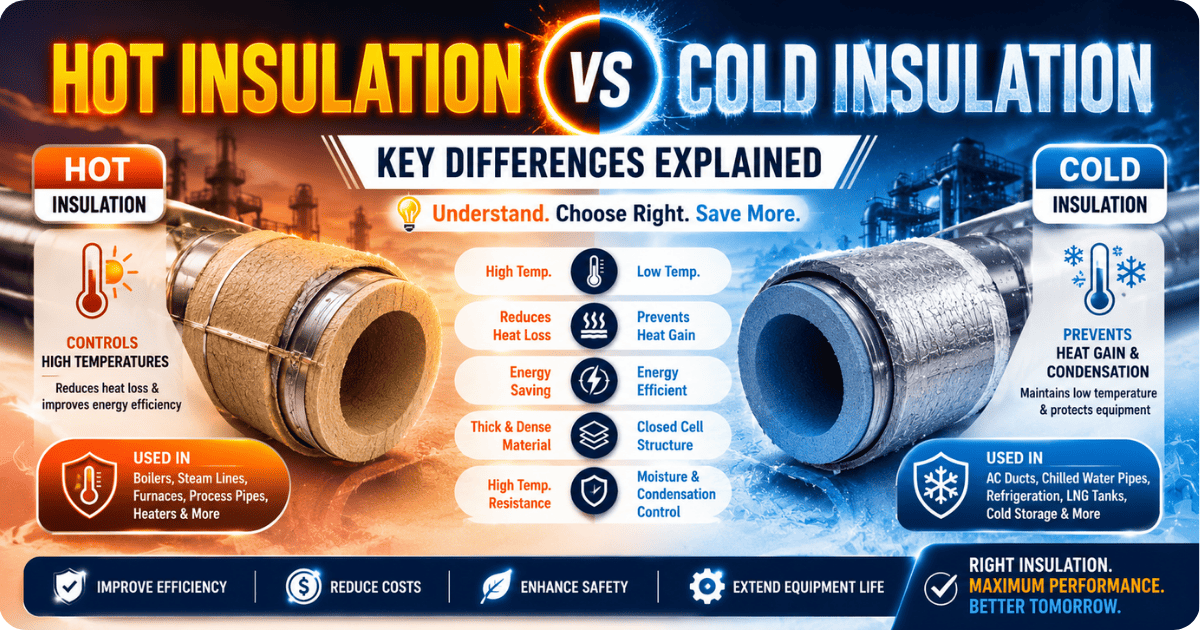
Hot insulation vs cold insulation is one of the most important decisions in any industrial, HVAC, or process-piping project in India. In short — hot insulation stops heat from escaping high-temperature equipment, while cold insulation stops outside heat from entering chilled or sub-ambient systems. Both serve opposite purposes, use different materials, and demand different installation techniques. At Amit Insulation, we’ve installed thermal insulation systems across refineries, dairies, pharma plants, and cold storages — and choosing between hot and cold insulation correctly can cut your energy bills by 20–35%.
This guide explains the key differences between Hot Insulation and Cold Insulation, materials used, applications, costs, and how to pick the right system for your Indian project.
What Is Hot Insulation?
Hot insulation (also called high-temperature insulation or thermal hot insulation) is the application of heat-resistant materials on pipes, vessels, boilers, ducts, and furnaces operating above ambient temperature — typically from 60 °C up to 1425 °C. Its primary job is to prevent heat loss, improve energy efficiency, protect personnel from burns, and maintain process temperature.
Common hot insulation materials used across India include:
- Rockwool / Mineral Wool — up to 750 °C, ideal for steam lines and boilers
- Glass Wool / Fiberglass — up to 540 °C, for ducts and HVAC hot lines
- Calcium Silicate — up to 1000 °C, for high-pressure steam piping
- Ceramic Fiber Blanket — up to 1425 °C, for furnaces, kilns, and reactors
- Perlite — for cryogenic and high-temp dual use
- Aerogel Blanket — premium, -200 °C to +650 °C
What Is Cold Insulation?
Cold insulation (also known as cryogenic insulation or sub-ambient insulation) is used on systems operating below ambient temperature — chilled water lines, refrigeration, LNG pipes, HVAC ducts, and cold storage walls. Its core goal is to prevent heat ingress, stop condensation, avoid icing, and protect against Corrosion Under Insulation (CUI).
Popular cold insulation materials include:
- Nitrile Rubber (NBR) / Elastomeric foam — flexible, closed-cell, ideal for HVAC
- EPS (Thermocole / Expanded Polystyrene) — cost-effective for cold rooms
- XLPE (Cross-linked Polyethylene) — chilled water lines
- PUF (Polyurethane Foam) & PIR (Polyisocyanurate) — cold storage panels, LNG
- Cellular Glass — for cryogenic and below-zero applications
- Phenolic Foam — low smoke, low flame, HVAC ducting
Hot Insulation vs Cold Insulation: Key Differences at a Glance
Here is the core comparison table that summarises the difference between hot and cold insulation:
| Parameter | Hot Insulation | Cold Insulation |
| Purpose | Prevent heat loss | Prevent heat gain & condensation |
| Operating Temperature | +60 °C to +1425 °C | -200 °C to +20 °C |
| Vapor Barrier Required? | No | Yes (mandatory) |
| Material Type | Rigid, fibrous, open-cell | Flexible, closed-cell |
| Moisture Behaviour | Moisture evaporates | Moisture accumulates → CUI/icing risk |
| Common Materials | Rockwool, Calcium Silicate, Ceramic Fiber | Nitrile Rubber, PUF, PIR, XLPE, EPS |
| Typical Applications | Boilers, steam pipes, furnaces | Chillers, cold storage, HVAC, LNG |
| Installation Complexity | Moderate | High (sealing critical) |
| Cost | Higher per kg | Lower per kg, higher labour |
| Maintenance | Periodic inspection | Vapor seal inspection critical |
Why Does Vapor Barrier Matter So Much in Cold Insulation?
In cold insulation, the surface temperature is below the dew point of surrounding ambient air. Water vapor naturally migrates from warm areas to cold areas. Without a vapor barrier, moisture penetrates the insulation, condenses, and eventually causes:
- Loss of thermal efficiency (wet insulation is up to 10x less effective)
- Corrosion Under Insulation (CUI)
- Mould, bacterial growth, and icing
- Premature system failure
Hot insulation does not face this issue because heat drives moisture outward, so any water vapor naturally evaporates.
Material Specifications Table (India-Ready Specs)
For engineers and procurement teams in India, here is a technical specification table to help choose the right material:
| Material | Type | Temp Range | Thermal Conductivity (W/mK) | Density (kg/m³) | Best For |
| Rockwool | Hot | Up to 750 °C | 0.035–0.045 | 100–150 | Steam lines, boilers |
| Calcium Silicate | Hot | Up to 1000 °C | 0.058 | 220–250 | High-pressure steam |
| Ceramic Fiber | Hot | Up to 1425 °C | 0.09–0.12 | 64–160 | Furnaces, kilns |
| Glass Wool | Hot | Up to 540 °C | 0.032–0.040 | 16–96 | HVAC, ducts |
| Nitrile Rubber | Cold | -40 °C to +105 °C | 0.034–0.038 | 50–80 | Chilled water, HVAC |
| PUF / PIR | Cold | -50 °C to +120 °C | 0.020–0.025 | 32–45 | Cold storage panels |
| XLPE | Cold | -80 °C to +95 °C | 0.034 | 25–40 | Chilled water lines |
| Cellular Glass | Cold | -260 °C to +480 °C | 0.040–0.048 | 100–140 | Cryogenic, LNG |
Where Is Hot Insulation Used in Indian Industries?
Hot insulation applications across India:
- Power Plants — boilers, steam turbines, superheaters
- Oil & Gas Refineries — distillation columns, heat exchangers
- Cement & Steel Plants — kilns, furnaces, ducts
- Pharma & Chemical — reactors, jacketed vessels
- Textile & Sugar Mills — steam piping, dryers
You May Also Read:- What Is Cold Insulation? Materials, Methods & Applications
Where Is Cold Insulation Used in Indian Industries?
Cold insulation applications across India:
- Cold Storage & Warehousing — fruit, dairy, pharma cold rooms
- HVAC Systems — commercial buildings, malls, hospitals
- Dairy & Food Processing — chilled milk lines, IQF freezers
- LNG Terminals — cryogenic transfer pipes
- Data Centers — chilled water and CRAC unit ducts
How to Choose Between Hot and Cold Insulation?
To decide between hot insulation vs cold insulation, evaluate these 6 factors:
- Operating temperature of the system (above or below ambient?)
- Ambient humidity — high humidity needs robust cold insulation vapor barriers
- Risk of condensation or icing
- Fire safety & smoke emission (LPCB / BS 476 compliance)
- Lifecycle cost — not just material cost
- CUI (Corrosion Under Insulation) prevention strategy
For most Indian plants — especially in coastal, humid, or monsoon-heavy regions — Amit Insulation recommends a custom mix of hot and cold insulation systems based on a full thermal audit.
Why Choose Amit Insulation for Hot & Cold Insulation in India?
At Amit Insulation, we are a trusted name for industrial hot and cold insulation services across India, with installations in Maharashtra, Gujarat, Delhi NCR, Rajasthan, Tamil Nadu, and beyond. We offer:
- Turnkey hot insulation: rockwool, calcium silicate, ceramic fiber, LRB mattresses
- Cold insulation: nitrile rubber, PUF, PIR, XLPE, cellular glass
- Aluminium cladding & weatherproof jacketing
- Acoustic & fire-rated insulation
- ISO-certified workmanship & on-site thermal audits
📞 Get a free consultation & quote today → Contact Amit Insulation
Hot Insulation vs Cold Insulation: FAQs
1. What is the main difference between hot and cold insulation?
The main difference is the direction of heat flow control. Hot insulation prevents heat loss from high-temperature systems (above ambient), while cold insulation prevents heat gain into low-temperature systems (below ambient) and includes a vapor barrier to stop condensation.
2. Which is more expensive — hot insulation or cold insulation?
Per kilogram, hot insulation materials like ceramic fiber and calcium silicate cost more due to high-temperature ratings. However, cold insulation projects often have higher total installed cost because of mandatory vapor barriers, sealing, cladding, and skilled labour.
3. Can the same material be used for both hot and cold insulation?
Some materials like perlite, fiberglass, and aerogel blankets can be used in both hot and cold applications across a wide temperature range. However, most projects use dedicated materials optimised for either heat retention or cold retention.
4. Why does cold insulation need a vapor barrier but hot insulation doesn’t?
Cold surfaces are below the dew point, causing water vapor to condense inside the insulation, leading to wet insulation, CUI, and energy loss. Hot insulation surfaces are above ambient, so moisture naturally evaporates outward — no vapor barrier needed.
5. What is the best hot and cold insulation material for Indian climate?
For India’s hot, humid, and monsoon climate:
- Hot insulation: Rockwool or LRB mattresses with aluminium cladding
- Cold insulation: Closed-cell nitrile rubber or PUF with proper vapor seal
Amit Insulation customises material selection based on site conditions, dew point analysis, and CUI risk.
Conclusion: Hot Insulation vs Cold Insulation
Understanding the key differences between hot insulation and cold insulation is critical for energy efficiency, equipment safety, and long-term cost savings. Hot insulation is your answer when you need to retain heat in steam lines, boilers, and furnaces. Cold insulation is essential whenever you handle chilled water, refrigeration, HVAC, or cryogenic systems — and a vapor barrier is non-negotiable.
Whether your project is a refinery in Gujarat, a cold storage in Maharashtra, or an HVAC retrofit in Delhi — the correct choice between hot and cold insulation can save you lakhs in energy costs annually. Amit Insulation brings 15+ years of on-ground experience installing both systems across India with ISO-certified quality.