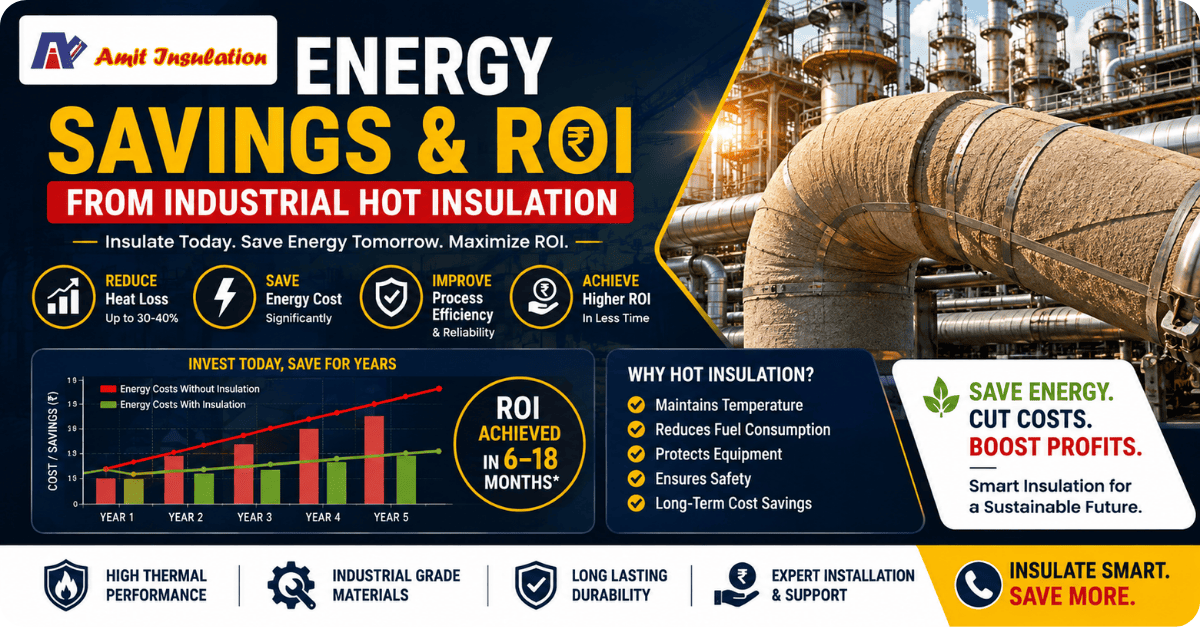
Industrial hot insulation is one of the few plant upgrades that pays for itself in months, not years. When bare steam, hot oil, or process lines are left exposed, plants lose measurable energy every single hour — and that loss shows up directly on the fuel bill. This guide breaks down the real insulation energy savings ROI you can expect from properly insulated hot systems, with the cost tables, payback formulas, and material comparisons plant managers use to justify the investment to finance teams. If you’re evaluating whether industrial hot insulation is worth the capital spend, the numbers in this article — backed by field data and Amit Insulation’s 30+ years of hot pipeline insulation projects — make the business case clear.
Unlike most insulation ROI content online, which focuses on residential attic and wall upgrades, this guide is built specifically for industrial plant owners, facility managers, and maintenance engineers evaluating steam lines, hot oil systems, boilers, and process equipment.
Why Industrial Hot Insulation Delivers Such Fast ROI
A bare steam pipe operating at 350°F can lose several hundred BTUs per linear foot every hour — heat that was already paid for at the boiler. Proper hot insulation cuts that heat loss by 85–95%, which is why mechanical insulation is consistently ranked among the highest-return energy efficiency investments a plant can make, often outperforming solar, VFDs, and other capital energy projects on a pure payback basis.
The insulation energy savings ROI comes from three combined sources: reduced fuel consumption at the boiler or heater, reduced steam trap losses and condensate formation along the line, and lower maintenance cost from preventing surface degradation and corrosion. Each of these compounds over the life of the insulation system — typically 15–20+ years for a well-installed hot insulation package.
Quick ROI Snapshot
| Metric | Typical Industrial Hot Insulation Result |
|---|---|
| Heat loss reduction | 85–95% vs. bare pipe/equipment |
| Typical payback period | 3 months to 2 years |
| System service life | 15–20+ years |
| Surface temperature after insulation | Below 60°C (140°F) — OSHA-safe touch limit |
| CO2 emissions reduction | Proportional to fuel savings, often 0.5+ metric tons/year per bare valve or flange |
How to Calculate Insulation Energy Savings ROI
The core formula plant engineers use to evaluate industrial hot insulation is straightforward:
Payback Period (years) = Total Insulation Installation Cost ÷ Annual Energy Cost Savings
To estimate annual energy cost savings, you need three inputs: the heat loss from the bare surface (BTU/hr, based on pipe/equipment size and operating temperature), the heat loss from the same surface once insulated (typically an 85–95% reduction), and your fuel or steam cost per unit of energy. Multiplying the difference by annual operating hours and fuel cost gives the yearly savings figure used in the ROI calculation.
Worked Example: Bare vs. Insulated Steam Line
| Line Detail | Bare Pipe (No Insulation) | Insulated Pipe (2″ Mineral Wool) |
|---|---|---|
| Pipe size / service | 4″ NPS, 150 psig steam | 4″ NPS, 150 psig steam |
| Approx. heat loss | ~415 MMBtu/yr per 100 ft | ~40–60 MMBtu/yr per 100 ft |
| Annual fuel cost impact (at $4.50/MMBtu) | ~$1,870 per 100 ft | ~$225 per 100 ft |
| Estimated annual savings | — | ~$1,645 per 100 ft, per year |
| Typical payback period | — | Under 12 months |
Figures are illustrative industry averages; actual savings depend on pipe size, insulation thickness, operating hours, and local fuel cost — Amit Insulation provides site-specific heat loss surveys before quoting a project.
What Affects Industrial Hot Insulation ROI
1. Operating Temperature and Insulation Thickness
Higher process temperatures lose more heat per hour when bare, which means the energy savings — and therefore the ROI — scale up with temperature. Low-temperature lines (up to 150°C) typically need 25–50mm of insulation, medium-temperature service (150–300°C) needs 50–75mm, and high-temperature steam or thermic fluid lines (above 300°C) often require 75–100mm or more. Under-sizing thickness leaves savings on the table; over-sizing adds cost without proportional return, which is why economic thickness calculations matter.
2. Insulation Material Selection
Material choice affects both installed cost and long-term thermal performance. Mineral wool and rockwool remain the industry standard for steam and hot oil lines due to their high-temperature tolerance and fire resistance, while calcium silicate is often specified for very high-temperature steam service. Amit Insulation’s hot & cold pipe insulation service matches material selection to each application’s temperature, pressure, and site conditions to maximize ROI rather than defaulting to a one-size-fits-all product.
3. Fittings, Valves, and Flanges — The Overlooked Savings
Bare valves, flanges, and strainers are frequently left uninsulated even when the connected pipe run is fully insulated, and they can represent significant bare surface area — a single 6″ gate valve can equal several linear feet of bare pipe in heat loss terms. Insulating these components with removable insulation blankets adds meaningful savings for relatively low incremental cost, often improving overall project ROI.
4. Surface Protection and Cladding Quality
Insulation ROI isn’t just about day-one savings — it depends on the system staying intact for its full service life. Poor cladding or jointing lets moisture in over time, degrading thermal performance and shortening the payback horizon. A properly clad, weatherproofed hot insulation system protects the ROI calculation for the full 15–20 year lifespan instead of losing efficiency after a few seasons.
You May Also Read:- 7 Causes of Industrial Insulation Failure (and How to Fix Them)
Insulation Energy Savings ROI by Application
| Application | Typical Payback Period | Additional ROI Factors |
|---|---|---|
| Steam distribution lines | 3–12 months | Reduced condensate load, steam trap savings |
| Hot oil / thermic fluid lines | 6–18 months | Process temperature stability, product quality |
| Boiler and header insulation | Under 6 months | Direct fuel savings at source |
| Bare valves & flanges | 6–12 months | Safety (burn prevention), noise reduction |
| Tanks & vessels (hot process) | 1–2 years | Reduced heating cycle time, energy consistency |
Beyond Energy: The Full ROI Picture
Energy cost savings are the headline number, but industrial hot insulation ROI also includes value that doesn’t always show up on the utility bill:
- Personnel safety — insulated surfaces stay below the 60°C (140°F) safe-touch threshold, reducing burn risk and related liability.
- Process stability — consistent surface temperatures mean more stable process conditions and fewer temperature-related quality issues.
- Noise reduction — insulation on process lines and equipment reduces ambient noise in mechanical areas.
- Carbon footprint — every unit of fuel saved reduces CO2 emissions, increasingly relevant for plants tracking ESG and energy-efficiency compliance targets.
- Extended equipment life — reduced thermal cycling and corrosion protection under quality cladding extends the service life of pipes and vessels alongside the insulation itself.
Why the Right Contractor Determines Your Actual ROI
The ROI numbers above assume correct material selection, accurate thickness calculation, and quality installation — and this is where projects most often underperform their projected payback. Gaps in coverage, poor cladding, or the wrong material for the application can cut real-world energy savings well below the calculated potential, stretching payback periods from months into years.
This is why plants planning a hot insulation upgrade should work with a contractor who conducts a proper site survey and heat loss assessment before quoting, rather than a flat per-meter estimate. Amit Insulation has delivered hot and cold insulation projects across Gujarat and pan-India facilities for over 30 years, with installation practices — documented in our thermal and acoustic insulation solutions guide — built specifically to protect the energy savings ROI our clients are quoted, not just at handover but across the full 15–20 year service life of the system.
Choosing an Insulation Partner: What to Look For
| Factor | Why It Affects Your ROI |
|---|---|
| Site-specific heat loss survey | Ensures thickness and material match actual operating conditions, not generic estimates |
| Material expertise across hot & cold systems | Prevents costly mismatches that shorten payback |
| Quality cladding and jointing standards | Protects savings for the full system lifespan, not just year one |
| Track record on industrial (not residential) projects | Industrial hot insulation has different engineering demands than home insulation |
| Post-installation inspection support | Catches early degradation before it erodes projected ROI |
Amit Insulation’s services span hot and cold pipe insulation, wall and slab insulation, over deck and under deck insulation, and complete fabrication and erection work for insulation-related structural needs — giving plants a single accountable partner from initial heat loss survey through installation and long-term maintenance.
Get an ROI Estimate for Your Facility
If your plant has bare or aging insulation on steam lines, hot oil systems, or process equipment, the fastest way to know your real insulation energy savings ROI is a site survey — not a generic online calculator. Amit Insulation provides on-site heat loss assessments and cost-benefit estimates for industrial hot insulation projects, so you get a payback figure based on your actual pipe sizes, operating temperatures, and fuel costs before committing budget. Contact Amit Insulation to schedule a site assessment and get a project-specific ROI estimate.
Conclusion
Industrial hot insulation consistently delivers one of the fastest energy-efficiency paybacks available to a plant — often between 3 months and 2 years — driven by reduced fuel consumption, lower maintenance cost, and a 15–20+ year service life once installed correctly. The actual insulation energy savings ROI a plant realizes depends heavily on accurate thickness calculation, correct material selection, and installation quality — which is why a site-specific heat loss survey, not a generic calculator, gives the most reliable numbers. Amit Insulation brings 30+ years of industrial hot insulation project experience to help facilities calculate, install, and protect that ROI from day one through the full life of the system.
Frequently Asked Questions
1. What is a typical ROI payback period for industrial Hot insulation?
Most industrial hot insulation projects pay back their installation cost within 3 months to 2 years, depending on operating temperature, fuel cost, and how much bare surface area is being insulated — steam lines and boiler headers often see the fastest payback.
2. How do you calculate insulation energy savings ROI?
Divide the total insulation installation cost by the annual energy cost savings (the difference between bare-surface heat loss cost and insulated-surface heat loss cost) to get the payback period in years.
3. How much heat loss does a bare steam pipe actually have?
A bare pipe operating at high steam temperatures can lose several hundred BTUs per linear foot per hour; proper insulation typically reduces this heat loss by 85–95%.
4. Does insulating valves and flanges really improve ROI?
Yes. Bare valves, flanges, and strainers are often left uninsulated even on otherwise insulated lines, and their exposed surface area can be equivalent to several feet of bare pipe — insulating them is a relatively low-cost way to capture additional savings.
5. What insulation thickness gives the best ROI for hot pipes?
The “economic thickness” — the point where added insulation cost stops being justified by additional energy savings — depends on pipe size and operating temperature; as a general guide, 25–50mm suits low-temperature service, 50–75mm suits medium temperatures, and 75–100mm or more is used for high-temperature steam and thermic fluid lines.
6. How long does industrial hot insulation last before it needs replacement?
A properly installed and clad hot insulation system typically lasts 15–20+ years, though poor cladding, moisture ingress, or physical damage can shorten this significantly and erode the original ROI projection.
7. Is industrial insulation ROI only about energy savings?
No. Beyond fuel savings, hot insulation ROI includes personnel safety (keeping surface temperatures below burn-risk thresholds), reduced noise, process temperature stability, extended equipment life, and lower carbon emissions.
8. What’s the difference between residential and industrial insulation ROI calculations?
Residential insulation ROI is based on HVAC load reduction across a building envelope, while industrial hot insulation ROI is calculated per pipe run, valve, or vessel based on process temperature, operating hours, and fuel cost — generally delivering much faster payback than residential upgrades.
9. Can poor installation reduce the actual ROI of hot insulation?
Yes — gaps in coverage, wrong material selection, or poor cladding can significantly reduce real-world energy savings compared to the calculated potential, which is why installation quality and contractor experience directly affect your realized ROI.
10. How can I get an accurate ROI estimate for my facility?
The most reliable way is an on-site heat loss survey by an experienced industrial insulation contractor, who can measure your actual pipe sizes, temperatures, and bare surface area — Amit Insulation offers this assessment before quoting any hot insulation project.