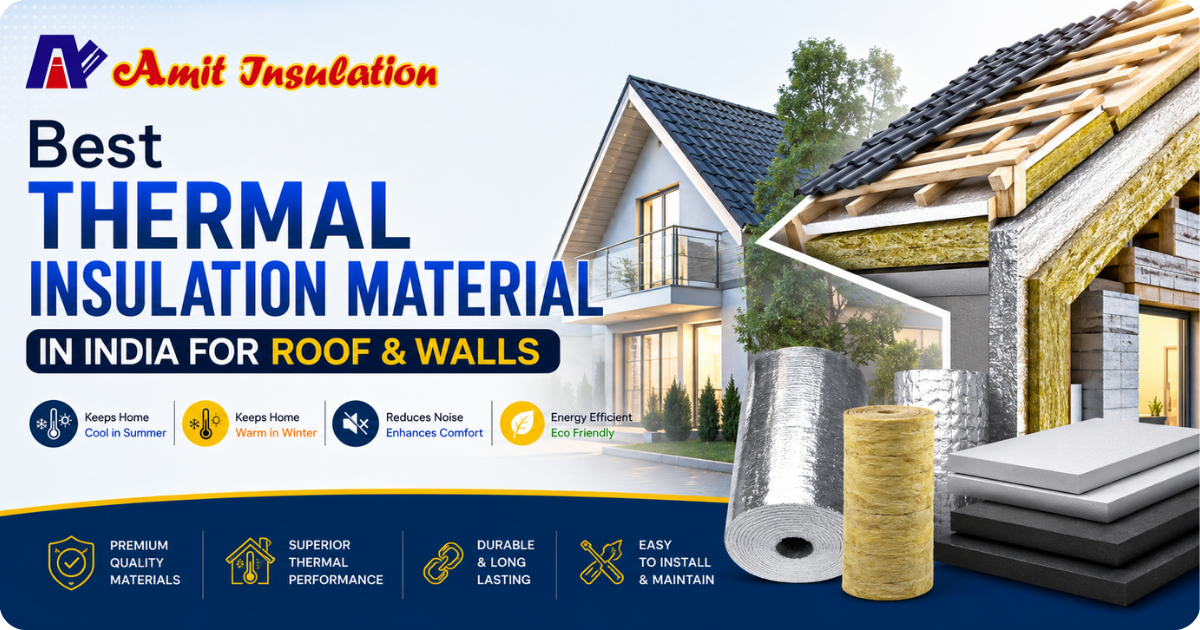
India’s hot climate demands smart choices for building efficiency. With rising energy costs and extreme heat, selecting the right Thermal Insulation Material has become essential for engineers, contractors, facility owners, and industrial buyers. Amit Insulation, a trusted industrial insulation company based in Vadodara, India, specializes in high-performance solutions.
This guide explores top thermal insulation material options for roofs and walls. You’ll learn why insulation matters, key types, comparisons via data tables, installation tips, and cost benefits. Backed by real market data, it helps you pick the best heat insulation material for roof and best thermal insulation material for walls to slash cooling bills and meet green building standards.
Why Thermal Insulation Matters for Indian Buildings?
India faces scorching summers with temperatures often exceeding 45°C in many regions. Poor insulation leads to massive heat gain through roofs and walls.
Buildings account for 40% of India’s electricity use, per the Bureau of Energy Efficiency (BEE). Without proper thermal insulation material, air conditioners run overtime, spiking bills by 30-50%.
Insulation creates a barrier that reflects heat, reduces conduction, and maintains indoor comfort. For roofs, it blocks solar radiation; for walls, it prevents conduction from hot exteriors.
Engineers note that insulated structures comply with IGBC norms, earning green certifications. Facility owners save on maintenance as insulation curbs moisture and mold.
In short, investing in quality thermal insulation material in India boosts energy efficiency and building longevity.
Key Properties of Effective Thermal Insulation Material
The best thermal insulation material excels in thermal conductivity, measured in W/mK (lower is better).
Top materials have R-values above 3.5 m²K/W for Indian conditions, per BIS standards. Density, fire resistance, and moisture resistance also count.
Heat insulation material for roofs must handle UV exposure and monsoon rains. Wall options need vapor permeability to avoid condensation.
Durability is key—materials should last 20-30 years without degrading. Acoustic benefits add value in noisy industrial zones.
Real data: Materials with thermal conductivity under 0.04 W/mK cut heat transfer by 70%, according to a 2023 TERI study.
Top Types of Thermal Insulation Material for Roofs
Roofs absorb 70% of solar heat in India, per NREL research. Heat insulation material for roof like reflective coatings, foam boards, and mineral wool lead the pack.
Reflective paints bounce back 80-90% of sunlight. Rigid polyurethane (PU) foam offers R-values up to 5.0. Glass wool suits metal roofs.
Expanded polystyrene (EPS) is lightweight and affordable for large sheds. Choose based on roof type—sloped or flat.
Installation tip: Layer with vapor barriers for monsoon protection. These options reduce roof surface temps by 15-20°C.
Best Thermal Insulation Material for Walls
Walls conduct heat steadily, making insulation critical. The best thermal insulation material for walls includes rockwool, extruded polystyrene (XPS), and phenolic foam.
Rockwool provides fire safety (non-combustible up to 1000°C) and soundproofing. XPS resists moisture, ideal for humid coastal areas.
Phenolic boards achieve low conductivity (0.02 W/mK) for thin walls. Sandwich panels integrate insulation with cladding for factories.
Per a 2024 CRISIL report, wall insulation cuts indoor temps by 5-8°C, vital for industrial facilities.
Comparison of Popular Thermal Insulation Materials
| Material | Thermal Conductivity (W/mK) | R-Value (per 50mm) | Fire Rating | Best For | Cost (₹/sqm) |
|---|---|---|---|---|---|
| Polyurethane Foam | 0.022 | 4.5 | Class 0 | Roofs & Walls | 250-350 |
| Extruded Polystyrene | 0.028 | 3.6 | Class 1 | Walls | 180-250 |
| Rockwool | 0.035 | 2.9 | A1 | Industrial Walls | 200-300 |
| Glass Wool | 0.040 | 2.5 | Class 1 | Roofs | 150-220 |
| Reflective Foil | 0.030 (effective) | 3.3 | Class 0 | Roofs | 100-150 |
Data sourced from BIS IS 8183 and manufacturer averages. Costs for 50mm thickness.
Benefits of Using Thermal Insulation Material in India
Energy savings top the list. BEE data shows insulated buildings reduce cooling needs by 25-40%, saving ₹50,000+ yearly for a 10,000 sqm facility.
Thermal insulation material in India fights urban heat islands. Cities like Delhi see 5-7°C cooler indoors with proper installs.
Sustainability angle: Insulation lowers CO2 emissions by 30%, aligning with India’s net-zero goals by 2070.
Health perks include better air quality—no dust or allergens in sealed systems. ROI hits in 2-3 years via lower bills.
Industrial buyers gain from extended equipment life—less strain on HVAC.
Cost Analysis and ROI of Thermal Insulation
Initial costs range ₹150-400/sqm, but payback is quick.
For a 5000 sqm warehouse, PU foam insulation costs ₹12-15 lakhs. Annual savings: ₹3-5 lakhs on electricity (at ₹8/unit).
ROI Comparison for Roof Insulation (5000 sqm Facility)
| Insulation Type | Install Cost (₹ Lakhs) | Annual Savings (₹ Lakhs) | Payback Period (Years) | Lifespan (Years) |
|---|---|---|---|---|
| PU Foam | 12.5 | 4.2 | 3 | 25-30 |
| EPS Boards | 9.0 | 3.1 | 3 | 20-25 |
| Mineral Wool | 10.5 | 3.5 | 3 | 30+ |
| No Insulation | 0 | 0 | N/A | N/A |
Assumes 30% energy cut, per IEA India Energy Outlook 2024. Savings at 2000 peak hours/month.
Long-term, maintenance is low—clean annually, inspect for cracks.
Installation Guide for Heat Insulation Material for Roof
Prep the surface: Clean and level roofs. For heat insulation material for roof, fix boards with adhesives or mechanical anchors.
Layer order: Base sheet, insulation (50-100mm), waterproof membrane, reflective coating. Use PU foam spray for irregular shapes.
For metal roofs, clip glass wool between purlins. Pros handle vapor barriers to prevent condensation.
Time: 1-2 days per 1000 sqm with a 5-person team. Dry monsoon installs for best adhesion.
Common pitfalls: Skipping overlaps leads to leaks—seal all joints.
Installation Tips for Best Thermal Insulation Material for Walls
Wall installs start with framing. Attach best thermal insulation material for walls like XPS via dots/dabs or clips.
Cavity walls: Fill gaps with rockwool batts. For solid walls, apply rigid boards over plaster, then render.
Thickness: 50mm for moderate climates, 75mm for extreme heat zones like Rajasthan.
Ventilate cavities to manage moisture. Test for thermal bridging with infrared scans post-install.
Hire certified applicators for uniform coverage—gaps raise conductivity by 20%.
Maintenance and Longevity of Thermal Insulation Material
Quality thermal insulation material lasts 20-50 years. Inspect yearly for settlements or damage.
Roofs: Clear debris to avoid water pooling. Walls: Check for cracks in cladding.
Fire safety: Use Class 0 materials; avoid oil-based paints nearby.
Repairs: Patch small holes with matching foam. Full replacement rare before 25 years.
Data shows maintained insulation retains 95% efficiency over a decade, per ASHRAE studies.
Table 3: Indian Market Growth for Thermal Insulation (2024-2030)
| Segment | 2024 Market Size (₹ Cr) | CAGR (%) | Key Drivers |
|---|---|---|---|
| Roof Insulation | 4500 | 12.5 | Urbanization, Green Norms |
| Wall Insulation | 3200 | 11.8 | Industrial Expansion |
| Total Thermal Market | 8500 | 12.2 | Energy Efficiency Mandates |
Source: Mordor Intelligence India Insulation Market Report 2024. Projections to 2030.
You May Also Read:- Best Cold Insulation Material for Pipes in India 2026
Conclusion
Choosing the right thermal insulation material transforms Indian buildings into energy-efficient havens. From slashing heat gain with heat insulation material for roof to stabilizing interiors via the best thermal insulation material for walls, these solutions deliver proven ROI.
Thermal insulation material in India isn’t a luxury; it’s a smart investment for engineers, contractors, and owners facing rising energy demands. Looking for thermal insulation material in India? Amit Insulation offers customized solutions for industrial and commercial needs across Gujarat and India.
FAQ
What is the best thermal insulation material in India for hot climates?
Materials like polyurethane foam and rockwool top the list for low conductivity (under 0.03 W/mK) and heat resistance. They suit India’s 45°C+ summers, reducing indoor temps by 10°C+.
Which heat insulation material for roof is most cost-effective?
EPS boards offer the best value at ₹150-200/sqm with 20-year life. They reflect 70% solar heat, per TERI tests, ideal for warehouses and factories.
What makes the best thermal insulation material for walls?
Rockwool or XPS excels due to moisture resistance, fire safety, and R-values over 3.5. Perfect for industrial walls exposed to humidity.
How much does thermal insulation material cost in India?
Expect ₹150-400/sqm for 50mm thickness. PU foam is premium (₹250+), while glass wool is budget-friendly (₹150+), with 2-3 year payback.
Can thermal insulation material in India withstand monsoons?
Yes—water-resistant options like XPS and treated mineral wool have low absorption (<2%). Pair with membranes for full protection.
What is the R-value for effective thermal insulation material?
Aim for 3.0-5.0 m²K/W in India. Higher values mean better performance; PU foam hits 4.5 easily for roofs and walls.
How to choose thermal insulation material for industrial use?
Factor conductivity, fire rating, and thickness. Use tables above for comparisons—consult BIS standards for compliance.
Does thermal insulation reduce electricity bills?
Absolutely—by 25-40%, per BEE. A 5000 sqm facility saves ₹3-5 lakhs yearly on AC usage.