In physics and building science, people often ask why is metal a good thermal conductor, especially when they see how fast a steel pipe or aluminium sheet gets hot compared to wood or insulation boards.
Metals allow heat to flow quickly through them, which is useful in factories and appliances but risky for buildings in hot cities like Vadodara, Gujarat, where poor insulation can lead to high energy bills and uncomfortable indoor temperatures.
At Amit Insulation, we work with contractors, plant engineers and homeowners who want to control heat flow, not just understand it in theory. That is why it helps to know how metal conducts heat, how it differs from good insulators and how the right thermal and acoustic insulation can protect your metal roofs, ducts and pipelines.
What does Thermal Conductor actually mean?
A thermal conductor is any material that allows heat to move through it easily.
The higher the thermal conductivity of a material, the faster heat energy will pass from the hot side to the cold side of that material.
Metals vs non‑metals in simple terms
- Metals (like copper, aluminium, steel) are good conductors of heat
- Non‑metals (like wood, plastic, rubber, most insulation materials) are poor conductors and act as insulators
Because metals conduct heat quickly, they are used in pans, heat exchangers, radiators and industrial equipment.
But in buildings and process plants in Vadodara’s hot climate, bare metal roofs, ducts and tanks can transfer heat into working spaces, increasing cooling loads unless they are properly insulated.
Why is metal a good thermal conductor? The science in simple language
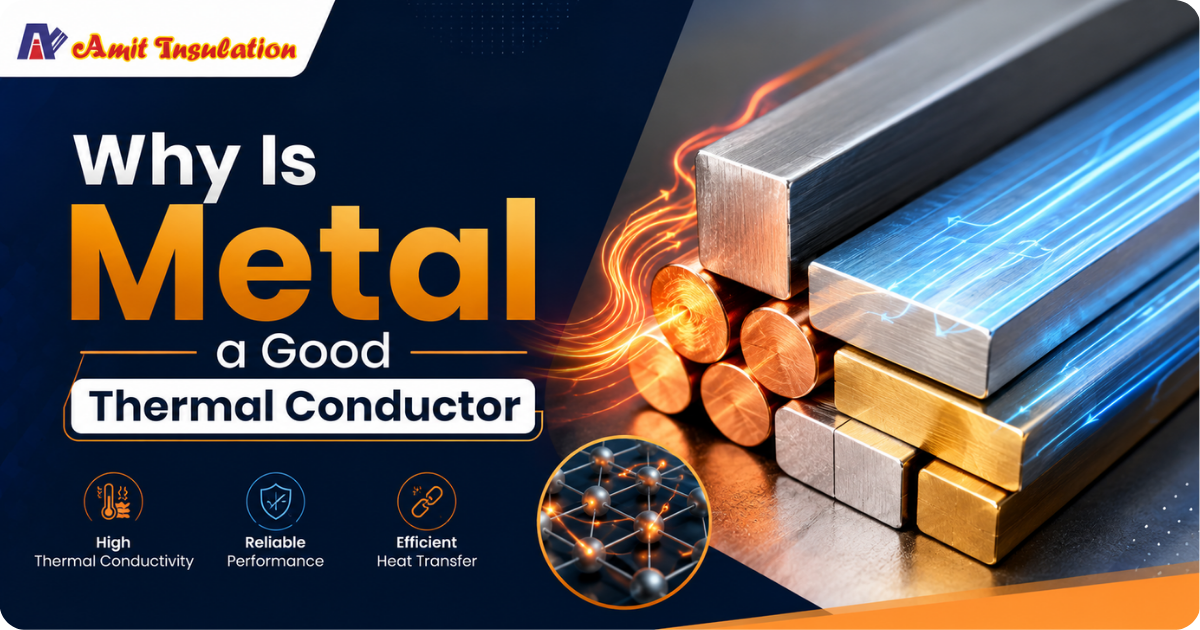
The main reason metals are good thermal conductors is the presence of free electrons and closely packed atoms in their crystal lattice.
Role of free electrons in metals
- In metals, many electrons are not tightly bound to any one atom and can move freely through the structure.
- These free electrons carry kinetic energy from hotter regions of the metal to cooler regions very rapidly, similar to how electricity moves in a copper wire.
This electron movement makes heat transfer in metals much faster than in materials where energy must pass from atom to atom only through vibrations.
Dense atomic structure and lattice vibrations
Metals also have a dense, ordered arrangement of atoms.
When one end of a metal rod is heated, those atoms vibrate more and bump into neighbouring atoms, passing on energy step by step through the lattice.
So metals have two efficient pathways for thermal conduction:
- Free electrons moving and colliding
- Lattice vibrations (also called phonons in solid-state physics)
Together, these mechanisms explain why metal is a good thermal conductor compared with materials like plastic or insulation foam, where electrons are not free and atoms are less efficient at passing heat.
Everyday examples that show metal’s high thermal conductivity
You experience metal’s good thermal conductivity almost every day.
Simple real‑life examples
- A metal spoon in a hot cup of chai quickly becomes hot from end to end.
- A metal doorknob in winter feels colder than a wooden door, because it pulls heat from your hand faster.
- A steel handrail in the sun becomes hot quickly, while nearby concrete or wood warms more slowly.
In all these cases, metal is not “colder” or “hotter” by itself; it simply transfers heat faster between your skin and the surrounding environment.
Thermal conductivity values: metals vs insulation
The table below shows indicative thermal conductivity ranges.
These numbers help you see how big the difference is between typical metals and insulation materials commonly used in Indian industry and buildings.
Approximate Thermal Conductivity Ranges
| Material type | Example material | Typical thermal conductivity (W/m·K) | Behaviour for heat flow |
|---|---|---|---|
| Good metal conductor | Copper | ~380–400 | Very fast heat transfer |
| Good metal conductor | Aluminium | ~200–230 | Fast heat transfer, lightweight |
| Structural metal | Mild steel | ~45–60 | High heat transfer vs insulation |
| Insulation material | Mineral wool | ~0.035–0.045 | Very slow heat transfer |
| Insulation material | PIR / PU foam | ~0.022–0.028 | Excellent thermal insulation |
Note: Values are representative ranges; actual performance depends on grade, density and temperature.
These differences show why bare metal roofs, tanks and ducts in Vadodara heat up quickly and why proper insulation from suppliers like Amit Insulation is critical to control thermal loss or gain.
Why metals are good conductors but poor insulators
Metals are good thermal conductors but poor thermal insulators for the same reason: free electrons and dense atomic structure.
Insulators, on the other hand, are designed with trapped air pockets and structures that slow down heat flow.
Conductor vs insulator at a glance
| Property | Good conductors (metals) | Good insulators (non‑metals/insulation) |
|---|---|---|
| Electron movement | Free electrons move easily | Electrons tightly bound |
| Thermal conductivity | High | Low |
| Heat transfer rate | Fast | Slow |
| Typical usage | Pans, pipes, radiators, heat exchangers | Roof, wall, duct and tank insulation |
| Example in Vadodara plant | Bare steel pipeline | Insulated pipeline with mineral wool & cladding |
Because metals are such good thermal conductors, they must often be combined with insulation systems to achieve energy efficiency and process safety targets in hot climates.
The Vadodara, Gujarat context – why insulation on metal matters
Vadodara has a hot and often humid climate for much of the year, which means:
- Metal roofs and wall sheets can become very hot in the afternoon sun.
- Metal pipelines carrying hot or chilled fluids can lose or gain heat quickly without proper insulation.
- Industrial units and commercial buildings face higher cooling loads and energy costs if bare metal surfaces are exposed.
Typical applications for metal and insulation in Vadodara
- Industrial plants: Insulated metal pipelines, boilers, storage tanks, and process equipment
- Commercial buildings: Insulated metal roofs, HVAC ducts, and chilled water lines
- Residential projects: Metal roofing with under‑deck insulation to reduce heat gain
In all these applications, understanding why metal is a good thermal conductor helps owners and engineers appreciate why they must combine metals with high‑quality thermal and acoustic insulation from trusted local suppliers such as Amit Insulation.
How Amit Insulation helps control metal heat conduction
Amit Insulation offers a range of insulation solutions designed to manage the fast heat transfer that occurs through metal structures.
Key insulation solutions for metal surfaces
- Thermal insulation materials
- Mineral wool, rockwool, glass wool
- PU/PIR rigid boards and pipe sections
- Acoustic insulation solutions for metal ducts and enclosures
- Protective metal cladding systems to cover insulation and withstand Vadodara’s weather conditions
By combining properly selected insulation with metal components, Amit Insulation helps reduce energy loss, improve process efficiency and create more comfortable indoor environments.
Example metal and insulation combinations
| Metal component | Typical issue without insulation | Recommended solution from Amit Insulation |
|---|---|---|
| Metal roof sheet | High heat gain, hot indoor temperatures | Under‑deck mineral wool or PU/PIR boards |
| Steam pipeline | Heat loss, surface burn risk | Preformed mineral wool / calcium silicate + cladding |
| Chilled water pipe | Condensation, energy loss | Closed‑cell insulation with vapour barrier |
| HVAC duct (metal) | Noise and temperature loss | Acoustic and thermal insulation with jacketing |
This approach turns metal’s strong thermal conduction into a controlled and predictable factor in your building or plant.
You May Also Read:- What is Thermal Conductivity
Safety, efficiency and comfort benefits
Safety advantages
- Reduced risk of burns on hot metal surfaces
- Lower surface temperatures for safer maintenance work
- Better protection of equipment from temperature swings
Energy and comfort advantages
- Lower energy consumption for HVAC systems
- More stable indoor temperatures in offices, factories and homes
- Reduced noise from metal ducts and equipment when acoustic insulation is added
For industrial units and commercial projects across Vadodara and Gujarat, these benefits translate into long‑term cost savings and improved comfort for occupants and workers.
Key takeaways: metals and insulation working together
Metals are essential in modern construction and industry because they are strong, durable and easy to fabricate.
However, because metal is a good thermal conductor, it must almost always be paired with a suitable insulation system when energy efficiency, comfort and safety are priorities.
Summary – when to use metal, when to add insulation
| Design question | Role of metal | Role of insulation |
|---|---|---|
| Need structural strength? | Primary structural material | Not designed for load carrying |
| Need to transfer heat quickly? | Use metal heat exchangers, coils, fins | Not used for fast heat transfer |
| Need to reduce heat gain or loss? | Metal alone is not enough | Essential around and below metal surfaces |
| Need noise control from metal equipment? | Metal ducts and casings carry noise | Acoustic insulation reduces sound levels |
| Hot climate like Vadodara, Gujarat? | Bare metal will overheat quickly | Insulation is critical for comfort and savings |
Amit Insulation helps you specify the right insulation system for your metal roofs, ducts, tanks and pipes so you can enjoy the benefits of metal without the drawbacks of uncontrolled heat flow.
Conclusion
Understandingwhy metal is a good thermal conductorhelps you design smarter buildings and industrial systems, especially in hot regions like Vadodara, Gujarat.Metals conduct heat quickly because of their free electrons and dense atomic structure, which is excellent for heat exchangers but problematic for uninsulated roofs, ducts and pipelines.
By pairing your metal components with the right thermal and acoustic insulation, you can capture the strength and durability of metal while controlling unwanted heat flow and noise.
Amit Insulation supports clients across Gujarat and India with practical insulation solutions that transform metal’s high thermal conductivity from a challenge into an advantage in energy‑efficient, comfortable and safe projects.
FAQs about metals as thermal conductors and insulation
Q1. Why are metals better thermal conductors than plastic or wood?
Metals have free electrons that move easily and carry heat quickly from hot areas to cold areas, and they also have a dense lattice that passes on vibrations efficiently.
Q2. Does high thermal conductivity mean metal is always bad for buildings?
No, it simply means heat moves through metal quickly; in buildings and plants, this is controlled by adding the correct type and thickness of insulation around metal components.
Q3. Why does a metal object feel colder than a wooden one in winter?
Because metal conducts heat away from your skin faster than wood, your hand loses heat more quickly, so the metal feels colder even at the same room temperature.
Q4. How does insulation work on metal roofs and pipes in Vadodara?
Insulation materials have low thermal conductivity, so they slow down heat transfer between the metal surface and the surrounding environment, reducing energy loss and improving comfort.
Q5. How can Amit Insulation help my project in Vadodara, Gujarat?
Amit Insulation can recommend suitable thermal and acoustic insulation products, thicknesses and cladding systems for your metal roofs, ducts, pipelines and tanks, helping you control heat flow and noise while meeting energy‑efficiency targets.