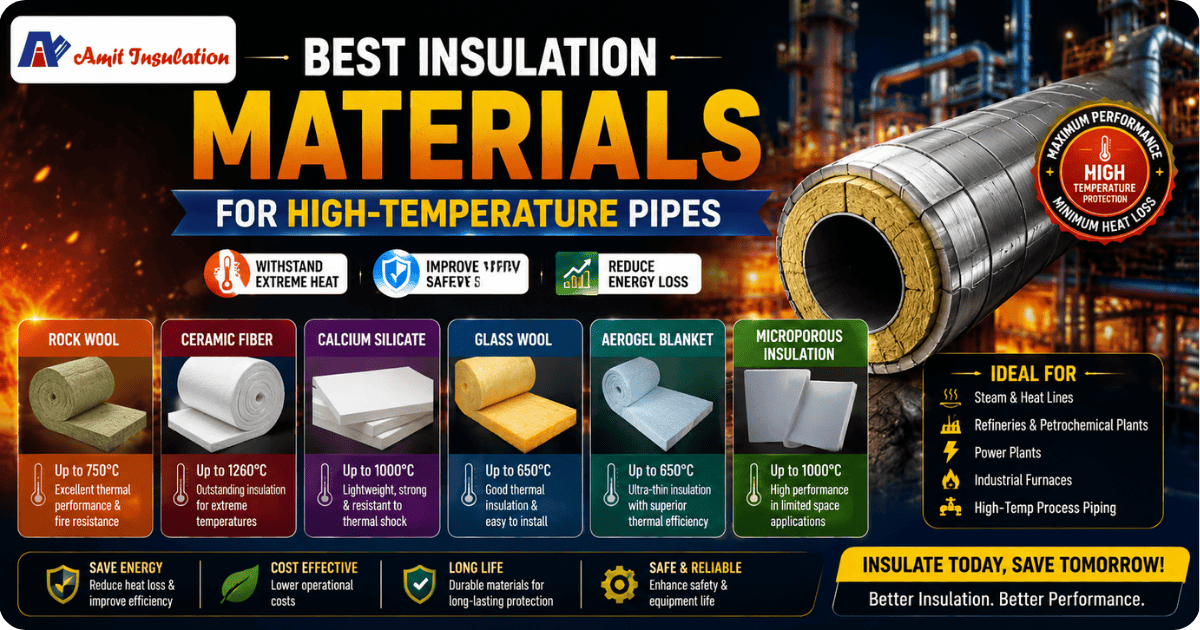
Choosing the best insulation materials for high-temperature pipelines is the single biggest decision that controls heat loss, surface safety, and energy cost in a refinery, power plant, or chemical unit. The right high temperature pipe insulation material can cut surface heat loss by 90%+, keep skin temperatures below 60 °C for worker safety, and pay back its installed cost in under 18 months. The wrong one fails inside a year, causes Corrosion Under Insulation (CUI), and bleeds energy 24/7. This guide explains every material engineers actually specify today — calcium silicate, mineral wool, ceramic fibre, perlite, cellular glass, and aerogel — with service temperatures, k-values, cost bands, and a clear decision framework. At the end, you’ll know exactly which insulation to install on any pipeline between 100 °C and 1,200 °C.
What Counts as a “High-Temperature” Pipeline?
In industrial practice, a pipeline is considered high-temperature once its operating temperature exceeds 120 °C (250 °F). Above this point ordinary elastomeric or polyethylene foams degrade, and you must move to mineral-based or refractory insulation. Most refinery, power, and process pipelines run between 150 °C and 540 °C, while reformer and furnace lines can reach 900–1,200 °C. ASTM standards (C547 for mineral fibre, C533 for calcium silicate, C610 for perlite, C552 for cellular glass) and Indian standards IS 8183 and IS 14164 govern selection and installation.
How to Choose the Right High Temperature Pipe Insulation Material
A good selection is driven by six factors:
- Operating temperature (continuous and peak)
- Thermal conductivity (k-value) at mean temperature
- Compressive strength — for walkable or load-bearing pipes
- Water absorption & CUI risk — closed-cell vs. fibrous
- Fire performance — non-combustible per ASTM E136
- Installed cost including jacketing, labour, and life-cycle
The 7 Best Insulation Materials for High-Temperature Pipelines
1. Calcium Silicate — The Workhorse for 100–650 °C
Calcium silicate is a rigid, hydrous-calcium-silicate insulation moulded to pipe radius. It is the default specification for steam headers, hot-oil lines, and superheater piping. It offers excellent compressive strength (≥ 1,000 kPa), is non-combustible, and resists abuse from boots and tools during turnarounds. Its k-value is around 0.058 W/m·K at 100 °C, making it efficient where dimensional stability matters.
2. Rock (Mineral) Wool — The All-Rounder up to 750 °C
Rock wool pipe sections are spun from basalt and slag, then resin-bonded. They are the most widely installed high temperature pipe insulation material in India because they balance cost, fire safety (melting point ~1,177 °C), and acoustic damping. Mineral wool is the right choice for steam, condensate, and hot-water mains across petrochemical and pharma plants.
3. Fibreglass (Glass Wool) — Best for 80–450 °C
Fibreglass pipe insulation suits medium-temperature service such as LP steam, hot water, and HVAC chilled-water dual-temp lines. It has a low k-value (~0.034 W/m·K at 24 °C) and is light to handle. Above 450 °C the binder burns out, so it is not recommended for superheated steam or furnace piping.
4. Ceramic Fibre Blanket — For Extreme Heat (up to 1,260 °C)
Ceramic fibre is the go-to refractory insulation for reformer lines, ethylene cracker piping, and exhaust ducts where temperatures exceed 1,000 °C. It is lightweight, flexible, and thermally shock resistant — ideal for hot-face linings and removable insulation jackets on flanges and valves.
5. Expanded Perlite — Asbestos-Free Replacement for 200–650 °C
Perlite pipe sections combine perlite, silicate binders, and reinforcing fibres. They are hydrophobic, non-combustible, and increasingly specified for cryogenic-to-hot transitions and refinery service per ASTM C610.
6. Cellular Glass — For CUI-Critical Hot Lines
Cellular glass (e.g., FOAMGLAS®) is a closed-cell borosilicate glass insulation rated to 482 °C. It absorbs zero moisture, making it the gold standard wherever Corrosion Under Insulation is unacceptable — sub-sea risers, intermittent service piping, and dual-temp lines.
7. Aerogel Blanket — The Premium Space-Saver
Silica aerogel blankets (e.g., Pyrogel® XTE) offer the lowest k-value commercially available (~0.020 W/m·K at 100 °C) and are rated up to 650 °C. They are 2–5× thinner than mineral wool for the same heat-loss target, ideal for tight pipe racks and retrofits in Vadodara, Dahej, and Ankleshwar plants where space is at a premium.
You May Also Read:- Hot Insulation vs Cold Insulation: Key Differences Explained
Comparison Table — High-Temperature Pipe Insulation at a Glance
| Material | Max service temp | k-value (W/m·K, mean ~100 °C) | Density (kg/m³) | Best for | Relative cost |
| Calcium silicate | 650 °C | 0.058 | 220–240 | Steam mains, hot-oil lines | ₹₹ |
| Rock / mineral wool | 750 °C | 0.040 | 100–150 | General process & steam piping | ₹ |
| Fibreglass (glass wool) | 450 °C | 0.034 | 48–96 | LP steam, hot water, HVAC | ₹ |
| Ceramic fibre blanket | 1,260 °C | 0.060 (at 400 °C) | 96–160 | Furnace, reformer, exhaust | ₹₹₹ |
| Expanded perlite | 650 °C | 0.062 | 180–220 | Refinery hot lines | ₹₹ |
| Cellular glass | 482 °C | 0.050 | 120 | CUI-critical, dual-temp piping | ₹₹₹ |
| Aerogel blanket | 650 °C | 0.020 | 140–160 | Tight pipe racks, retrofits | ₹₹₹₹ |
Decision Framework — Pick by Pipeline Temperature
| Pipeline operating temperature | Recommended primary material | Backup option | Typical application |
| 120–250 °C | Fibreglass or mineral wool | Cellular glass (for CUI) | Hot water, LP steam, condensate |
| 250–450 °C | Mineral wool | Calcium silicate | MP steam, hot-oil, distillation |
| 450–650 °C | Calcium silicate or perlite | Aerogel blanket | HP steam, reformer feed |
| 650–1,000 °C | Ceramic fibre blanket | Calcium silicate (outer layer) | Cracker, furnace headers |
| 1,000–1,260 °C | Ceramic fibre (high-purity) | Refractory module | Reformer, kiln, exhaust duct |
Installation Best Practices (Often Skipped)
- Use double-layer staggered joints above 350 °C to eliminate thermal bridging.
- Always specify a vapour-tight aluminium or stainless-steel cladding to prevent CUI.
- Maintain annular space for thermal expansion on lines above 300 °C.
- Inspect insulation per API 583 for CUI every 3–5 years in coastal/humid plants (relevant for most Gujarat sites).
- For chilled-cold transitions, read our companion article: Hot Insulation vs Cold Insulation: Key Differences Explained and What Is Cold Insulation? Materials, Methods & Applications.
Why Amit Insulation Is Gujarat’s Preferred Pipeline Insulation Contractor
For over two decades, Amit Insulation has delivered turnkey hot insulation, cold insulation, and refractory pipework across refineries, petrochemical complexes, and pharma plants in Vadodara, Ankleshwar, Dahej, Bharuch, and Nandesari. We supply and install every material listed above — calcium silicate, mineral wool, ceramic fibre, perlite, cellular glass, and aerogel — with in-house fabrication, cladding, scaffolding, and sandblasting & painting crews. Each project is delivered to IS 14164 and client-specific TPI standards, with documented heat-loss calculations and CUI-prevention protocol.
10 Frequently Asked Questions (FAQ)
1. What is the best insulation material for high-temperature pipelines above 600 °C?
For continuous service above 600 °C, calcium silicate is the most cost-effective specification up to its 650 °C limit, while ceramic fibre blanket is the best choice from 650 °C up to 1,260 °C. Many refinery lines combine an inner ceramic-fibre layer with an outer calcium-silicate or mineral-wool layer for a balanced system.
2. Which is better for steam pipes — mineral wool or calcium silicate?
For LP and MP steam up to 450 °C, mineral wool wins on cost and ease of installation. For HP and superheated steam above 450 °C, calcium silicate is preferred because it holds its shape and compressive strength at sustained high temperatures.
3. Can fibreglass be used as a high temperature pipe insulation material?
Standard fibreglass pipe insulation is rated to 450 °C because the organic binder degrades above this point. For higher service temperatures use mineral wool, calcium silicate, perlite, or ceramic fibre.
4. What is the most energy-efficient pipeline insulation?
On a pure k-value basis, silica aerogel blanket (~0.020 W/m·K) is the most thermally efficient pipe insulation available. It delivers the same heat-loss target as mineral wool in 2–5× less thickness, which is critical on retrofits where pipe spacing is fixed.
5. How is insulation thickness for a high-temperature pipeline calculated?
Thickness is calculated using ASTM C680 or the 3E-Plus® software, balancing heat-loss, surface temperature (typically ≤ 60 °C for personnel protection), and dew-point control. Inputs include pipe size, process temperature, ambient temperature, wind speed, jacket emissivity, and insulation k-value.
6. What is Corrosion Under Insulation (CUI) and how do I prevent it?
CUI is corrosion of the pipe surface caused by water trapped under insulation between −4 °C and 175 °C. Prevent it with closed-cell insulation (cellular glass) in CUI-critical zones, vapour-tight metal cladding, anti-corrosive coatings on the pipe, and inspection per API 583.
7. Is ceramic fibre safe and is it asbestos?
Ceramic fibre is not asbestos. Modern bio-soluble high-temperature wools meet European EU Directive 97/69/EC. Installers must still follow PPE protocols (FFP3 mask, gloves) during cutting per the manufacturer’s MSDS.
8. What insulation works for both hot and cold service?
Cellular glass is uniquely suited to dual-temperature service (−260 °C to +482 °C) because its closed-cell structure blocks moisture in both directions. Aerogel blankets also handle a wide range when properly jacketed.
9. How much does high-temperature pipeline insulation cost in India?
Installed cost (material + labour + cladding) typically ranges from ₹450/m to ₹2,800/m depending on pipe diameter, material, and thickness. Mineral wool is the lowest, aerogel the highest. Amit Insulation provides itemised quotations on request.
10. Which insulation contractor should I hire for high-temperature pipelines in Gujarat?
Choose a contractor with documented experience in your service temperature range, in-house cladding and scaffolding, and references from refineries or chemical plants in your area. Amit Insulation services the entire Vadodara–Ankleshwar–Dahej belt with certified crews and TPI-ready documentation.
Conclusion
The best insulation materials for high-temperature pipelines are not picked from a generic list — they are matched to your exact operating temperature, CUI risk, and budget. For most Indian industrial plants the answer falls between mineral wool, calcium silicate, perlite, and ceramic fibre, with cellular glass added wherever moisture is a threat and aerogel reserved for space-constrained retrofits. Specify the right high temperature pipe insulation material and you protect personnel, hit your energy targets, and dramatically extend asset life. To get a tailored material recommendation, thickness calculation, and budgetary quote for your plant, contact Amit Insulation today — Gujarat’s trusted hot, cold, and refractory insulation specialist.