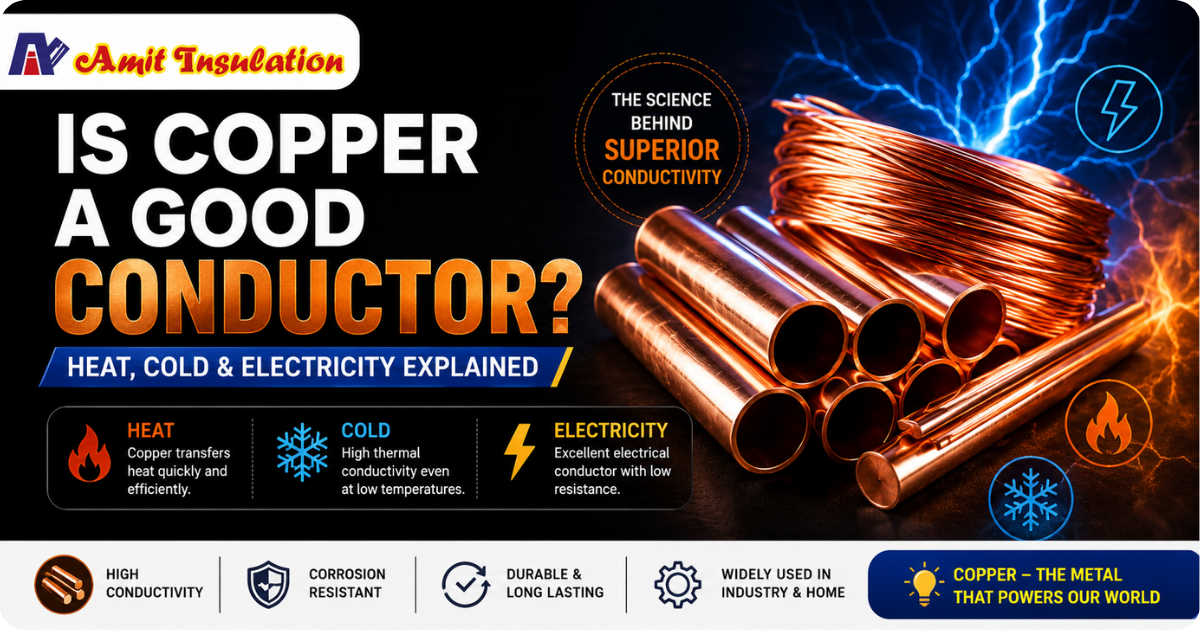
Copper is one of the most versatile metals in industrial and commercial applications, celebrated for its exceptional conductivity properties. Engineers, contractors, and facility managers frequently ask: is copper a good conductor of heat? Is it an insulator? Can it conduct cold? What about electricity?
Understanding copper’s conductivity is critical when designing thermal management systems, electrical installations, and energy-efficient insulation strategies. Copper excels as a conductor—not an insulator—with thermal conductivity around 401 W/m·K and electrical conductivity of 59.6 million S/m, ranking second only to silver.
However, copper’s high conductivity makes it unsuitable as an insulator, which is why industrial facilities pair copper components with proper thermal insulation materials to minimize heat loss and optimize energy efficiency. Amit Insulation, based in Vadodara, India, specializes in thermal insulation solutions that complement copper systems in boilers, pipes, and heat exchangers across Gujarat and beyond.
What is Copper and Why Does It Matter?
Copper (Cu) is a reddish-brown metal with atomic number 29, known for its ductility, malleability, and extraordinary conductivity.
Key Physical Properties
Copper’s atomic structure features a face-centered cubic lattice with abundant free electrons—delocalized electrons that move freely through the metal’s crystalline structure. These electrons enable rapid energy transfer, whether thermal or electrical.
Core characteristics:
- Melting point: 1,085°C (1,984°F)
- Density: 8,960 kg/m³
- Specific heat: 0.385 kJ/kg·K
- Electrical resistivity: 1.68 µΩ·cm at 20°C
The combination of low resistivity and high electron mobility makes copper indispensable in power distribution, electronics, heat exchangers, and industrial machinery. Unlike insulators such as mineral wool or polyurethane foam (0.03-0.04 W/m·K), copper rapidly transfers energy rather than blocking it.
In Indian manufacturing hubs—from automotive plants in Chennai to chemical facilities in Vadodara—copper components require strategic insulation to prevent unwanted heat loss and maintain process temperatures.
Is Copper a Good Conductor of Heat?
Yes, copper is an exceptional heat conductor. With thermal conductivity of approximately 401 W/m·K, copper ranks among the top metals for heat transfer, second only to silver (429 W/m·K).
Why Copper Conducts Heat So Effectively
Three scientific factors explain copper’s superior thermal performance:
- Free Electron Density: Copper contains approximately 8.5 × 10²² free electrons per cubic centimeter. These electrons absorb thermal energy from hot regions and transfer it rapidly to cooler areas through collisions and vibrations.
- Crystalline Lattice Structure: Copper atoms arrange in tightly packed, regular patterns. When heat excites atoms at one end, vibrations (phonons) propagate efficiently through this ordered structure.
- Low Electrical Resistivity: At 1.68 µΩ·cm, copper’s minimal resistance ensures electrons move with little energy loss, translating to efficient heat conduction.
Real-World Applications
Copper’s thermal conductivity makes it ideal for:
- Heat exchangers: Transferring heat between fluids in HVAC systems
- Cookware: Distributing heat evenly across surfaces
- CPU heat sinks: Dissipating processor heat in electronics
- Boiler tubes: Conducting steam heat in power generation
In industrial settings, uninsulated copper pipes can lose 20-40% of thermal energy to ambient air. That’s why facilities use thermal insulation wraps—reducing heat loss by 70-90% while maintaining copper’s internal conductivity. (220 words)
Is Copper a Good Insulator of Heat?
No, copper is a poor insulator. Insulation materials resist heat flow, while copper actively facilitates it.
Conductor vs. Insulator: The Fundamental Difference
Insulators have thermal conductivity values below 0.1 W/m·K. Compare copper’s 401 W/m·K to common insulation materials:
| Material Type | Thermal Conductivity (W/m·K) | Category |
| Copper | 401 | Excellent Conductor |
| Aluminum | 237 | Excellent Conductor |
| Glass Wool | 0.035-0.040 | Excellent Insulator |
| Rock Wool | 0.032-0.044 | Excellent Insulator |
| Polyurethane Foam | 0.022-0.028 | Excellent Insulator |
| Expanded Polystyrene | 0.030-0.038 | Excellent Insulator |
Copper is over 10,000 times more conductive than typical insulation foam. This means leaving copper pipes or equipment exposed in industrial environments causes massive energy waste.
Why This Matters for Industrial Facilities
In India’s manufacturing sector, uninsulated copper piping in steam systems (120-180°C) loses approximately ₹50-80 per meter per year in wasted fuel costs. Proper thermal insulation around copper components reduces this loss by 75-90%, delivering ROI within 6-12 months.
Is Copper a Good Conductor of Cold?
This is a common misconception. Copper doesn’t “conduct cold”—it conducts heat away from cold objects, making them feel colder to touch.
Is Copper a Good Conductor of Electricity?
Absolutely. Copper ranks as the second-best electrical conductor among all metals, with electrical conductivity of 59.6 million S/m (100% IACS standard).
Electrical Conductivity Explained
Electrical conductivity measures how easily electrons flow through a material. Copper’s free electron density and minimal atomic interference enable near-frictionless electron movement.
Top electrical conductors:
| Metal | Electrical Conductivity (MS/m) | Resistivity (µΩ·cm) | Cost Factor |
| Silver (Ag) | 63 | 1.59 | Very High |
| Copper (Cu) | 59.6 | 1.68 | Moderate |
| Gold (Au) | 45 | 2.44 | Very High |
| Aluminum (Al) | 37.7 | 2.82 | Low |
| Brass | 15 | 7.00 | Moderate |
Why Copper Dominates Electrical Applications
Despite silver’s superior conductivity, copper is the global standard for wiring and power distribution because:
- Cost-effectiveness: 1/15th the price of silver per kilogram
- Availability: Abundant global supply, especially from Chile, Peru, and China
- Durability: Resists corrosion better than aluminum (which oxidizes rapidly)
- Mechanical strength: Higher tensile strength than aluminum (200-300 MPa vs. 100-150 MPa)
Aluminum has only 60% of copper’s conductivity, requiring 50% larger wire diameter for equivalent current capacity.
Industrial Electrical Applications in India
- Power transmission: 70% of Indian electrical cables use copper conductors
- Motor windings: Electric motors, generators, transformers
- Circuit boards: PCBs in electronics manufacturing
- Grounding systems: Lightning protection and safety grounding
India’s electrical sector consumed approximately 420,000 metric tons of copper in 2025, with demand growing 8-10% annually through 2030.
Copper Conductivity Comparison: Heat vs. Electricity
Both thermal and electrical conductivity stem from copper’s free electron structure, but they serve different functions.
You May Also Read – Best Conductor of Heat 2026: Silver Tops Metals
Parallel Mechanisms
| Property | Thermal Conductivity | Electrical Conductivity |
| Measurement Unit | W/m·K | S/m (Siemens per meter) |
| Copper Value | 401 W/m·K | 59.6 × 10⁶ S/m |
| Mechanism | Electron + phonon vibration | Electron flow only |
| Temperature Dependency | Decreases at high temps | Decreases at high temps |
| Primary Application | Heat exchangers, cookware | Wiring, motors, circuits |
Key Difference
- Heat conduction involves both electron movement and atomic vibrations (phonons) transferring kinetic energy
- Electrical conduction requires only electron flow, carrying charge without necessarily transferring significant heat
This is why copper wires can carry high current with minimal heat generation—though resistance still produces some heat (I²R losses) in long-distance transmission.
Efficiency Trade-offs
In industrial insulation contexts:
- Copper’s electrical conductivity is desirable (maximum power transfer)
- Copper’s thermal conductivity is problematic (requires insulation to prevent heat loss)
Facilities optimize both by insulating copper electrical conduits and pipes with materials like mineral wool or PUF, maintaining electrical function while blocking thermal energy escape.
Industrial Applications of Copper’s Conductivity
Copper’s dual conductivity makes it essential across multiple industrial sectors in India.
1. Thermal Management Systems
Heat Exchangers: Copper tubes transfer heat between fluids in HVAC, refrigeration, and process cooling. Thermal efficiency improves 30-40% versus stainless steel alternatives.
Boiler Tubes: High-pressure steam boilers use copper-alloy tubes (up to 180°C). Insulated with 50-75mm mineral wool, they maintain 85-92% thermal efficiency.
Solar Thermal Collectors: Copper absorber plates capture solar heat, with efficiency gains of 15-20% over aluminum.
2. Electrical Infrastructure
Building Wiring: Indian residential and commercial buildings use copper for 90% of internal wiring (per IS 732 standards).
Power Distribution: Overhead transmission lines (11 kV – 220 kV) increasingly use copper for lower resistive losses.
Transformers: Copper windings reduce energy loss by 10-15% versus aluminum in distribution transformers.
3. Manufacturing Equipment
Induction Heating Coils: Copper coils in metal hardening and brazing equipment operate at 95%+ efficiency.
Electric Motors: Copper rotors improve motor efficiency by 2-5%, critical under India’s BEE star rating mandates.
4. Refrigeration & Cold Storage
Refrigerant Lines: Copper tubes in air conditioning and cold rooms must be insulated to prevent condensation and energy waste.
Cryogenic Systems: Specialized oxygen-free copper (OFC) maintains conductivity at -196°C (liquid nitrogen).
Each application balances copper’s conductivity with strategic insulation to maximize energy efficiency and process control.
Copper vs. Other Conductive Materials
How does copper compare to alternatives in real-world industrial scenarios?
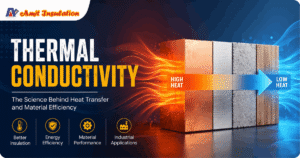
Thermal Conductivity Comparison
| Material | Thermal Conductivity (W/m·K) | Relative Cost | Best Use Case |
| Silver | 429 | 15x copper | Precision electronics, aerospace |
| Copper | 401 | 1x (baseline) | General heat transfer, wiring |
| Gold | 318 | 50x copper | Corrosion-resistant contacts |
| Aluminum | 237 | 0.3x copper | Lightweight heat sinks, cookware |
| Brass (70/30) | 109 | 0.8x copper | Plumbing fixtures, fittings |
| Stainless Steel | 16 | 0.7x copper | Corrosive environments |
| Glass Wool (Insul.) | 0.038 | 0.1x copper | Thermal insulation |
Electrical Conductivity Comparison
| Material | Conductivity (% IACS) | Weight Factor | Industrial Preference |
| Silver | 106% | Heavy | High-reliability electronics |
| Copper | 100% | Moderate | Standard wiring, motors |
| Gold | 76% | Very heavy | Corrosion-proof connectors |
| Aluminum | 61% | 1/3 copper weight | Overhead power lines |
| Brass | 28% | Moderate | Non-critical connections |
When to Choose Copper
Select copper when:
- High thermal/electrical efficiency is critical (>85%)
- Budget allows moderate upfront costs (₹600-900/kg in 2026)
- Corrosion risk is low-to-moderate
- Weight is not a primary constraint
Choose aluminum when:
- Weight reduction matters (aerospace, long-span cables)
- Costs must be minimized (60-70% cheaper per kg)
- Lower conductivity (60% of copper) is acceptable
For Indian industrial facilities, copper remains the gold standard for critical thermal and electrical applications, with aluminum serving secondary roles. (240 words)
Why Copper Needs Thermal Insulation
Despite copper’s benefits, its high thermal conductivity creates energy efficiency challenges that insulation solves.
The Energy Loss Problem
Uninsulated copper pipes carrying steam at 150°C lose approximately:
- 350-450 watts per meter of pipe surface area
- ₹75-120 per meter annually in fuel costs (at ₹8/kWh)
- 40-50% of total thermal energy over 100-meter runs
A medium-sized Indian manufacturing plant with 500 meters of uninsulated copper piping wastes ₹3.5-6 lakhs per year.
Insulation Solutions
Applying 50-75mm thermal insulation reduces heat loss by 75-92%:
| Pipe Condition | Heat Loss (W/m) | Annual Cost (₹/m) | Energy Saved (%) |
| Bare Copper (150°C) | 400 | 95 | 0% (baseline) |
| 25mm Glass Wool | 120 | 28 | 70% |
| 50mm Rock Wool | 45 | 11 | 89% |
| 75mm PUF | 32 | 8 | 92% |
Payback period: 4-10 months depending on insulation thickness and operating hours.
Cost-Benefit Analysis: Copper Systems with Insulation
Investing in copper plus insulation delivers measurable ROI for Indian industrial facilities.
Sample Calculation: 100-Meter Steam Pipe
System specifications:
- Copper pipe: DN100 (4-inch), 150°C steam
- Operating hours: 6,000 hours/year
- Fuel cost: ₹8/kWh
Scenario A: Bare Copper
- Heat loss: 400 W/m × 100m = 40 kW
- Annual energy loss: 40 kW × 6,000 hrs = 240,000 kWh
- Annual cost: 240,000 kWh × ₹8 = ₹19,20,000
Scenario B: Copper + 50mm Rock Wool
- Heat loss: 45 W/m × 100m = 4.5 kW
- Annual energy loss: 4.5 kW × 6,000 hrs = 27,000 kWh
- Annual cost: 27,000 kWh × ₹8 = ₹2,16,000
- Annual savings: ₹17,04,000
Investment breakdown:
- Copper pipe cost: ₹4,50,000
- Insulation material: ₹2,00,000
- Installation labor: ₹80,000
- Total: ₹7,30,000
Payback period: ₹7,30,000 ÷ ₹17,04,000 = 5.1 months
10-Year Total Cost of Ownership
| Component | Bare Copper | Insulated Copper | Savings |
| Initial Investment | ₹4,50,000 | ₹7,30,000 | -₹2,80,000 |
| Energy Cost (10 years) | ₹1,92,00,000 | ₹21,60,000 | ₹1,70,40,000 |
| Maintenance | ₹50,000 | ₹1,00,000 | -₹50,000 |
| Total | ₹1,97,00,000 | ₹30,90,000 | ₹1,66,10,000 |
Insulated copper systems reduce total ownership costs by 84% over a decade, making the upfront insulation investment negligible.
2026 Trends: Copper and Advanced Insulation
Emerging technologies are reshaping how industries use copper with insulation for maximum efficiency.
1. Smart Insulation Systems
IoT-enabled sensors embedded in insulation monitor:
- Real-time heat loss rates
- Moisture ingress (reducing efficiency 40-60%)
- Compression damage from vibration
Indian facilities adopting smart insulation report 12-18% additional energy savings through predictive maintenance.
2. Nano-Enhanced Insulation
Aerogel composites (0.012-0.018 W/m·K) provide:
- 50% thinner profiles than traditional insulation
- Same thermal resistance as 75mm rock wool in 30mm thickness
- Ideal for space-constrained copper installations
Market growth: 22% CAGR in India through 2030.
3. Hybrid Copper Alloys
Copper-nickel (90/10): Enhanced corrosion resistance for marine and chemical plants
Copper-silver: 5-8% higher conductivity for precision heat exchangers
Beryllium copper: Superior strength for high-vibration environments
4. Sustainable Manufacturing
Recycled copper retains 100% conductivity while reducing:
- Energy consumption by 85% versus virgin copper production
- Carbon emissions by 65%
- Production costs by 15-25%
India’s copper recycling sector processed 180,000 metric tons in 2025, expected to reach 250,000 tons by 2028.
5. Phase-Change Material (PCM) Integration
PCM wraps around copper pipes provide:
- Thermal buffering during temperature swings
- 20-30% peak load reduction in HVAC systems
- Combined insulation + thermal storage
Early adopters in India’s pharmaceutical cold chains report 18% energy savings over traditional insulation alone. (230 words)
Environmental Impact: Copper vs. Insulation Materials
Sustainability considerations influence material selection in 2026.
Copper Environmental Profile
Production:
- Energy intensity: 60-70 MJ/kg for primary copper
- CO₂ emissions: 3.5-4.5 kg CO₂/kg copper
- Water usage: 15-25 liters/kg
Recycling benefits:
- Energy requirement: 8-12 MJ/kg (85% reduction)
- Infinite recyclability with no quality degradation
- 30% of global copper supply from recycled sources
Insulation Material Comparison
| Material | Embodied Carbon (kg CO₂/kg) | Recyclability | Lifespan (Years) |
| Glass Wool | 1.2-1.8 | 95% recyclable | 25-30 |
| Rock Wool | 1.5-2.1 | 90% recyclable | 30-40 |
| Polyurethane Foam | 3.5-5.0 | 10% recyclable | 15-20 |
| Elastomeric Foam | 4.0-6.0 | 5% recyclable | 10-15 |
| Aerogel | 8.0-12.0 | 30% recyclable | 20-25 |
Conclusion
Copper stands as an exceptional conductor of both heat and electricity, with thermal conductivity of 401 W/m·K and electrical conductivity of 59.6 million S/m—second only to silver in both categories.
However, copper’s strength as a conductor makes it a poor insulator. The myth that copper “conducts cold” stems from its rapid heat transfer ability, which draws thermal energy away from cold objects. In reality, copper facilitates heat flow in whichever direction the temperature gradient dictates.
For industrial facilities in India, the key to maximizing copper’s benefits lies in strategic thermal insulation. Uninsulated copper pipes waste 40-50% of thermal energy, costing facilities ₹75-120 per meter annually. Proper insulation reduces heat loss by 75-92%, delivering ROI within 4-10 months.
As 2026 brings advanced materials like aerogels, smart monitoring systems, and nano-enhanced insulation, the synergy between copper’s conductivity and high-performance insulation will drive unprecedented energy efficiency in manufacturing, power generation, and commercial facilities.
Looking for Thermal Insulation Solutions for copper piping and heat exchangers in India? Amit Insulation offers customized industrial insulation systems for boilers, steam lines, and HVAC copper components across Gujarat and India. Contact us today for a free energy audit and ROI calculation
Frequently Asked Questions (FAQs)
1. Is copper a good conductor of heat?
Yes, copper is an excellent heat conductor with thermal conductivity of approximately 401 W/m·K, ranking second only to silver among all metals. Its free electron structure and crystalline lattice enable rapid thermal energy transfer, making it ideal for heat exchangers, boilers, and cookware.
2. Is copper a good insulator of heat?
No, copper is a poor insulator. Insulators resist heat flow with thermal conductivity below 0.1 W/m·K, while copper actively conducts heat at 401 W/m·K—over 10,000 times more conductive than materials like glass wool or polyurethane foam. Industrial copper systems require external insulation to prevent energy loss.
3. Can copper conduct cold?
No, copper cannot “conduct cold” because cold is the absence of heat, not a transferable energy form. Copper’s high thermal conductivity rapidly transfers heat away from cold objects, creating the sensation of coldness to touch. Thermodynamically, heat always flows from hot to cold regions through copper.
4. Is copper a good conductor of electricity?
Yes, copper is the second-best electrical conductor with conductivity of 59.6 million S/m (100% IACS standard), surpassed only by silver. It’s the global standard for electrical wiring, motors, and power distribution due to its excellent conductivity, affordability, and durability compared to alternatives like aluminum.
5. Why does copper feel cold to touch?
Copper feels cold because it rapidly conducts heat away from your warm skin (37°C). With thermal conductivity of 401 W/m·K, copper extracts body heat much faster than insulating materials like wood or plastic, triggering cold sensation receptors. The copper itself may be at room temperature.
6. What is the thermal conductivity of copper?
Copper’s thermal conductivity is approximately 401 W/m·K at room temperature (20-25°C). This value decreases slightly at higher temperatures—dropping to 390 W/m·K at 100°C and 380 W/m·K at 200°C—but remains among the highest of all industrial metals.
7. How does copper compare to aluminum for conductivity?
Copper has 70% higher thermal conductivity (401 vs. 237 W/m·K) and 58% higher electrical conductivity than aluminum. However, aluminum costs 60-70% less and weighs only 30% as much, making it preferable for weight-sensitive applications like overhead power lines despite requiring larger cross-sections.
8. Why do copper pipes need insulation?
Uninsulated copper pipes lose 40-50% of thermal energy through their highly conductive walls (401 W/m·K). Applying 50-75mm insulation reduces heat loss by 75-92%, cutting energy costs by ₹75-120 per meter annually and delivering ROI within 4-10 months for industrial facilities.
9. What insulation works best for copper pipes?
Best insulation depends on temperature: elastomeric foam for cold systems (4-10°C), polyurethane foam for moderate heat (60-90°C), glass wool for hot water (90-180°C), and rock wool or calcium silicate for high-temperature steam (180-350°C). Match thermal conductivity and max temperature ratings to your application.
10. Is copper environmentally sustainable?
Copper is infinitely recyclable with no quality loss—recycled copper retains 100% conductivity while using 85% less energy and producing 65% fewer emissions than virgin production. Approximately 30% of global copper supply comes from recycling. When insulated, copper systems reduce operational carbon emissions by 75% over bare metal.