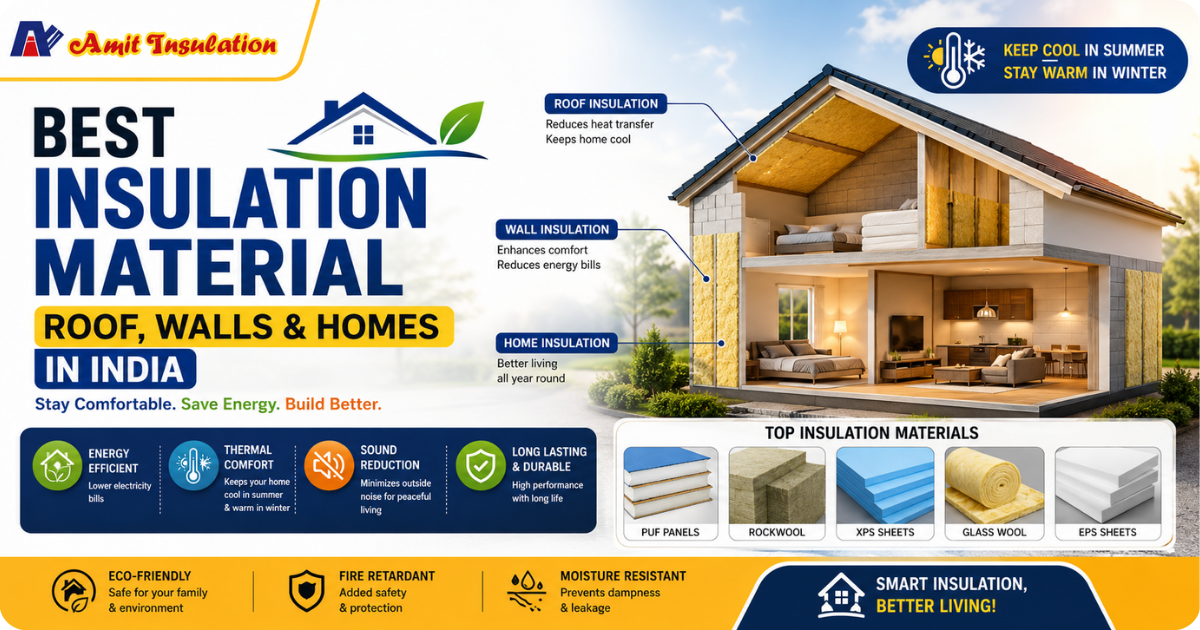
Choosing the best insulation material for roofs, walls, and homes is critical for energy efficiency, thermal comfort, and long-term cost savings in India’s diverse climate zones. With temperatures ranging from 48°C in summer to sub-zero in northern regions, proper insulation reduces cooling costs by 30-45% and heating expenses by 35-50%.
The Indian insulation market offers multiple materials—PUF panels, mineral wool, glass wool, XPS, and EPS—each suited for specific applications. Understanding thermal conductivity, R-values, moisture resistance, and fire safety helps engineers, contractors, and facility owners make informed decisions. Amit Insulation, based in Vadodara, specializes in industrial and commercial Thermal Insulation Solutions across Gujarat and India.
What is Thermal Insulation?
Thermal insulation is a barrier material that reduces heat transfer between surfaces at different temperatures. It works by trapping air pockets within its structure, minimizing conductive, convective, and radiant heat flow.
In buildings, insulation maintains indoor temperatures by preventing heat gain during summers and heat loss during winters. This reduces mechanical cooling and heating loads by 40-60%, directly lowering energy consumption.
Key Performance Indicators
Thermal Conductivity (K-value): Measures heat transfer rate through materials in W/m·K. Lower values indicate better insulation performance.
R-value (Thermal Resistance): Indicates insulation effectiveness per unit thickness. Higher R-values provide superior thermal protection.
U-value: Overall heat transfer coefficient for complete building assemblies. Lower U-values mean better energy efficiency.
India’s Eco Niwas Samhita (ENS 2018) mandates residential buildings achieve RETV below 15 W/m²K and wall U-values below 0.40 W/m²K for compliance.
Types of Best Insulation Materials
1. PUF Panels (Polyurethane Foam)
PUF panels consist of high-density polyurethane foam core sandwiched between metal sheets, offering the lowest thermal conductivity among common materials.
Key specifications:
- Thermal conductivity: 0.020-0.024 W/m·K
- R-value: R-6.0 to R-7.0 per inch
- Density: 38-42 kg/m³
- Temperature range: -40°C to +120°C
Applications: Industrial roofs, cold storage, warehouses, pre-fabricated buildings
2. Mineral Wool (Rock Wool)
Manufactured from molten volcanic rock spun into fibers, mineral wool provides exceptional fire resistance and acoustic insulation.
Key specifications:
- Thermal conductivity: 0.032-0.044 W/m·K
- R-value: R-3.3 to R-4.2 per inch
- Fire rating: Class A (non-combustible, 1,000°C melting point)
- Temperature range: -40°C to +750°C
Applications: Fire-rated walls, high-temperature equipment, soundproofing
3. Glass Wool (Fiberglass)
Spun glass fiber insulation offering balanced thermal and acoustic properties at moderate cost.
Key specifications:
- Thermal conductivity: 0.035-0.045 W/m·K
- R-value: R-2.9 to R-3.8 per inch
- Fire rating: Class A (non-combustible)
- Lifespan: 20-30 years
Applications: Cavity walls, attics, HVAC ducts, partition walls
4. XPS Boards (Extruded Polystyrene)
Closed-cell rigid foam boards with superior moisture resistance and compressive strength.
Key specifications:
- Thermal conductivity: 0.028-0.033 W/m·K
- R-value: R-5.0 per inch
- Moisture absorption: <0.1%
- Compressive strength: 200-300 kPa
Applications: Flat roofs, below-grade foundations, coastal humid zones
5. EPS Sheets (Expanded Polystyrene)
Lightweight beadboard insulation providing affordable thermal protection for residential and commercial projects.
Key specifications:
- Thermal conductivity: 0.033-0.038 W/m·K
- R-value: R-3.6 to R-4.2 per inch
- Density: 15-30 kg/m³
- Cost: Most economical option
Applications: Roof insulation, cavity walls, under-tile installations
Benefits and Applications
Energy Cost Reduction
Properly installed insulation cuts HVAC energy consumption by 30-50% in Indian climates. For a 10,000 sq ft industrial facility, this translates to annual savings of ₹2-3.5 lakhs depending on operating hours and climate zone.
Enhanced Thermal Comfort
Insulation maintains interior temperatures 5-8°C cooler in summer and 4-6°C warmer in winter without continuous mechanical systems. This improves occupant comfort and productivity.
Regulatory Compliance
Meeting ENS 2018 standards requires specific R-values based on climate zones. Insulation helps achieve mandated RETV and U-value targets, avoiding penalties and enabling green building certifications.
Fire Safety
Non-combustible materials like mineral wool and glass wool provide critical fire resistance for industrial facilities, high-rises, and manufacturing plants where safety regulations are stringent.
Acoustic Control
Fibrous insulation materials reduce noise transmission by 40-50 dB, essential for residential apartments, offices, theaters, and factories near urban areas.
Moisture Protection
Closed-cell foams like PUF and XPS prevent condensation and moisture ingress, protecting structural integrity in coastal regions with high humidity and monsoon exposure.
Industrial Applications
- Manufacturing plants: Temperature-controlled production environments
- Cold storage: Maintaining sub-zero temperatures for food/pharma
- Power plants: Boiler and turbine insulation
- Chemical facilities: High-temperature process equipment
- Commercial buildings: Roof and wall envelope systems
Material Comparison Table
| Material | Thermal Conductivity (W/m·K) | R-Value (per inch) | Fire Rating | Moisture Resistance | Cost (₹/m², 50mm) | Best Application |
|---|---|---|---|---|---|---|
| PUF Panels | 0.020-0.024 | R-6.0 to R-7.0 | Class B | Excellent | ₹950-1,450 | Industrial roofs, cold storage |
| Mineral Wool | 0.032-0.044 | R-3.3 to R-4.2 | Class A | Poor (needs barrier) | ₹1,400-1,950 | Fire-rated walls, high-temp |
| Glass Wool | 0.035-0.045 | R-2.9 to R-3.8 | Class A | Poor (needs barrier) | ₹500-900 | Cavity walls, attics |
| XPS Boards | 0.028-0.033 | R-5.0 | Class C | Excellent | ₹700-1,100 | Coastal areas, flat roofs |
| EPS Sheets | 0.033-0.038 | R-3.6 to R-4.2 | Class D | Moderate | ₹330-600 | Budget residential roofs |
Performance Characteristics
| Property | PUF | Mineral Wool | Glass Wool | XPS | EPS |
|---|---|---|---|---|---|
| Thermal Efficiency | Excellent | Good | Good | Very Good | Good |
| Fire Resistance | Moderate | Excellent | Excellent | Poor | Poor |
| Moisture Barrier | Excellent | Poor | Poor | Excellent | Moderate |
| Acoustic Performance | Moderate | Excellent | Very Good | Poor | Moderate |
| Compressive Strength | Good | Moderate | Low | Excellent | Moderate |
| Lifespan (years) | 25-30 | 30-40 | 20-30 | 30+ | 15-25 |
Cost, ROI, and Factors to Consider
Installation Costs (50mm Thickness)
Material costs vary significantly based on thermal performance and application requirements:
- EPS sheets: ₹250-450/m² (material only)
- Glass wool: ₹400-700/m² (material only)
- XPS boards: ₹600-900/m² (material only)
- PUF panels: ₹800-1,200/m² (material only)
- Mineral wool: ₹1,200-1,600/m² (material only)
Installation labor adds ₹80-350/m² depending on material complexity and project scale.
ROI Analysis
Example: 5,000 sq ft industrial roof in Ahmedabad
Scenario A: No insulation
- Annual cooling energy: ₹2,80,000
- 10-year cost: ₹28,00,000
Scenario B: 75mm PUF panels (₹7,25,000 investment)
- Annual cooling energy: ₹1,54,000 (45% reduction)
- Annual savings: ₹1,26,000
- Payback period: 5.75 years
- 10-year net savings: ₹5,35,000
Scenario C: 50mm EPS sheets (₹3,00,000 investment)
- Annual cooling energy: ₹1,82,000 (35% reduction)
- Annual savings: ₹98,000
- Payback period: 3.06 years
- 10-year net savings: ₹6,80,000
Key Selection Factors
Climate Zone: Hot-dry regions benefit from radiant barriers plus conductive insulation. Humid coastal areas require moisture-resistant closed-cell foams.
Operating Temperature: High-temperature applications (>200°C) mandate mineral wool or calcium silicate. Standard HVAC uses PUF, XPS, or EPS effectively.
Fire Safety Requirements: Industrial facilities and high-rises need Class A non-combustible materials. Residential projects can use flame-retardant foams.
Budget Constraints: EPS provides lowest initial cost with good performance. PUF offers superior long-term value through energy savings despite higher upfront investment.
Moisture Exposure: Coastal installations and monsoon-prone regions require XPS or PUF. Inland dry climates can use mineral wool with vapor barriers.
Acoustic Needs: Fibrous materials (mineral wool, glass wool) outperform foam-based options for sound dampening in noise-sensitive applications.
You May Also Read – Is Copper a Good Conductor? Heat, Cold & Electricity Explained
How to Choose the Right Insulation Material
Step 1: Assess Application Requirements
Identify whether insulation is for roofs, walls, equipment, or complete building envelopes. Each application has specific thermal, structural, and safety needs.
Step 2: Determine Climate Zone
India’s National Building Code defines five climate zones with varying insulation requirements:
- Hot-dry (Rajasthan, Gujarat): Focus on radiant heat blocking
- Warm-humid (Coastal Kerala, Mumbai): Prioritize moisture resistance
- Composite (Delhi, Pune): Balance seasonal extremes
- Moderate (Nashik): Standard insulation adequate
- Cold (Kashmir, Shimla): Maximum R-values needed
Step 3: Calculate Required R-Value
ENS 2018 mandates minimum thermal resistance based on climate:
- Hot-dry zones: R-19 roofs, R-11 walls
- Composite zones: R-30 roofs, R-13 walls
- Cold zones: R-38 roofs, R-19 walls
Step 4: Evaluate Fire Safety Standards
Check local building codes and insurance requirements. Industrial and commercial projects often mandate Class A non-combustible insulation for fire-rated assemblies.
Step 5: Consider Moisture Management
Coastal regions and areas with >70% humidity require closed-cell foams (PUF, XPS) or fibrous materials with properly installed vapor barriers.
Step 6: Compare Total Cost of Ownership
Factor in material cost, installation labor, energy savings, maintenance, and lifespan. Lower upfront costs don’t always translate to better long-term value.
Step 7: Verify Compliance Standards
Ensure materials meet:
- IS 11827: Thermal insulation specifications
- IS 8183: Fiberglass insulation standards
- IS 12436: Mineral wool specifications
- ENS 2018: Energy conservation requirements
Conclusion
Selecting the best insulation material for roofs, walls, and homes requires balancing thermal performance, fire safety, moisture resistance, and cost considerations specific to Indian climates and applications.
PUF panels deliver superior thermal efficiency for industrial roofs and cold storage. Mineral wool provides unmatched fire safety and acoustics for walls. XPS boards excel in coastal humidity. EPS offers budget-friendly performance for residential projects. Glass wool provides versatile cavity wall solutions.
With energy costs rising and ENS 2018 compliance mandatory, proper insulation transforms from optional upgrade to essential investment. Industrial facilities achieve 30-50% HVAC cost reduction with 3-6 year payback periods.
Looking for the best insulation material solutions in India? Amit Insulation offers customized thermal insulation systems for industrial and commercial needs across Gujarat and India. Contact Us Today for expert consultation and professional installation.
Frequently Asked Questions
1. What is the best insulation material for roofs in India?
PUF panels are the best insulation material for roofs, offering thermal conductivity of 0.020-0.024 W/m·K and R-6 to R-7 per inch. They reduce roof heat gain by 40-50% and provide structural strength for industrial applications. For budget-conscious projects, 50mm EPS sheets deliver good performance at ₹330-600/m².
2. Which insulation material is best for walls?
Mineral wool is the best insulation material for walls, providing R-3.3 to R-4.2 per inch, Class A fire rating, and 40-50 dB noise reduction. It achieves wall U-values of 0.35-0.45 W/m²K, meeting ENS 2018 standards. Glass wool offers similar benefits at lower cost (₹500-900/m² vs ₹1,400-1,950/m²).
3. What is the best insulation material for homes in hot climates?
For hot-dry climates (Rajasthan, Gujarat), combine reflective foil with 50mm EPS or PUF panels. Reflective barriers block 90-95% radiant heat while foam provides conductive resistance. For warm-humid coastal regions, use XPS boards with 0.1% moisture absorption to prevent condensation and maintain R-value.
4. Which is the cheapest insulation material with good performance?
EPS (Expanded Polystyrene) sheets are the most economical at ₹330-600/m² for 50mm thickness installed. They provide R-3.6 to R-4.2 per inch thermal resistance and deliver 30-35% energy savings with fastest ROI of 2-3 years for residential and light commercial applications.
5. What R-value insulation do I need for my climate zone in India?
Minimum R-values per ENS 2018: Hot-dry zones need R-19 roofs and R-11 walls. Composite zones require R-30 roofs and R-13 walls. Cold zones need R-38 roofs and R-19 walls. Warm-humid zones need R-15 roofs and R-8 walls with moisture barriers.
6. Is mineral wool better than fiberglass for insulation?
Mineral wool offers higher temperature resistance (750°C vs 450°C), better fire safety (1,000°C melting point), and superior acoustic performance (NRC 0.85-0.95 vs 0.75-0.85). However, fiberglass costs 40-50% less (₹500-900/m² vs ₹1,400-1,950/m²) and performs similarly for standard residential applications.
7. How does XPS compare to EPS for moisture-prone areas?
XPS absorbs only 0.1% water versus EPS’s 2-4%, making it superior for coastal regions, basements, and monsoon-exposed applications. XPS also provides higher compressive strength (200-300 kPa vs 70-150 kPa) but costs 60-80% more (₹700-1,100/m² vs ₹330-600/m²).
8. What is the best insulation material for cold storage facilities?
PUF panels are optimal for cold storage, maintaining temperatures from -40°C to +10°C with minimal heat gain. Their closed-cell structure prevents moisture intrusion and achieves R-6 to R-7 per inch. Thickness of 100-150mm standard for frozen storage applications.
9. Do I need vapor barriers with insulation in India?
Yes, in warm-humid coastal regions, install vapor barriers on the exterior (warm) side to prevent condensation within fibrous insulation like mineral wool or glass wool. In cold climates, place barriers on interior (warm) side. Closed-cell foams (PUF, XPS) don’t require separate barriers.