Thermal insulation plays a vital role in industrial operations by managing heat transfer, and understanding specific heat is key to selecting the right materials. Specific heat defines how much energy a material absorbs to raise its temperature, directly impacting insulation performance. Amit Insulation, based in Vadodara, India, specializes in solutions that leverage these principles for energy efficiency.
Engineers, contractors, facility owners, and industrial buyers often ask: which statement best defines specific heat? This guide breaks it down simply, linking it to Thermal Insulation strategies. Expect real-world applications, data tables, and 2026 trends to help you make informed decisions.
What is Specific Heat?
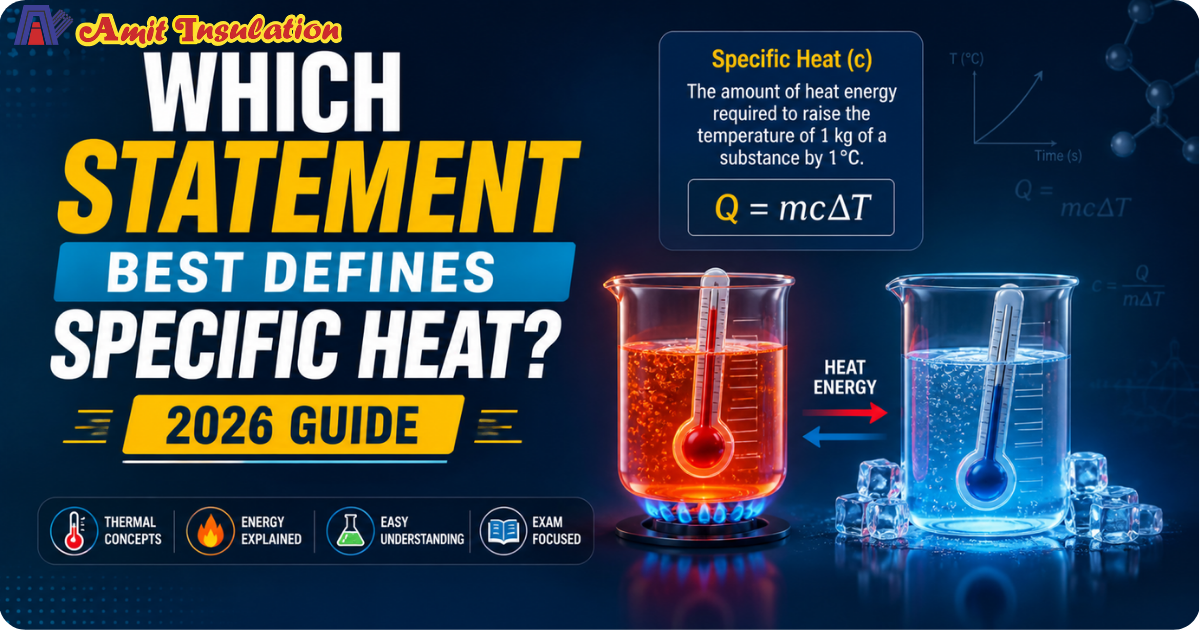
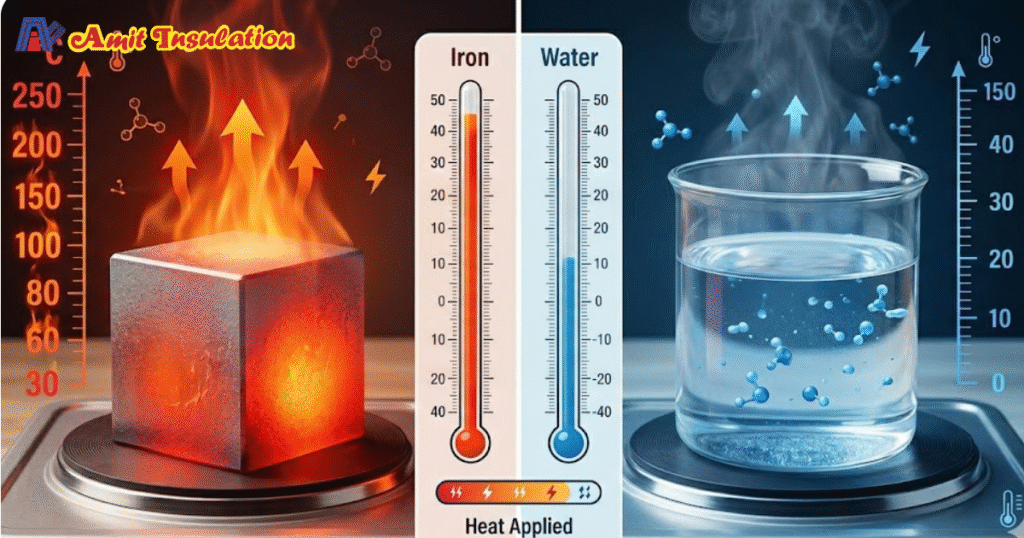
Specific heat is the amount of heat energy required to raise the temperature of one kilogram of a substance by one degree Celsius (or Kelvin).
The statement that best defines it: “Specific heat is the heat needed to increase the temperature of 1 kg of a material by 1°C without changing its phase.” This makes it an intensive property, independent of mass.
In thermal insulation, low specific heat materials respond quickly to temperature changes, minimizing heat gain or loss. For example, insulators like mineral wool have specific heats around 0.8-1.0 kJ/kg·K, balancing heat storage and release.
This concept underpins why thermal insulation works—materials with tailored specific heats reduce energy waste in pipes, tanks, and boilers.
Key Types of Thermal Insulation Materials
Thermal insulation materials vary by composition, each with unique specific heat values suited to industrial needs.
- Fibrous Insulation: Includes glass wool and rock wool. Specific heat: 0.8-1.0 kJ/kg·K. Excellent for high-temperature pipes.
- Cellular Insulation: Foam-based like polyurethane (PUF) or expanded polystyrene (EPS). Specific heat: 1.2-1.8 kJ/kg·K. Ideal for cold storage.
- Granular Insulation: Perlite or vermiculite. Specific heat: 0.2-0.8 kJ/kg·K. Used in loose-fill applications for walls.
- Reflective Insulation: Foil-faced materials. Specific heat: ~0.9 kJ/kg·K. Blocks radiant heat via low emissivity.
These types leverage specific heat to control thermal mass, preventing rapid heat buildup. Selection depends on operating temperatures up to 650°C for fibrous types.
Benefits and Applications
Thermal insulation delivers energy savings, safety, and process control, all tied to specific heat management.
Key benefits:
- Reduces heat loss by 70-90% in industrial pipes, per industry benchmarks.
- Lowers energy costs—up to 25% ROI in first year for factories.
- Enhances safety by keeping surfaces below 60°C.
Applications:
- Pipes and Boilers: Fibrous insulation maintains steam efficiency.
- Tanks and Vessels: Cellular foams prevent condensation.
- HVAC Systems: Granular fills optimize airflow.
- Refrigeration: Reflective layers minimize cold bridging.
In India’s manufacturing hubs, these cut operational costs amid rising energy prices. Specific heat ensures materials don’t over-absorb ambient heat, sustaining performance.
Comparison Table
| Material Type | Specific Heat (kJ/kg·K) | Thermal Conductivity (W/m·K) | Max Temp (°C) | Density (kg/m³) | Cost (₹/m², approx.) |
|---|---|---|---|---|---|
| Glass Wool | 0.85 | 0.035-0.040 | 450 | 20-50 | 150-250 |
| Rock Wool | 0.92 | 0.032-0.044 | 650 | 40-100 | 200-350 |
| Polyurethane Foam | 1.25 | 0.022-0.028 | 120 | 30-40 | 300-500 |
| Expanded Polystyrene | 1.67 | 0.030-0.038 | 75 | 15-30 | 100-200 |
| Perlite | 0.78 | 0.040-0.050 | 1000 | 50-100 | 120-220 |
This table highlights how specific heat influences insulation choice—lower values suit high-heat scenarios. Data based on standard engineering references.
Cost, ROI, and Factors to Consider
Thermal insulation costs range from ₹100-500 per m², depending on material and thickness.
ROI Calculation: A 100m pipe system insulated at ₹200/m² saves ₹50,000/year in fuel (at 20% efficiency gain). Payback: 6-12 months. Indian factories report 15-30% annual energy reduction.
Factors:
- Thickness: 50-100mm standard; thicker for extreme temps.
- Installation: Labor ~30% of total cost.
- Maintenance: Low for quality materials (5-10 year lifespan).
- Energy Prices: At ₹8/kWh, savings amplify ROI.
Consider specific heat for long-term value—materials absorbing less heat reduce cycling costs.
ROI Example
| Plant Size (Pipes, m) | Insulation Cost (₹) | Annual Savings (₹) | Payback Period (Months) |
|---|---|---|---|
| 500 | 1,00,000 | 2,50,000 | 5 |
| 1000 | 2,00,000 | 5,00,000 | 5 |
| 2000 | 4,00,000 | 10,00,000 | 5 |
Assumes 25% efficiency gain from thermal insulation.
How to Choose the Right Thermal Insulation
Match insulation to your needs using a step-by-step approach.
- Assess temperature range: >400°C? Choose rock wool (specific heat 0.92 kJ/kg·K).
- Calculate heat load: Use Q = m·c·ΔT, where c is specific heat.
- Check conductivity: Aim <0.04 W/m·K.
- Evaluate space: Cellular for tight fits.
- Test compatibility: Non-corrosive to metals.
Prioritize low specific heat for dynamic environments. Consult standards like IS 818 for Indian compliance.
You May Also Read – Scaffolding Services Gujarat: Types, Cost & Safety Guide 2026
Future Trends
By 2026, thermal insulation evolves with smart materials and sustainability.
- Aerogels: Specific heat ~0.9 kJ/kg·K, 0.01 W/m·K conductivity—ultra-thin for space-constrained plants. Market growth: 15% CAGR in India.
- Phase-Change Materials (PCMs): Dynamic specific heat via latent heat storage, ideal for variable loads.
- Nano-Enhanced Foams: 20% better efficiency, reducing energy use by 30%.
- Bio-Based Insulators: From agricultural waste, specific heat 1.0-1.2 kJ/kg·K, eco-friendly.
India’s green building codes (IGBC) drive adoption, targeting 20% industrial energy cut by 2030. Expect IoT-integrated insulation for real-time specific heat monitoring.
2026 Trends Impact
| Trend | Specific Heat Impact | Efficiency Gain | India Market Size (₹ Cr, 2026) |
|---|---|---|---|
| Aerogels | Stabilized at 0.9 | 40% | 500 |
| PCMs | Variable (0.8-1.5) | 25% | 1200 |
| Nano-Foams | Reduced absorption | 30% | 800 |
Conclusion
Mastering specific heat—”the heat to raise 1 kg by 1°C”—unlocks superior thermal insulation choices for industrial efficiency. From pipes to tanks, it ensures minimal energy loss, cost savings, and compliance. This 2026 guide equips engineers and buyers with data-driven insights for optimal performance.
Looking for thermal insulation solutions in India? Amit Insulation offers customized products for industrial and commercial needs across Gujarat and India.
FAQ
Which statement best defines specific heat?
The best definition: Specific heat is the energy required to raise 1 kg of a substance by 1°C, without phase change. It’s crucial for thermal insulation material selection.
Why is specific heat important for thermal insulation?
Low specific heat means materials heat up slowly, reducing heat transfer in industrial settings like boilers and pipes.
What material has the lowest specific heat for insulation?
Perlite at 0.78 kJ/kg·K excels in high-heat, loose-fill applications.
How does specific heat affect energy costs?
Lower specific heat cuts heat absorption, saving 20-30% on fuel in Indian factories.
What is the specific heat of common insulation like rock wool?
Around 0.92 kJ/kg·K, balancing durability and thermal control.
Can specific heat change with temperature?
Yes, slightly for most materials, but it’s treated as constant in standard calculations.
How to calculate heat transfer using specific heat?
Use Q = m × c × ΔT, where c is specific heat, for precise insulation sizing.
What are 2026 trends in insulation specific heat tech?
Aerogels and PCMs offer optimized, variable specific heats for smarter energy management.