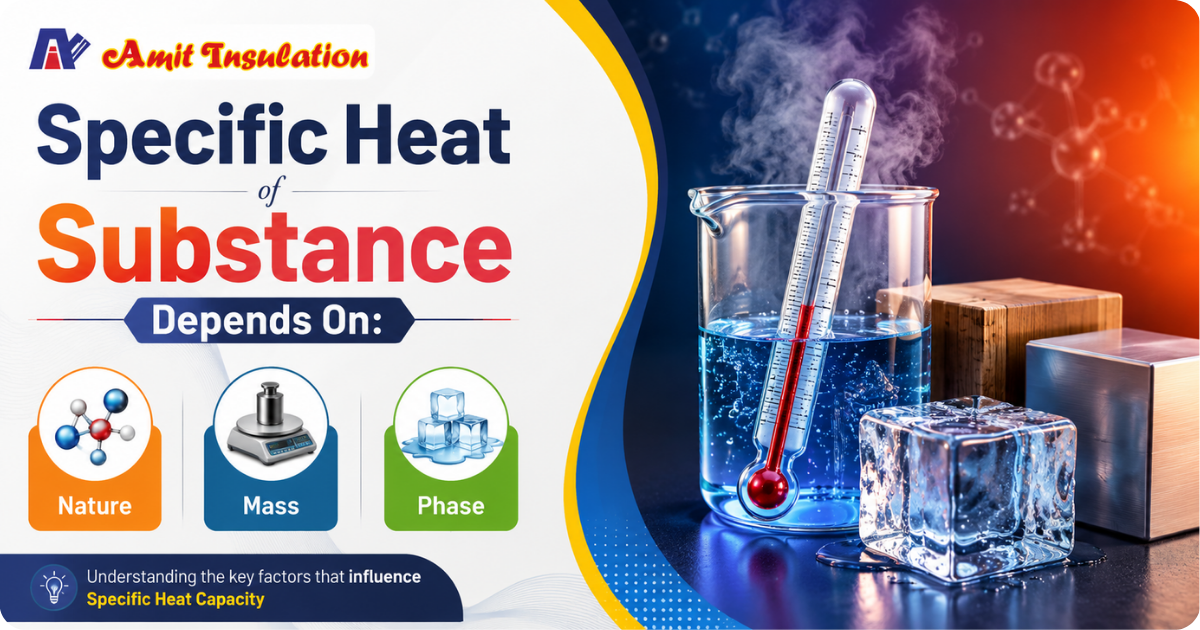
In every boiler, heat exchanger, or process line, temperature control starts with understanding how materials store and release heat. The specific heat of substance depends on its nature, mass, and phase, and these factors directly influence heat load, equipment sizing, and insulation design. In India’s process industries, this knowledge helps engineers, contractors, and facility owners reduce fuel bills, stabilize product quality, and protect equipment. Amit Insulation, an industrial insulation company based in Vadodara, supports these goals by helping industries align material behavior with the right insulation systems. When teams understand what the specific heat of substance depends on, they can make better decisions about process fluids, metals, refractory linings, and insulation thicknesses for pipelines, tanks, and high-temperature equipment.
What is Specific Heat of a Substance?
In thermodynamics, specific heat (or specific heat capacity) is the amount of heat that must be added to one unit mass of a substance to raise its temperature by one degree Celsius at constant pressure. It is usually expressed in kJ/kg·K and is a fundamental property used in heat and mass balance calculations.
This property tells you how “thermally heavy” a substance is. Materials with high specific heat, like water, can absorb large amounts of energy with relatively small temperature changes, while materials with low specific heat heat up and cool down quickly. In industrial systems, this difference affects start-up time, process stability, and the energy required to keep equipment at setpoint.
Mathematically, specific heat appears in the relation Q=m c ΔTQ=mcΔT, where QQ is heat energy, mm is mass, cc is specific heat, and ΔTΔT is temperature change. This basic equation underpins many decisions related to utility sizing, burner capacity, and insulation thickness around process equipment.
What the Specific Heat of Substance Depends On
Nature (Material Type and Structure)
The specific heat of substance depends mainly on the nature or composition of the material. Different substances have different specific heat values because of variations in their molecular or atomic structure and degrees of freedom.
For example, water has a much higher specific heat than many metals, which is why it is widely used as a heating and cooling medium in industrial utilities and process loops. Polyatomic gases and complex molecules typically store more energy per unit mass than simple monatomic gases. This directly affects how quickly media respond to heating and cooling in reactors, heat exchangers, and distribution lines.
Mass of the System
Although specific heat itself is defined per unit mass and is a material property, the total heat transferred in practice depends on the mass of the system. Experiments show that the heat required depends on three factors: the temperature change, the mass of the system, and the material nature.
For engineers, this means that heavier equipment, thicker steel walls, or large volumes of liquid require more energy to reach the same temperature rise. Large storage tanks, long steam lines, and heavy refractory-lined furnaces all exhibit greater thermal inertia. In turn, this affects start-up time, shutdown planning, and energy consumption during transient operation.
Phase and Temperature
The specific heat of substance depends on its phase (solid, liquid, or gas) and can vary with temperature. Water, for instance, has different specific heat values as ice, liquid water, and steam, and these differences are crucial when designing boilers, condensers, and steam distribution systems.
During phase changes such as melting and boiling, substances absorb or release latent heat without changing temperature. In practical terms, this means that significant energy can be stored or released at constant temperature in processes like evaporation, condensation, and solidification. Engineers must consider this behavior when sizing equipment, designing heat recovery, and deciding insulation levels for lines that carry fluids near their phase-change conditions.
Methods in Industrial Systems
Industrial facilities deal with a mix of metals, process fluids, and insulation materials, each with different specific heat values and roles. The table below shows typical values for common materials around insulated systems.
Typical Specific Heat Values in Industrial
These figures are indicative and vary with temperature and product grade, but they show that fluids like water store much more heat per kilogram than metals, and common insulation materials have moderate specific heat but low thermal conductivity.
In design, engineers combine knowledge of specific heat with insulation to manage heat flows. High-specific-heat fluids paired with the right insulation can stabilize temperatures and reduce utility peaks during load changes.
Benefits and Applications
Knowing what the specific heat of substance depends on helps engineers design more efficient and reliable systems across many sectors. It supports better sizing of boilers, chillers, and heat exchangers, and guides insulation selection to minimize losses.
Key benefits and applications include:
- More accurate heat load calculations for process and utility systems
- Optimized start-up and shutdown strategies based on equipment thermal mass
- Improved temperature control in reactors, dryers, kilns, and ovens
- Better design of steam and condensate lines, including insulation thickness
- Reduced risk of condensation, icing, or overheating in insulated lines
Industrial insulation enhances these benefits by cutting unwanted heat gain or loss from high-specific-heat media. Studies indicate that upgraded mechanical insulation can deliver billions of dollars in energy savings annually in industrial and commercial facilities by reducing thermal losses and improving efficiency.
Example Applications Where Specific Heat Matters
| Application Area | Key Medium / Material | Why Specific Heat Matters |
|---|---|---|
| Boiler feedwater systems | Water | Determines energy required to reach steam conditions and benefit from insulation on lines and tanks. |
| Thermal oil heaters | Heat transfer oils | Governs heat storage and response time during load changes. |
| Food and pharma heating | Water, product mix | Affects temperature uniformity and product quality. |
| Power plant steam circuits | Steam, steel | Influences heat-up time and metal temperature gradients. |
| High-temp furnaces | Refractories, steel | Controls start-up energy and cooling rates. |
Comparison Table (Material/Type vs Properties)
Beyond specific heat, engineers must consider thermal conductivity, density, and operating temperature range when designing insulated systems. These properties interact to determine overall heat loss and system behavior.
Material / Type vs Key Thermal Properties
Combining material nature, mass, and phase with these properties gives a realistic picture of how systems will behave thermally. It also helps justify the business case for insulation upgrades in terms of energy savings and equipment protection.
Cost, ROI, and Factors to Consider
When planning insulation and thermal system improvements, understanding what the specific heat of substance depends on supports more accurate cost and ROI estimates. High-specific-heat media and heavy equipment require more energy to heat up, so any reduction in heat loss translates into significant savings over time.
India’s industrial insulation market is growing strongly, reflecting this focus on efficiency. Recent analysis shows that the Indian industrial insulation market generated around USD 266.2 million in 2023 and is projected to reach about USD 465.8 million by 2030, growing at a CAGR of 8.3% between 2024 and 2030. This growth is driven by energy cost pressures, emission reduction targets, and the need to protect personnel and assets.
Key factors to consider in cost and ROI analysis include:
- Fuel and electricity prices
- Operating hours per year
- Temperature difference between process and ambient
- Specific heat and mass of process media and equipment
- Current insulation condition and thickness
- Maintenance and access requirements
Even modest improvements in insulation around systems with high heat capacity can yield attractive payback periods. Independent sources indicate that mechanical insulation upgrades across industrial and commercial facilities could deliver several billion dollars in annual energy savings globally.
You May Also Read:- Steam Pipe Insulation in India — Complete Guide to Materials, Thickness & Industrial Best Practices
How to Choose the Right Approach When Specific Heat Depends on Nature, Mass, Phase
To make practical use of the idea that the specific heat of substance depends on nature, mass, and phase, engineers can follow a structured approach. This involves combining thermodynamic data with real operating and business constraints.
step-by-step way to proceed:
- Identify all key media and materials (water, steam, oils, metals, refractories, insulation) in the system.
- Collect specific heat data for each material over the relevant temperature range, considering phase and potential phase changes.
- Estimate the mass of each component (equipment walls, contents, lining, insulation).
- Calculate heat loads for start-up, steady operation, and shutdown using Q=m c ΔTQ=mcΔT.
- Evaluate current heat losses or gains through surfaces using thermal conductivity and surface area.
- Assess how additional or upgraded insulation will reduce losses and improve temperature stability.
This methodology helps align design decisions with plant priorities like energy cost reduction, throughput, product quality, and safety. It also gives a clear technical basis for investment in insulation projects and heat recovery initiatives.
Future Trends
Looking ahead to 2026 and beyond, the understanding that the specific heat of substance depends on material nature, mass, and phase is being combined with advanced digital tools. For example, recent research explores using machine learning to model Thermal Insulation and predict heat transfer more accurately, improving the design of energy-efficient systems.
Globally, the industrial insulation market is expected to reach around USD 9.2 billion in 2026, driven by stricter energy efficiency regulations, decarbonization efforts, and rising energy prices. In India, continued growth in sectors such as power, chemicals, and food processing will keep demand strong for optimized insulation solutions that are grounded in robust thermal calculations.
We can expect more plants to integrate real-time monitoring of temperatures and heat flows with digital twins that incorporate specific heat data and insulation performance. This will allow teams to continuously optimize operating conditions, reduce emissions, and extend equipment life.
Conclusion
In modern industrial facilities, it is not enough to know that materials get hot or cold. Engineers must understand that the specific heat of substance depends on its nature, mass, and phase, and then apply this knowledge to design efficient, safe, and economical systems. By combining accurate specific heat data with the right insulation, plants across India can cut energy costs, stabilize product quality, and protect both people and equipment. Looking for specific-heat and insulation–related solutions in India? Amit Insulation offers customized thermal insulation products and services for industrial and commercial needs across Gujarat and India. Contact Us Today.
FAQ Section
Q1. What does it mean when we say the specific heat of substance depends on nature?
The specific heat of substance depends on nature in the sense that each material’s molecular or atomic structure determines how much energy is needed to raise its temperature by one degree. Different materials have different specific heat values because of their internal degrees of freedom.
Q2. Does specific heat depend on mass?
Specific heat as a property is defined per unit mass and does not depend on how much of the substance you have. However, the total heat required in a real system does depend on the mass, so larger equipment or fluid volumes require more energy to heat or cool.
Q3. How does phase (solid, liquid, gas) affect specific heat?
The specific heat of substance depends on phase because solids, liquids, and gases have different molecular arrangements and motion. For example, water, ice, and steam all have different specific heat values, which must be considered when designing boilers, condensers, and insulated lines.
Q4. Why is specific heat important for industrial insulation design?
Specific heat indicates how much heat a material or fluid will store or release for a given temperature change, which influences heat loads and surface temperatures. Insulation is then applied to manage these heat flows, reduce losses, and improve energy efficiency and safety.
Q5. What industries benefit most from understanding specific heat?
Industries such as power generation, oil and gas, chemicals, food processing, and pharmaceuticals benefit because they rely heavily on heating and cooling operations. Correctly applying specific heat data leads to better design of boilers, reactors, dryers, and insulated distribution systems.
Q6. How does insulation improve ROI in systems with high-specific-heat media?
In systems that contain high-specific-heat media like water, thermal oils, or heavy refractories, reducing heat loss yields significant long-term savings because large amounts of energy are involved. Upgraded insulation can lower fuel and electricity consumption and often deliver attractive payback periods.
Q7. Are there digital tools that use specific heat data for optimization?
Yes, modern simulation software and emerging machine learning models can incorporate specific heat, thermal conductivity, and other properties to optimize thermal system design and insulation thickness. This helps plants predict performance more accurately and support data-driven investment decisions.