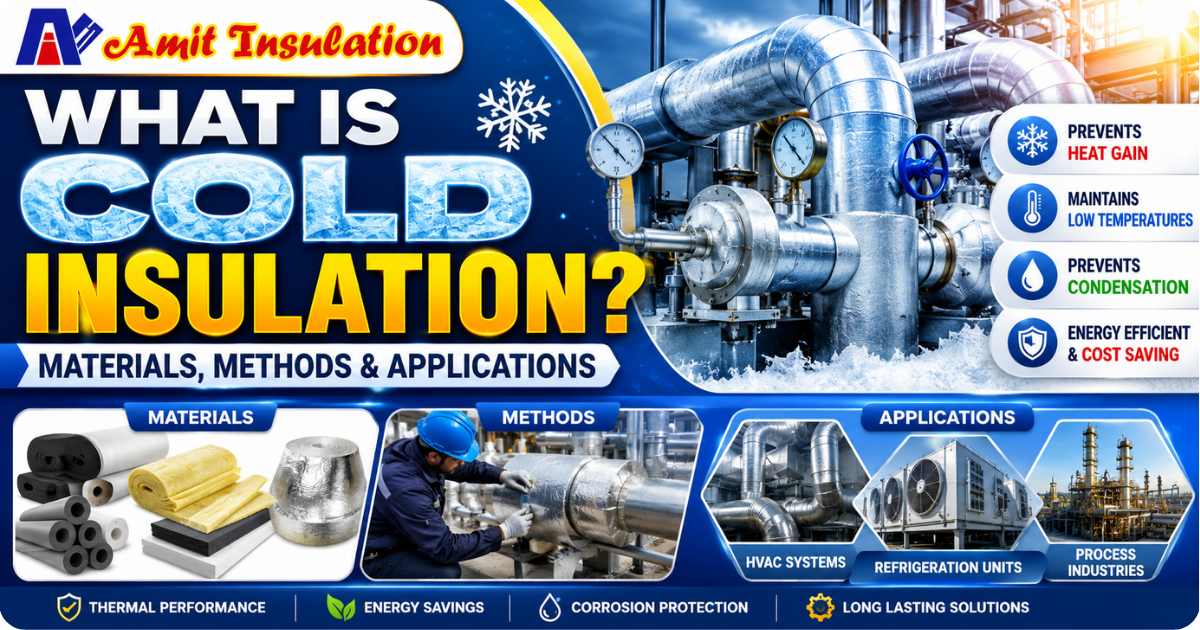
Cold insulation is the system of low-temperature insulating materials, methods and applications used to stop heat from entering pipes, tanks and equipment that operate below ambient temperature — while preventing condensation, ice formation and energy loss. In simple terms, where hot insulation keeps heat in, cold insulation keeps heat out and keeps cold surfaces dry. It is essential anywhere chilled water, refrigerants, LPG/LNG or cryogenic fluids are handled.
Unlike high-temperature insulation, cold insulation must defeat a second enemy besides heat gain: moisture. When a surface drops below the surrounding air’s dew point, water vapour migrates toward it, condenses, and — if it reaches the cold surface — causes dripping, mould, ice build-up and corrosion under insulation (CUI). That is why every correctly engineered cold insulation system pairs a low-conductivity, closed-cell material with a continuous vapour barrier. This guide explains the materials, methods and applications in full, with practical guidance for industrial plants in India.
Why Is Cold Insulation Important?
For industrial operators, cold insulation is not optional — it protects both efficiency and the asset itself. The main benefits are:
- Energy efficiency: Less heat gain means refrigeration and chilling systems work less, cutting power bills in HVAC, cold storage and process cooling.
- Condensation & dripping control: A proper vapour barrier keeps cold surfaces above the dew point, eliminating sweating pipes, wet floors and water-damaged equipment.
- Corrosion (CUI) prevention: Stopping trapped moisture protects carbon-steel and stainless pipework from costly under-insulation corrosion.
- Process stability & safety: Maintaining low temperatures keeps refrigerants, LNG and chemicals within safe operating limits and prevents pressure build-up.
- Lower carbon footprint: Reduced cooling load directly lowers emissions — increasingly important for Indian industries chasing energy and ESG targets.
Cold Insulation vs Hot Insulation: Key Differences
Both control heat flow, but they solve opposite problems. The table below summarises how a cold insulation system differs from a hot one.
| Factor | Cold Insulation | Hot Insulation |
| Main goal | Stop heat gain & condensation | Stop heat loss |
| Temperature | Below ambient (down to cryogenic) | Above ambient (up to ~600°C+) |
| Vapour barrier | Essential (on the warm/outer side) | Usually not required |
| Material structure | Closed-cell, low water absorption | Fibrous or rigid, breathable |
| Typical materials | Nitrile rubber, PUF, PIR, phenolic, cellular glass | Rock wool, glass wool, ceramic wool, calcium silicate |
| Key failure risk | Moisture ingress & CUI | Thermal bridging & heat loss |
What Materials Are Used for Cold Insulation?
The best cold insulation material depends on the operating temperature, exposure and budget. The shared requirement is low thermal conductivity plus low moisture absorption (closed-cell structure). Here are the materials most used on below-ambient systems.
| Material | Approx. temperature range | Key strength | Typical use |
| Elastomeric nitrile rubber | Up to about −50°C | Flexible, built-in vapour resistance | Chilled water, HVAC, refrigeration lines |
| Polyurethane foam (PUF / PUR) | About −180°C to +110°C | Very low conductivity, rigid | Cold storage, LNG, low-temp pipework |
| Phenolic foam | About −180°C to +120°C | Low conductivity, good fire rating | HVAC ducts, chilled-water systems |
| Polyisocyanurate (PIR) | About −180°C to +140°C | Strong, dimensionally stable | Large cold stores, chemical plants |
| Cellular glass | Down to about −260°C | Impermeable, crush-resistant | Cryogenic, LNG, submerged & load-bearing |
| Aerogel blanket | Down to cryogenic | Thinnest profile, hydrophobic | Space-restricted & critical cold lines |
What Are the Methods of Cold Insulation?
A durable cold insulation system is built in layers, each with a job. The correct method (and sequence) matters as much as the material choice.
1. Surface preparation & support
Pipes and vessels are cleaned and, where needed, primed for corrosion protection. Cold shoes/supports are fitted so the insulation is not crushed at hangers.
2. Insulation layering
The insulant is applied as preformed pipe sections, slabs or sheets. For very low temperatures, multi-layer construction with staggered joints prevents thermal bridging and cold leaks.
3. Vapour barrier application
A vapour-retarder (mastic, foil, or factory-applied membrane) is installed on the warm side with all seams sealed — the single most important step in any cold insulation method.
4. Cladding / jacketing
An outer layer of aluminium, stainless steel or GI cladding (or PVC for indoor lines) protects against weather, UV and mechanical damage and gives a clean finish.
Where Is Cold Insulation Applied? (Industries & Applications)
Cold insulation is used wherever below-ambient temperatures must be maintained. In India’s industrial belt — especially Gujarat’s chemical, petrochemical and pharma clusters — demand is driven by process cooling, cold chain and LNG infrastructure.
| Industry / sector | Typical cold insulation application |
| HVAC & building services | Chilled-water pipes, AHU ducts, refrigerant lines |
| Refrigeration & cold storage | Cold rooms, freezer panels, brine & glycol lines |
| Oil, gas & LNG | Cryogenic tanks, LPG/LNG pipework, cold vessels |
| Chemical & petrochemical | Low-temperature reactors, chilled process lines |
| Pharmaceutical & food | Cold-chain storage, process chillers, clean utilities |
| Power & utilities | Condensate, cooling water and chilled service lines |
How to Choose the Right Cold Insulation System
Use these factors as a quick selection checklist:
- Operating temperature — chilled water, refrigeration or cryogenic decides the material.
- Moisture exposure — outdoor or humid areas need stronger vapour barriers and impermeable materials like cellular glass.
- Mechanical load — walkable or load-bearing points need crush-resistant insulants.
- Fire safety — plants with fire codes favour phenolic foam or cellular glass.
- Space — tight pipe racks benefit from thin, high-performance aerogel.
- Lifecycle cost — cheaper material + poor vapour barrier = early failure; engineer the whole system.
Not sure which system fits your plant? Amit Insulation’s hot & cold insulation experts will assess your operating conditions and recommend the right specification.
FAQs About Cold Insulation
1. What is cold insulation in simple terms?
Cold insulation is low-temperature insulation applied to below-ambient pipes, tanks and equipment to stop heat gain and prevent condensation, helping systems stay cold and dry.
2. What is the difference between hot and cold insulation?
Hot insulation keeps heat in (prevents heat loss); cold insulation keeps heat out and prevents condensation. Cold insulation always needs a vapour barrier; hot insulation usually does not.
3. Which material is best for cold insulation?
It depends on temperature: nitrile rubber and phenolic foam for chilled water and HVAC, PUF/PIR for cold storage, and cellular glass or aerogel for cryogenic and LNG service.
4. Why is a vapour barrier necessary in cold insulation?
Below-ambient surfaces draw in water vapour. Without a vapour barrier on the warm side, moisture condenses inside the insulation, causing ice, reduced performance and corrosion under insulation (CUI).
5. What temperature range does cold insulation cover?
From just below ambient (chilled water around 5–10°C) down through refrigeration and into cryogenic temperatures below −100°C for LNG and industrial gases.
6. Does cold insulation save energy?
Yes. By reducing heat gain it lowers the load on chillers and refrigeration systems, cutting electricity use and operating costs while reducing carbon emissions.
7. What is corrosion under insulation (CUI)?
CUI is corrosion of the pipe or vessel caused by moisture trapped under insulation. Closed-cell materials and a sealed vapour barrier are the main defences against it.
8. Can cold insulation be used outdoors?
Yes, but it needs a robust vapour barrier and weatherproof cladding (aluminium, stainless steel or GI) to handle humidity, rain and UV exposure.
9. How thick should cold insulation be?
Thickness is calculated to keep the outer surface above the dew point and prevent condensation; it increases with lower process temperatures and higher ambient humidity.
10. Who provides cold insulation services in India?
Amit Insulation, an ISO 9001:2015-certified contractor in Vadodara, Gujarat, with 30+ years’ experience, provides engineered hot and cold insulation for industrial plants across India.
Conclusion
Cold insulation is far more than wrapping a cold pipe — it is an engineered system of the right material, vapour barrier, method and cladding working together to stop heat gain, prevent condensation and protect equipment from corrosion. Choosing the correct material for your temperature range and pairing it with a flawless vapour barrier is the difference between decades of reliable performance and early, costly failure. For Indian industries running chilled-water, refrigeration, LNG or cryogenic systems, professional design and installation deliver real savings in energy, maintenance and downtime.