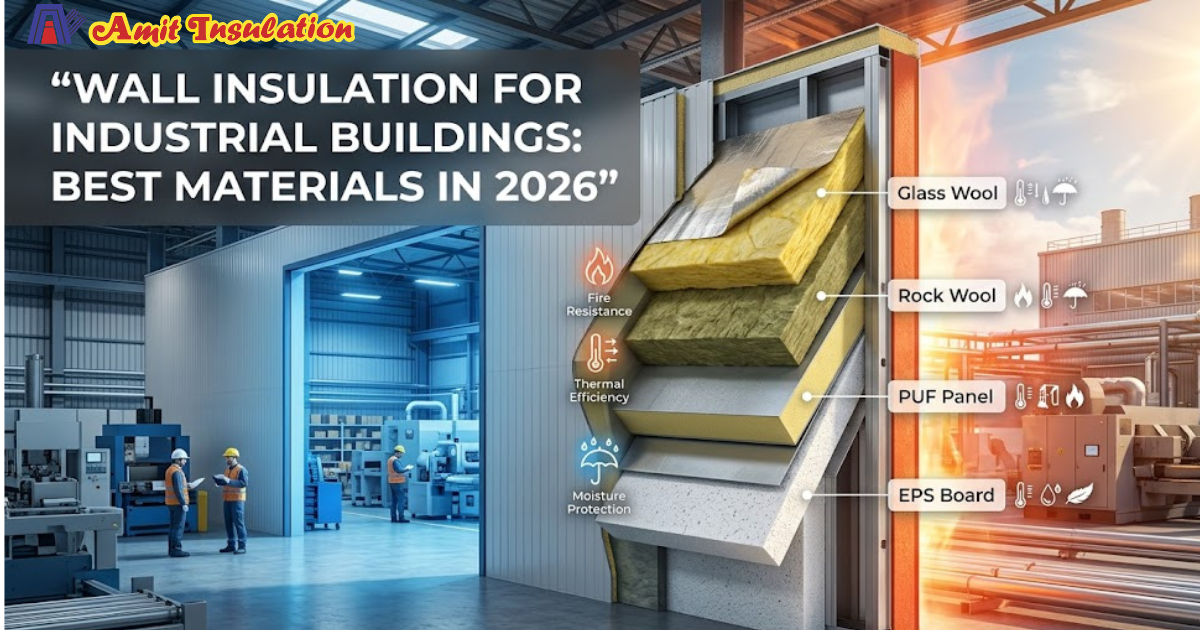
Amit Insulation, a trusted provider based in Vadodara, India, specializes in high-performance solutions for industrial needs. Engineers, contractors, facility owners, and industrial buyers in India face rising energy costs and strict sustainability mandates. Wall Insulation for Industrial Buildings plays a key role in tackling these challenges. It reduces heat loss, lowers electricity bills, and boosts operational efficiency.
In 2026, with India’s industrial sector projected to grow at 7.5% annually (per IBEF data), choosing the right wall insulation becomes essential. Poor insulation can waste up to 30% of a building’s energy, according to the Bureau of Energy Efficiency (BEE). This post breaks down the best materials, their benefits, and installation insights to help you make informed decisions. Whether upgrading existing factories or designing new warehouses, effective wall insulation ensures compliance with green building norms like IGBC ratings. Let’s explore how to select top options for lasting results.
What is Wall Insulation for Industrial Buildings?
Wall insulation for industrial buildings involves materials installed within or on exterior walls to control heat transfer, sound, and moisture.
These systems prevent thermal bridging, where heat escapes through uninsulated areas. In large factories or warehouses, walls cover vast surfaces, making insulation critical for overall energy performance.
Industrial walls endure harsh conditions like vibrations, chemicals, and temperature swings from 5°C to 50°C in India. Quality insulation maintains stable indoor climates, protecting machinery and workers.
Unlike residential setups, industrial wall insulation prioritizes high R-values (thermal resistance) and fire safety. It supports HVAC efficiency, cutting cooling costs by 20-25% in hot regions like Gujarat.
Benefits of Wall Insulation in Industrial Settings
Wall insulation delivers measurable gains in energy savings, cost control, and safety.
First, it slashes energy use. India’s industrial sector consumes 50% of national electricity (BEE 2025 report), with poor walls contributing 15-20% to losses. Insulated walls can recover costs in 2-3 years through reduced bills.
Second, it enhances comfort and productivity. Stable temperatures minimize worker fatigue, boosting output by up to 10% per studies from the National Productivity Council.
Third, it aids compliance. Many states now mandate R-values above 3.5 for new builds under ECBC norms.
Here’s a quick comparison of key benefits:
| Benefit | Impact | Statistic (India 2026 Projection) |
| Energy Savings | Reduces heat loss by 25-40% | ₹5-10 lakh annual savings for 10,000 sqm factory |
| Cost Recovery | Payback in 2-4 years | BEE: 30% ROI on insulation investments |
| Productivity | Improves worker efficiency | 8-12% output gain (NPC data) |
| Compliance | Meets ECBC/IGBC standards | 70% of new industries adopting |
Best Materials for Wall Insulation: Rockwool
Rockwool tops the list for wall insulation in industrial buildings due to its superior fire resistance and durability.
Made from basalt rock and recycled slag, it offers R-values of 3.8-4.2 per inch. It withstands temperatures up to 650°C, ideal for factories with hot processes.
In humid Indian climates, rockwool resists mold and absorbs sound, cutting noise by 40-50 dB. It’s non-combustible, earning Class A1 fire ratings.
Installation uses rigid boards or blankets fixed to metal frames. Density options (80-150 kg/m³) suit heavy-duty walls.
Pros include longevity (50+ years) and eco-friendliness—recyclable with low embodied carbon.
Best Materials for Wall Insulation: Polyurethane (PU) Foam
Polyurethane foam excels in high-performance wall insulation, especially for space-constrained industrial buildings.
Spray-applied PU achieves R-values up to 6.5 per inch, the highest among common materials. Closed-cell variants provide vapor barriers, preventing condensation in monsoon-prone areas.
It bonds seamlessly to concrete or steel walls, eliminating gaps. In 2026, low-GWP (global warming potential) formulations meet India’s Phase 2 refrigerant rules.
A 50mm layer matches 150mm of traditional fiberglass in efficiency. It’s lightweight, reducing structural load.
| Material Property | Rockwool | PU Foam | Fiberglass |
| R-Value per Inch | 4.0 | 6.5 | 3.2 |
| Fire Rating | A1 (Non-combustible) | B2 (Self-extinguishing) | A |
| Density (kg/m³) | 100-150 | 30-40 | 20-50 |
| Cost (₹/sqm, 50mm) | 250-350 | 300-450 | 150-250 |
| Lifespan (Years) | 50+ | 40+ | 30+ |
Best Materials for Wall Insulation: Extruded Polystyrene (XPS)
Extruded polystyrene boards offer robust moisture resistance for wall insulation service in damp industrial environments.
XPS features closed-cell structure, with water absorption under 0.5%. R-value stays at 5.0 per inch even when wet, outperforming open-cell foams.
Common in cold storage warehouses, it handles -20°C to 75°C. Easy to cut and install with adhesives or mechanical fixings on precast walls.
In India, XPS aligns with rising cold chain demands, projected to hit $42 billion by 2026 (IMARC Group).
It’s recyclable and uses hydrofluoroolefin blowing agents for lower environmental impact.
Emerging Materials for Wall Insulation Industrial Buildings
New innovations like aerogel blankets and vacuum insulated panels (VIPs) are gaining traction for wall insulation industrial buildings.
Aerogel, with R-values over 10 per inch, suits thin walls in retrofits. Silica-based, it’s flexible and fire-safe up to 1,200°C.
VIPs achieve R-40 in 25mm thickness via evacuated cores. Though pricier upfront, they cut energy by 50% in high-value facilities.
Bio-based insulators, like mycelium or hemp wool, emerge for sustainable builds. These use agricultural waste, supporting India’s circular economy push.
| Emerging Material | R-Value per Inch | Key Advantage | India Market Growth (2026) |
| Aerogel Blankets | 10+ | Ultra-thin | 25% CAGR (MarketsandMarkets) |
| Vacuum Insulated Panels | 40 (25mm) | Extreme efficiency | Pilot projects in pharma plants |
| Bio-based (Hemp/Mycelium) | 3.5-4.5 | Eco-friendly | 15% adoption in green factories |
You May Also Read – What is Sandblasting? Process, Types & Industrial Uses in India 2026
Wall Insulation Service: Installation Best Practices
Professional wall insulation service ensures maximum performance and longevity.
Start with site assessment: Measure wall area, check for leaks, and test humidity. Use thermal imaging to spot weak points.
Prep involves cleaning surfaces and applying vapor barriers. For metal buildings, add anti-corrosion primers.
Layering matters: Core insulation between studs, faced with foil for reflection. Seal joints with tapes to hit 99% airtightness.
Post-install, verify with blower door tests. In India, hire certified teams compliant with IS 8183 standards.
Common pitfalls: Skipping expansion joints (causes cracks) or under-specifying for seismic zones.
Maintenance and Longevity of Wall Insulation
Regular upkeep extends wall insulation life beyond 40 years.
Inspect annually for damage from rodents, impacts, or settling. Clean debris to avoid moisture traps.
Monitor R-value degradation—under 5% annually for quality materials. Infrared scans detect issues early.
Repairs are simple: Patch PU foam with spray kits; replace rockwool sections. Budget 1-2% of install cost yearly.
Data shows maintained systems save 15% more energy over a decade.
Future Trends in Wall Insulation (2026 Focus)
By 2026, smart and green tech will redefine wall insulation for industrial buildings. Phase-change materials (PCMs) embedded in walls store/release heat, stabilizing temps without extra energy. Expect 20% adoption in smart factories. Nanotech coatings boost R-values by 30% while self-cleaning. India’s market for advanced insulators hits ₹15,000 crore (Grand View Research projection).
Digital twins simulate insulation performance pre-install. Recycled-content mandates rise under Plastic Waste Rules. Hybrid systems combining PU with rockwool optimize cost-performance. Sustainability certifications like GRIHA drive 40% of new projects.
Conclusion
Wall insulation for industrial buildings remains a smart investment in 2026, delivering energy savings, compliance, and efficiency amid India’s industrial boom. From rockwool’s fireproof reliability to PU’s high R-values and emerging aerogels, the right materials match your facility’s needs. Pair them with expert wall insulation service for optimal results.
Facility owners and engineers benefit from lower costs—up to 30% energy cuts—and enhanced durability. Act now to future-proof your operations. Looking for wall insulation for industrial buildings in India? Amit Insulation offers customized wall insulation service for industrial and commercial needs across Gujarat and India.
FAQ
What is the best material for wall insulation in industrial buildings?
Rockwool and PU foam lead due to high R-values (4-6.5 per inch) and fire resistance. Choose based on budget and conditions—rockwool for fire-prone areas, PU for efficiency.
How much does wall insulation cost for industrial buildings in India?
Expect ₹200-500 per sqm for materials and install (2026 rates). A 5,000 sqm factory costs ₹10-25 lakh, with 2-3 year payback via energy savings.
What are the benefits of wall insulation service for factories?
It cuts energy bills by 25%, improves comfort, and ensures ECBC compliance. Professional service prevents gaps, maximizing ROI.
How to choose wall insulation for high-humidity areas like Gujarat?
Opt for moisture-resistant options like XPS or closed-cell PU. Add vapor barriers to keep absorption below 1%.
What R-value is needed for industrial wall insulation in India?
Aim for R-3.5 to R-5 per ECBC norms for most zones. Hot climates need R-4+; verify with BEE calculators.
Are there sustainable options for wall insulation in 2026?
Yes, bio-based like hemp wool and recycled rockwool. Aerogels and PCMs offer low-carbon alternatives with 30% better efficiency.
How long does industrial wall insulation last?
Quality installs last 30-50 years with maintenance. Regular checks prevent 80% of failures.