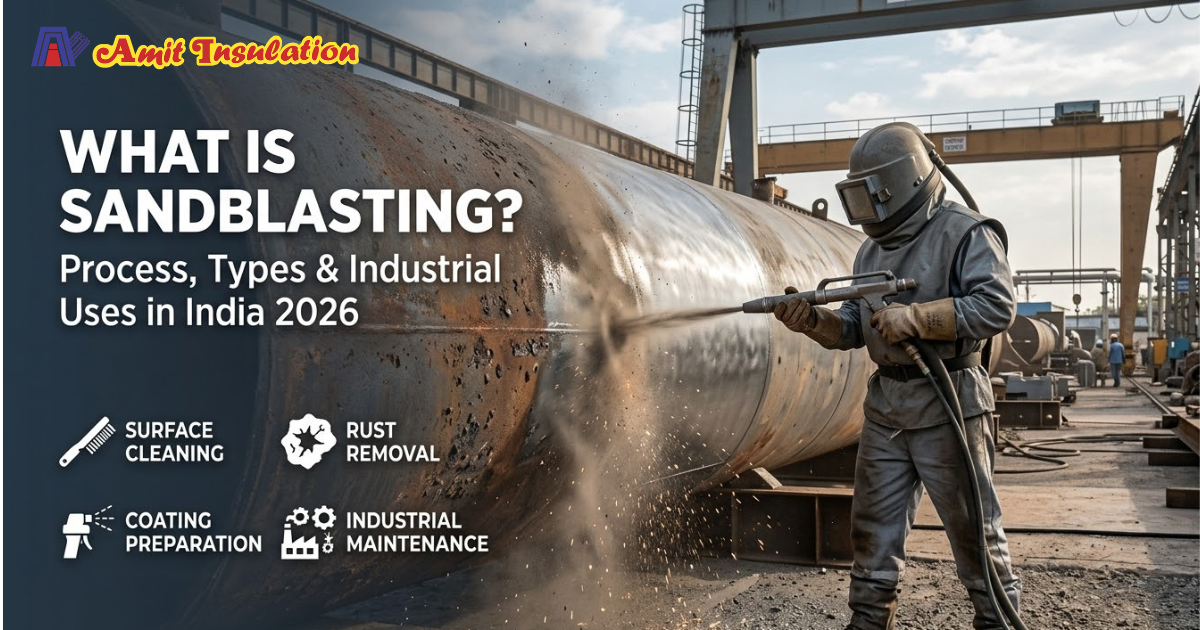
Amit Insulation, a leading industrial insulation company based in Vadodara, India, supports surface preparation needs across manufacturing sectors. The Sandblasting Process India has evolved into a vital technique for cleaning and prepping surfaces before insulation application. This method removes rust, old coatings, and contaminants efficiently, ensuring strong adhesion for insulation materials.
Engineers, contractors, facility owners, and industrial buyers rely on it for durability in harsh environments. With India’s industrial growth—projected to hit $1 trillion by 2026 per NITI Aayog—demand surges in sectors like oil & gas, automotive, and power plants. This guide breaks down the sandblasting process in India, its types, steps, and key uses. You’ll learn how it enhances sandblasting Insulation projects, boosting longevity and safety.
What is Sandblasting?
Sandblasting strips away unwanted materials from surfaces using high-pressure abrasive media. It creates a clean, profiled base ideal for coatings or insulation.
Originally called “sandblasting” for using sand, modern versions employ safer abrasives like garnet or glass beads to avoid health risks. In India, it’s regulated under OSHA-like guidelines from the Directorate General Factory Advice Service.
The process propels media at 60-120 psi, etching surfaces at speeds up to 200 feet per second. India’s market for surface treatment, including sandblasting, reached $2.5 billion in 2025, growing at 8.5% CAGR per Mordor Intelligence.
Facilities use it for metal, concrete, and composites, preparing them for protective layers.
The Sandblasting Process Step-by-Step
The sandblasting process follows a structured sequence for safety and efficiency. First, assess the surface: inspect for contaminants like rust or paint. Select media based on material—fine for soft metals, coarse for heavy rust.
Setup involves a blast pot, compressor, and nozzle. Operators wear PPE: helmets, suits, and respirators. Blasting occurs in controlled bursts, moving the nozzle 6-12 inches from the surface at 45-90 degrees.
Post-blast, vacuum debris and inspect profile depth (1-3 mils typical).
| Step | Description | Key Equipment | Time Estimate (per 100 sq ft) |
| 1. Surface Assessment | Identify rust, scale, coatings | Inspection tools | 10-15 mins |
| 2. Media Selection & Setup | Choose abrasive, load pot | Blast pot, compressor | 20-30 mins |
| 3. Blasting | Propel media at high pressure | Nozzle (1/4-1/2 inch) | 30-60 mins |
| 4. Cleanup & Inspection | Remove residue, measure profile | Vacuum, profilometer | 15-20 mins |
Types of Sandblasting Techniques
Sandblasting comes in several types, each suited to specific industrial needs. Dry blasting uses compressed air without water—fast for large areas but dusty. Wet blasting adds water to suppress dust, ideal for indoor sites.
Vacuum blasting recaptures media, eco-friendly for tight spaces. Wheelabrator (centrifugal) spins wheels for high-volume jobs.In India, dry abrasive blasting dominates 65% of applications per IBISWorld data.
| Type | Media Used | Best For | Dust Level | Speed |
| Dry Abrasive | Garnet, steel grit | Outdoor metal prep | High | Fastest |
| Wet Slurry | Glass beads + water | Indoor, sensitive surfaces | Low | Medium |
| Vacuum | Recycled garnet | Confined spaces | Very Low | Slow |
| Wheelabrator | Steel shot | Heavy fabrication | Medium | Very Fast |
Choose based on project scale and environment.
Benefits of Sandblasting for Industrial Applications
Sandblasting delivers superior surface prep, extending asset life by 2-3x.
It removes 99% of contaminants, per ASTM D4417 standards, ensuring coatings adhere without failures.
Cost savings hit 20-30% long-term by preventing corrosion—critical in India’s humid coastal plants.
Uniform profiles improve insulation bonding, reducing thermal bridging.
Safety improves: profiled surfaces prevent slips on wet coatings.
Environmentally, recyclable media cuts waste by 70% versus chemical stripping.
Engineers value its versatility across substrates.
You May Also Read – Top Scaffolding Materials 2026: Trends, Types & Innovations
Sandblasting Process India: Key Equipment and Safety
In the sandblasting process India, equipment reliability drives results.
Core gear includes air compressors (100-200 CFM), blast pots (150-300 lb capacity), and nozzles (tungsten carbide for longevity).
Hoses withstand 400 psi; moisture separators prevent clogs.
Safety protocols mandate blast rooms with ventilation (500 CFM exhaust).
India’s Factories Act 1948 requires NIOSH-approved respirators; silica exposure limits at 0.05 mg/m³.
Training via certified sandblasting service providers ensures compliance.
| Equipment | Purpose | Capacity Specs | Maintenance Tip |
| Compressor | Powers air stream | 185 CFM @ 125 psi | Daily oil check |
| Blast Pot | Holds media | 200 lb deadweight | Weekly valve clean |
| Nozzle | Directs blast | 3/8 inch venturi | Replace every 50 hrs |
| PPE Suit | Protects operator | Full coverage | Inspect seals daily |
Proper setup minimizes risks in high-volume ops.
Industrial Uses of Sandblasting in India
India’s industries leverage sandblasting for maintenance and fabrication.
Oil & gas pipelines get prepped for anti-corrosion coatings, handling 1.2 million km network.
Power plants blast boiler tubes, extending life amid 450 GW capacity growth by 2026.
Automotive sector cleans chassis; shipyards treat hulls in Mumbai and Chennai ports.
For sandblasting insulation, it profiles pipes and tanks before applying rockwool or foam—vital for refineries.
Construction uses it on bridges, like those under Bharatmala project.
Steel mills blast slabs, supporting 120 MT production.
You may also read: [Thermal Insulation for Pipes in Industrial Plants]
Future Trends in Sandblasting (2026 Focus)
By 2026, India’s sandblasting process India will integrate automation and green tech.
Robotic blasters, like those from global adopters, cut labor 40%—pilots in Gujarat plants.
Eco-abrasives like walnut shells rise, reducing silica bans impact.
AI monitors blast profiles in real-time via sensors.
Market to grow 9.2% CAGR to $3.2 billion, per Mordor Intelligence, driven by renewables.
Wet/dry hybrid systems dominate for dust-free sandblasting services.
Digital twins simulate jobs, optimizing media use.
Conclusion
The sandblasting process in India remains essential for robust industrial prep, from pipelines to power infrastructure. Its types—dry, wet, vacuum—offer flexibility, while benefits like cost savings and safety propel adoption. With equipment advancements and safety standards, it supports India’s manufacturing boom.
Looking ahead to 2026, automation and sustainability will redefine efficiency. For contractors and engineers, mastering this process ensures project success. Looking for sandblasting process solutions in India? Amit Insulation offers customized sandblasting insulation services for industrial and commercial needs across Gujarat and India.
FAQ
What is the sandblasting process in India?
The sandblasting process in India involves propelling abrasive media at high pressure to clean and profile surfaces. It’s widely used in manufacturing for rust removal and coating prep, following local safety norms.
What are the main types of sandblasting services?
Key types include dry abrasive, wet slurry, vacuum, and wheelabrator blasting. Each suits different environments, with wet options preferred for low-dust indoor sandblasting services.
Why is sandblasting used before insulation?
Sandblasting insulation prep creates a rough profile for better adhesion. It removes contaminants, preventing failures in thermal systems like pipes and tanks.
What equipment is needed for sandblasting in India?
Essential gear includes compressors, blast pots, nozzles, and PPE. Capacities range from 100 CFM compressors for small jobs to 300 lb pots for industrial scales.
Is sandblasting safe for industrial use?
Yes, with proper PPE and ventilation. India’s regulations limit silica dust; modern abrasives enhance safety in sandblasting services.
What are the 2026 trends in India’s sandblasting process India?
Trends include robotic automation, AI monitoring, and eco-media. The market eyes 9% growth, focusing on sustainable practices.