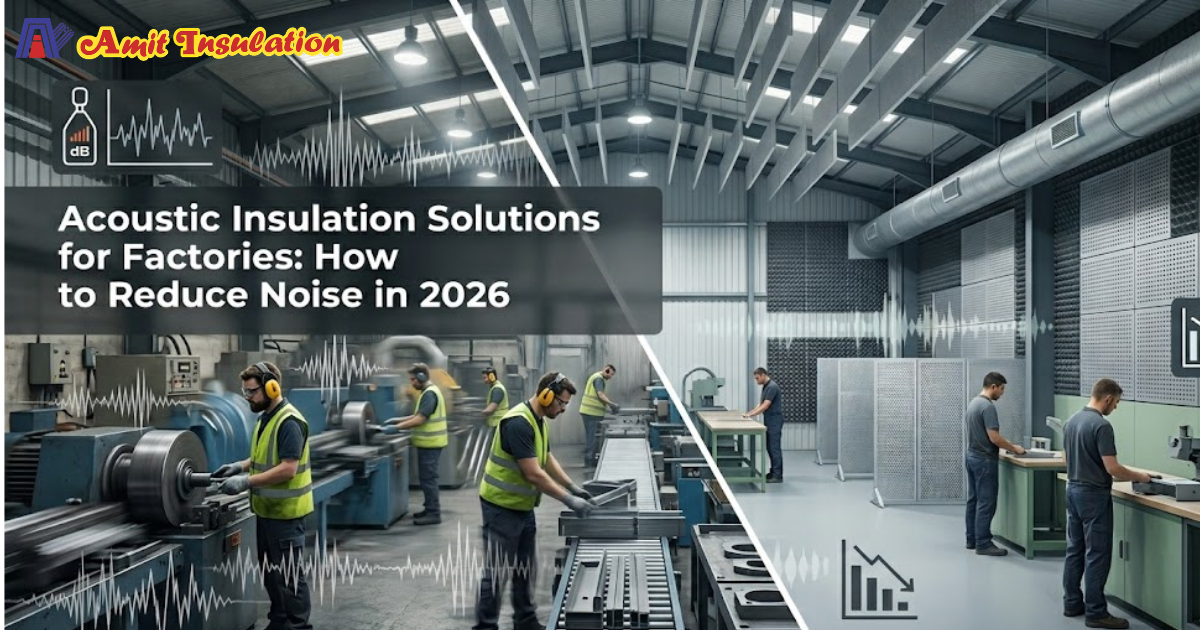
Amit Insulation, a trusted industrial insulation company based in Vadodara, India, specializes in high-performance solutions for manufacturing environments. Factories in India generate excessive noise from machinery, impacting worker health and productivity. Acoustic Insulation Solutions address this by absorbing sound waves and creating quieter workspaces.
According to the World Health Organization, noise above 85 dB harms hearing and raises stress levels. In 2025, India’s industrial sector reported over 30% of workers exposed to hazardous noise, per Ministry of Labour data. This blog explores proven acoustic insulation solutions for factories. It covers essentials, benefits, types, installation, costs, case studies, and 2026 trends.
Engineers and facility owners can implement these strategies to meet OSHA-equivalent standards in India, like the Factories Act noise limits of 90 dB. Reduce downtime, boost efficiency, and ensure compliance with targeted acoustic insulation solutions.
What is Acoustic Insulation?
Acoustic insulation refers to materials designed to block, absorb, or dampen sound waves in industrial settings. Unlike thermal insulation, which focuses on heat, acoustic versions target noise frequencies from 125 Hz to 8,000 Hz common in factories. These solutions use porous structures that trap sound energy, converting it to heat.
Factories benefit from reduced reverberation, where sound bounces off hard surfaces like metal walls. Key properties include Noise Reduction Coefficient (NRC) ratings from 0 to 1—higher means better absorption.
In India, demand for acoustic insulation solutions has grown 12% yearly, driven by expanding manufacturing hubs in Gujarat and Maharashtra. Materials like fiberglass, rockwool, and foam meet IS 818 standards for fire safety. Selecting the right type prevents echo in large halls with punch presses or compressors.
Benefits of Acoustic Insulation Solutions in Factories
Acoustic insulation solutions improve safety and operations in high-noise environments.
Workers exposed to chronic noise face 20-30% higher injury risks due to reduced concentration, per a 2024 ILO report.
Implementing these solutions lowers noise by up to 50 dB, enhancing focus and cutting errors.
Productivity rises as quieter spaces reduce fatigue—studies show 15% output gains in insulated plants.
Compliance with India’s Noise Pollution Rules, 2000, avoids fines up to ₹1 lakh.
Energy savings occur too, as less HVAC strain in controlled acoustic environments.
Facility owners report 25% fewer absenteeism days post-installation.
These benefits make acoustic insulation solutions essential for modern factories.
Types of Acoustic Insulation Materials
Factories require versatile acoustic insulation materials suited to vibrations and humidity.
Here’s a comparison of common types:
| Material | NRC Rating | Fire Rating | Best For | Cost per sqm (INR) |
| Fiberglass Panels | 0.85-0.95 | Class A | Walls/Ceilings | 500-800 |
| Rockwool Blankets | 0.90-1.00 | Non-combustible | Machinery Enclosures | 600-900 |
| Acoustic Foam | 0.70-0.90 | Class B | Ducts/Floors | 400-700 |
| Mass-Loaded Vinyl (MLV) | 0.50-0.70 (barrier) | Class A | Barriers/Doors | 700-1,200 |
Fiberglass excels in absorption for open areas.
Rockwool handles high temperatures near furnaces.
Foam offers flexibility for irregular shapes.
MLV blocks transmission through partitions.
Choose based on factory layout—combine for optimal results.
An acoustic insulation solutions supplier in India ensures material compatibility with local conditions like dust.
Installation Guide for Acoustic Insulation in Factories
Proper installation maximizes acoustic insulation effectiveness. Start with a noise audit using sound level meters to identify hotspots. Prepare surfaces: clean metal walls and seal gaps.
For walls, fix panels with adhesives or clips, overlapping edges. Ceiling baffles hang via wires for overhead absorption. Enclose noisy machines in booths lined with 50-100 mm thick material. Use mechanical fasteners in vibration zones to prevent loosening. Test post-installation with decibel readings. Common pitfalls: ignoring HVAC ducts, which amplify noise. Hire certified installers for compliance. This process typically takes 2-5 days for a 5,000 sqm factory.
Cost Analysis of Acoustic Insulation Solutions
Budgeting for acoustic insulation solutions involves upfront and long-term savings. Average costs in India range from ₹400-1,200 per sqm, depending on material and thickness.
Here’s a breakdown for a mid-sized factory (10,000 sqm):
| Component | Area Coverage | Unit Cost (INR/sqm) | Total Cost (INR) |
| Wall Panels | 6,000 sqm | 600 | 36,00,000 |
| Ceiling Baffles | 2,000 sqm | 800 | 16,00,000 |
| Machine Enclosures | 1,000 sqm | 900 | 9,00,000 |
| Labor & Audit | – | – | 10,00,000 |
| Total | 9,000 sqm | – | 71,00,000 |
ROI appears in 2-3 years via 15-20% productivity gains and lower health claims. Government incentives under MSME schemes can offset 20-30% costs.
Compare quotes from acoustic insulation solutions suppliers in India for best value. Thicker materials (75 mm+) yield higher NRC but increase costs by 30%.
Case Studies: Real Results from Acoustic Insulation
Real-world applications prove acoustic insulation solutions’ impact.
In a Gujarat textile mill, rockwool panels reduced compressor noise from 105 dB to 72 dB.
Workers reported 18% less fatigue; output rose 12% within months.
A Maharashtra auto parts factory used fiberglass and MLV on assembly lines.
Noise dropped 40 dB, passing state inspections and cutting rework by 22%.
In an electronics plant near Vadodara, foam baffles tamed fan noise to 65 dB.
Annual savings hit ₹5 lakhs from reduced turnover.
These cases show 30-50% noise cuts across sectors like pharma and food processing.
Data from 2024 Indian factory retrofits confirms consistent gains.
You May Also Read – Wall Insulation for Industrial Buildings: Best Materials in 2026
Maintenance and Longevity of Acoustic Insulation
Acoustic insulation demands regular upkeep for sustained performance.
Inspect quarterly for dust buildup, which lowers NRC by 20%.
Vacuum porous surfaces; avoid water jets on fiberglass.
Replace damaged sections in high-traffic zones every 5-7 years.
Rockwool lasts 15+ years in dry conditions.
Monitor via annual sound tests to track degradation.
In humid Indian factories, use anti-microbial coatings to prevent mold.
Proper care extends life by 50%, per industry benchmarks.
Train staff on handling to avoid tears.
This ensures ongoing compliance and efficiency.
Acoustic Insulation Solutions: Compliance and Regulations in India
Acoustic Insulation Solutions and Indian Standards
Navigating regulations is key for factories adopting acoustic insulation solutions. The Factories Act, 1948, mandates noise below 90 dB for 8-hour shifts. Noise Pollution (Regulation) Rules, 2000, limit industrial zones to 75 dB daytime.
IS 4750 and IS 818 guide material selection for absorption and fire resistance. CPCB audits enforce penalties up to ₹10 lakhs for violations. Acoustic insulation solutions suppliers in India provide certified products meeting these. Integrate with ISO 45001 for occupational health. Annual compliance saves legal hassles.
Future Trends in Acoustic Insulation for 2026
2026 brings smart, sustainable acoustic insulation innovations.
MarketsandMarkets predicts a 9.5% CAGR for global acoustic insulation to $25 billion by 2030, with India at 11% growth.
Trends include:
- Smart Sensors: IoT-integrated panels monitor noise in real-time, alerting via apps.
- Bio-Based Materials: Recycled denim or mycelium foams cut carbon footprint by 40%.
- Nanotech Enhancers: Aerogels boost NRC to 0.99 at half thickness.
- 3D-Printed Panels: Custom-fit for machinery, reducing install time 30%.
In India, Gujarat’s green manufacturing push will drive adoption. Expect hybrid thermal-acoustic solutions for dual efficiency. Factories preparing now gain competitive edges.
Conclusion
Amit Insulation, Acoustic insulation solutions transform noisy factories into productive, safe spaces. From understanding types and installation to embracing 2026 trends like smart materials, these strategies deliver measurable results.
Indian manufacturers face rising noise regulations and worker demands—address them proactively. Reduce noise, enhance compliance, and boost output with proven methods. Data shows 20-50% improvements in health and efficiency.
FAQ
What are the best acoustic insulation solutions for factories?
Acoustic insulation solutions like rockwool and fiberglass panels absorb noise effectively. They suit machinery enclosures and walls, achieving NRC ratings over 0.85 for 30-50 dB reductions.
How much does acoustic insulation cost for Indian factories?
Costs range ₹400-1,200 per sqm. A 10,000 sqm factory budgets ₹70-80 lakhs total, with ROI in 2-3 years from productivity gains.
What materials make effective acoustic insulation solutions?
Fiberglass, rockwool, acoustic foam, and MLV lead options. Rockwool excels for high-heat areas; foam for flexibility. Choose per NRC and fire ratings.
How to install acoustic insulation in a factory?
Conduct a noise audit, prepare surfaces, fix panels with clips/adhesives, and test levels. Pros handle 5,000 sqm in 3-5 days.
Why choose an acoustic insulation solutions supplier in India?
Local suppliers ensure IS-compliant materials, quick delivery, and humidity-resistant options. They cut logistics costs by 20-30% versus imports.
What are 2026 trends in acoustic insulation for factories?
Smart IoT sensors, bio-based foams, and nanotech aerogels dominate. India’s market grows 11% yearly, focusing on sustainability.
Does acoustic insulation improve factory productivity?
Yes, quieter spaces reduce errors by 15-20% and absenteeism by 25%, per ILO data. Compliance avoids fines too.