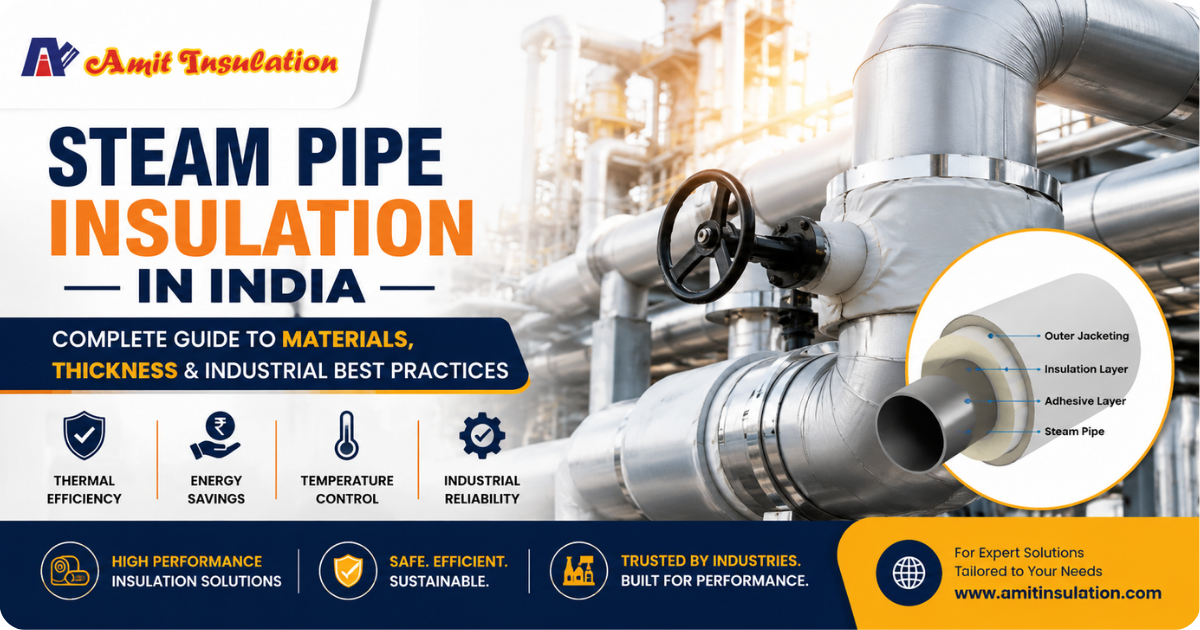
Steam is the lifeblood of Indian industry — from refineries and power stations to pharmaceutical plants and food processing units. But every metre of uninsulated steam pipe is a metre of energy hemorrhaging into the air. Studies consistently show that proper steam pipe insulation can reduce heat losses by up to 90%, delivering a payback period measured in months, not years. Yet insulation failures, incorrect material selection, and inadequate thickness specification remain common — and costly — on Indian industrial sites. This guide covers everything you need to know about steam pipe insulation in India: the right materials, the correct thickness, applicable Indian standards, and the full-scope industrial expertise that Amit Insulation — Vadodara’s most trusted insulation contractor with 30+ years of experience — brings to every project.
What Is Steam Pipe Insulation and Why Does It Matter?
Steam pipe insulation is the application of thermal insulating materials around steam-carrying pipes to minimize heat loss from the hot steam to the surrounding environment. In industrial settings — refineries, chemical plants, power generation facilities, food processing units, and pharmaceutical factories — steam is used for heating, sterilization, process reactions, and power generation. Keeping steam at the right temperature and pressure from the boiler to the point of use is fundamental to plant efficiency and safety.
According to the Bureau of Energy Efficiency (BEE), India, insulation is one of the most cost-effective energy conservation measures available to industrial plants. Any surface operating above 50°C should ideally be insulated, and steam lines — which typically operate between 120°C and 400°C depending on pressure — are among the highest-priority targets.
The consequences of inadequate or deteriorating steam pipe insulation are severe:
- Massive heat energy loss, raising fuel consumption and carbon emissions
- Pressure drop along the steam distribution network, reducing plant efficiency
- Increased condensate formation inside steam lines, causing water hammer and pipe damage
- Burn risk to personnel working near hot, uninsulated surfaces
- Higher maintenance costs from accelerated thermal cycling of uninsulated metalwork
Key Fact: The US Department of Energy states that steam pipe insulation can typically reduce energy losses by 90%. On a typical Indian industrial boiler plant generating 10 tonnes per hour of steam, even a 10% improvement in steam distribution efficiency can save tens of lakhs of rupees annually in fuel costs.
Insulation Materials Used for Steam Pipes in India
Selecting the right insulation material for a steam pipe is not a one-size-fits-all decision. The choice depends on the operating temperature, pipe location (indoor vs. outdoor), mechanical load considerations, fire safety requirements, and budget. The following table covers the primary materials used for industrial steam pipe insulation in India.
| Material | Max Temp. (°C) | Thermal Conductivity | Key Properties | Typical Steam Application |
|---|---|---|---|---|
| Mineral Wool (Rockwool) | Up to 750°C | ~0.033–0.046 W/m·K | Non-combustible, excellent fire rating, good sound absorption, resists vibration | Low, medium & high-pressure steam lines; steam headers; boiler insulation |
| Glass Wool (Fiberglass) | Up to 350°C | ~0.030–0.042 W/m·K | Light weight, low cost, easy to install, non-combustible | Low-pressure steam lines, condensate return pipes, utility steam |
| Calcium Silicate | Up to 650°C | ~0.055–0.100 W/m·K | High compressive strength, dimensionally stable, suitable for hot environment, load-bearing | High-temperature / high-pressure steam; steam lines in petrochemical & power plants |
| Ceramic Fiber | Up to 1,260°C | ~0.10–0.25 W/m·K (at high temps) | Extremely high-temperature capability, lightweight, low thermal mass | Super-heated steam; furnace connections; high-temp steam vent lines |
| Expanded Perlite | Up to 870°C | ~0.05–0.08 W/m·K | Inorganic, fire-safe, low moisture absorption, stable at very high temps | High-temperature industrial steam pipework in refineries and power stations |
| Polyurethane Foam (PUF) | Up to ~120°C | ~0.022–0.028 W/m·K | Excellent low-temp insulation, closed-cell, low moisture absorption | Condensate return lines; low-temp utility steam; pre-insulated pipe systems |
Material selection for steam pipe insulation should be confirmed by a qualified insulation engineer against the specific operating temperature, pressure class, and site conditions. Amit Insulation provides material selection guidance as part of its project scoping service.
For the vast majority of industrial steam pipe insulation projects in India — refineries, chemical plants, power stations, and utilities — mineral wool (rockwool) and calcium silicate are the go-to materials. Mineral wool offers the best all-round combination of fire safety, temperature capability, ease of handling, and cost for steam lines in the 150–500°C range. Calcium silicate is preferred where mechanical loading, personnel traffic on insulation, or very high temperatures demand greater compressive strength.
Related Service from Amit Insulation:
→ Hot & Cold Insulation Services — Complete hot pipe insulation for steam, hot oil, and process lines
→ Thermal & Acoustic Insulation — Combined energy and noise control solutions
→ Pipe, Slab, Wall & Deck Insulation — Full-scope insulation contracting
Steam Pipe Insulation Thickness — Reference Guide for Indian Projects
One of the most common questions on any insulation project is: how thick does the insulation need to be? For steam pipe insulation thickness, the answer depends on the operating temperature, the pipe outer diameter, the insulation material’s thermal conductivity, the ambient temperature, and the target heat loss or surface temperature limit.
In India, insulation thickness for industrial pipework is governed by IS 14164:2008 — the Bureau of Indian Standards code for “Industrial Application and Finishing of Thermal Insulation for Equipment and Pipes.” This standard covers temperatures from -80°C to 750°C and sets out the methodology for calculating economic insulation thickness based on heat loss, energy cost, and material properties.
The table below provides a practical reference for steam pipe insulation thickness under typical Indian industrial conditions, using mineral wool as the base material (k ≈ 0.040 W/m·K at mean temperature), assuming indoor installation and ambient temperature of approximately 35°C.
| Steam Pressure Class | Operating Temp. (°C) | Pipe NB 25 mm (1″) | Pipe NB 50 mm (2″) | Pipe NB 100 mm (4″) | Pipe NB 200 mm (8″) |
|---|---|---|---|---|---|
| Low Pressure (≤ 3.5 bar) | ~120–135°C | 40 mm | 50 mm | 50 mm | 65 mm |
| Medium Pressure (3.5–10 bar) | ~145–180°C | 50 mm | 65 mm | 75 mm | 75 mm |
| High Pressure (10–40 bar) | ~180–250°C | 65 mm | 75 mm | 100 mm | 100 mm |
| Very High Pressure / Superheat (40+ bar) | 250–400°C+ | 75 mm | 100 mm | 100–125 mm | 125 mm |
| Condensate Return Lines | ~80–100°C | 25 mm | 38 mm | 40 mm | 50 mm |
Important: Outdoor steam pipe insulation always requires an additional protective cladding layer — typically 0.5–0.8 mm aluminum sheet or GI sheet — to protect the insulation from rain, UV degradation, and mechanical damage. The cladding does not contribute significantly to thermal performance but is critical for long-term system durability.
Indian Standards and Codes for Steam Pipe Insulation
Industrial steam pipe insulation in India must comply with a set of national and international standards that govern material quality, installation practices, and performance requirements. Compliance with these standards is typically mandatory for public sector projects, refineries, power plants, and EPC contracts.
IS 14164:2008 — The Primary Indian Standard
IS 14164:2008 published by the Bureau of Indian Standards (BIS) is the definitive Indian code of practice for “Industrial Application and Finishing of Thermal Insulation for Equipment and Pipes.” It covers the insulation of surfaces at temperatures from -80°C to 750°C — encompassing the full range of steam pipe operating conditions found in Indian industry. The standard addresses design methodology, material selection, installation practices, cladding, and surface finish requirements, and is harmonized with BS 5970:2001 for international compatibility.
Material Standards
The materials used for steam pipe insulation must individually comply with their respective BIS or equivalent standards. Common material standards referenced in Indian industrial projects include IS 8183 (bonded mineral wool), IS 9428/ASTM C533 (calcium silicate insulation), IS 12436 (glass wool products), and IS 15399 (ceramic fiber products). Insulation contractors are expected to hold and present test certificates on representative material samples.
Energy Conservation Context
Steam pipe insulation in India is also governed by broader energy policy through the Energy Conservation Act, 2001 and the Bureau of Energy Efficiency’s Perform, Achieve and Trade (PAT) scheme, which creates compliance obligations for energy-intensive industries. Proper pipe insulation directly reduces Specific Energy Consumption (SEC), a key metric under PAT, making it simultaneously a compliance measure and a cost-saving investment.
Industrial Steam Pipe Insulation — Sector-by-Sector Applications in India
Steam is used across virtually every segment of Indian industry. The following table maps the most important sectors, their steam system characteristics, and the insulation requirements that apply — illustrating the breadth of industrial steam pipe insulation work that experienced contractors like Amit Insulation handle.
| Industry Sector | Steam Use | Typical Pressure / Temp | Recommended Insulation Material | Key Insulation Requirement |
|---|---|---|---|---|
| Oil Refinery / Petrochemical | Process heating, stripping, tracing, steam turbines | High: 40–100 bar / 250–400°C+ | Calcium silicate, mineral wool | High-temp stability, fire rating, personnel protection |
| Power Generation | Turbine steam, boiler headers, condensate | Very high: 100+ bar / 400–600°C | Calcium silicate, ceramic fiber, mineral wool | Superheated steam tolerance, dimensional stability under load |
| Chemical & Fertilizer Plants | Reactor heating, distillation, heat exchangers | Medium-high: 10–40 bar / 180–250°C | Mineral wool, calcium silicate | Chemical resistance, IS 14164 compliance, corrosion protection |
| Pharmaceutical Manufacturing | Sterilization (autoclaves), clean steam, WFI heating | Low-medium: 3–10 bar / 135–180°C | Mineral wool, glass wool with SS cladding | GMP compliance, hygiene, smooth cladding for cleanability |
| Food & Beverage Processing | Cooking, pasteurization, CIP, drying | Low-medium: 3–10 bar / 135–180°C | Mineral wool, glass wool with aluminum cladding | Food-safe materials, no asbestos, hygienic cladding finish |
| Textile Mills | Dyeing, finishing, pressing, drying | Low: 2–6 bar / 120–160°C | Glass wool, mineral wool | Cost-effective insulation, personnel burn protection |
| Paper & Pulp Industry | Pulping, drying cylinders, evaporators | Medium: 5–15 bar / 160–200°C | Mineral wool, calcium silicate | High-humidity resistance, robust cladding for industrial environment |
Installation Best Practices for Industrial Steam Pipe Insulation
Even the best insulation material will underperform if poorly installed. Industrial steam pipe insulation must be executed by trained, experienced contractors who understand the critical details that prevent heat loss, moisture ingress, and premature system failure. Here are the key best practices that govern high-quality steam pipe insulation work in Indian industrial plants.
Correct Surface Preparation
Before insulation is applied, pipe surfaces must be clean, dry, and free of scale, rust, oil, and loose mill scale. Where required by the project specification — particularly in coastal or corrosive environments — a primer or anti-corrosion coating should be applied to the pipe before insulation. Contaminated or wet surfaces under insulation are the primary cause of accelerated pipe corrosion (CUI — Corrosion Under Insulation), one of the most costly and dangerous failure modes in process plants.
Proper Sectional Fitting and Jointing
For mineral wool and calcium silicate, pre-formed pipe sections (half-shells or segments) should be used wherever possible to achieve consistent thickness and tight fit. Sections must be installed with staggered joints — never allowing circumferential and longitudinal joints to align — to minimize heat bridging through the insulation system. On large-diameter pipes where pre-formed sections are not available, slabbed or mattress insulation is applied in layers with staggered joints between layers.
Cladding Selection and Application
All outdoor steam pipe insulation, and much of the indoor insulation in harsh industrial environments, must be finished with a robust outer cladding. Standard cladding materials in India include:
- Aluminum sheet (0.5–0.8 mm): Lightweight, corrosion-resistant, preferred for most industrial steam pipe installations
- Galvanized Iron (GI) sheet: More economical, suitable for indoor applications and less corrosive environments
- Stainless steel sheet: For pharmaceutical, food, and highly corrosive environments
- Canvas/PVC jacketing: For smaller utility pipes and low-temperature steam condensate lines
Insulating Fittings, Valves, and Flanges
Elbows, tees, valves, flanges, and pipe supports are thermal weak points that are frequently under-insulated or left uninsulated on Indian industrial sites — representing significant, measurable heat loss. Best practice requires that all fittings be insulated to the same thickness as the adjacent pipe, using pre-formed elbows or custom-cut pieces, and that removable insulation covers (jacketing) be used on valves and flanges to allow routine maintenance without destroying the insulation system.
Common Mistake to Avoid: Leaving valves, flanges, and steam traps uninsulated while insulating the main pipe run is one of the most frequent and costly errors on Indian industrial sites. A single uninsulated DN100 gate valve on a 200°C steam line can lose as much heat as several metres of uninsulated pipe. Always insulate all fittings and accessories.
Dealing with Pipe Supports and Anchors
Pipe supports present a classic thermal bridging challenge. The metal clamp or shoe creates a direct heat path from the hot pipe to the structure, bypassing the insulation. High-performance installations use insulated pipe shoes (calcium silicate or high-density glass wool pads under the shoe) to break this thermal bridge. IS 14164 and standard piping specifications address this requirement explicitly for high-temperature steam lines.
Why Amit Insulation Is India’s Most Trusted Partner for Steam Pipe Insulation
Choosing the right insulation contractor is as consequential as choosing the right insulation material. Steam pipe insulation failures — whether from incorrect thickness, poor jointing, uninsulated fittings, or inadequate cladding — cost Indian industry crores of rupees in energy waste, maintenance, and downtime every year. Amit Insulation has built its 30-year reputation on getting these details right, every time.
Three Decades of Industrial Insulation Experience
Founded and headquartered in Vadodara, Gujarat — India’s chemical and engineering capital — Amit Insulation has been executing industrial insulation projects since the company’s early years in the 1990s. This depth of experience means the company’s technical team has encountered and solved virtually every steam pipe insulation challenge encountered in Indian industrial conditions: high-temperature superheated steam, corrosive coastal environments, dense pipe racks, confined space applications, and shut-down turnaround insulation work.
150+ Completed Projects Across India
With over 150 completed projects spanning refineries, chemical plants, power generation, pharmaceuticals, food processing, and commercial buildings, Amit Insulation’s project portfolio demonstrates consistent delivery across sectors and project sizes. This breadth means the company brings cross-sector technical insights to every new engagement — not just rote execution of a single standard method.
Full-Scope Contracting Capability
What sets Amit Insulation apart from many insulation suppliers and sub-contractors is its full-scope contracting capability. The company doesn’t just apply insulation — it provides the complete package of industrial services that large plant projects demand:
- Hot & cold insulation for steam, hot oil, chilled water, and cryogenic applications
- Thermal and acoustic insulation for process and building applications
- Painting and sandblasting for corrosion protection and surface preparation
- Scaffolding services for safe access on large, complex plant structures
- Fabrication and erection work for supports, hangers, and structural elements
- Custom insulation solutions for unique project requirements
This one-stop capability means project owners and EPC contractors can engage Amit Insulation as a single point of responsibility for the entire insulation scope — eliminating the coordination overhead and risk of managing multiple sub-contractors.
Commitment to Standards and Quality
Every steam pipe insulation project undertaken by Amit Insulation is executed in accordance with IS 14164:2008 and relevant project-specific specifications. The company’s technical team works with clients’ QA/QC requirements, prepares material submittals, and provides documentation including material test certificates and as-installed records for ongoing maintenance reference.
Serving Gujarat and Neighboring States
Based on National Highway 8 in Vadodara, Amit Insulation is strategically located to serve the dense industrial belt of Gujarat — including the petrochemical clusters of Dahej, Ankleshwar, and Bharuch; the pharmaceutical and chemical zones of Ahmedabad and Vadodara; and the power and utilities infrastructure across the state. The company also undertakes projects in Maharashtra, Rajasthan, Madhya Pradesh, and other states for key industrial clients.
You May Also Read:- Best Thermal Insulation Material in India for Roof & Walls
Choosing the Right Steam Pipe Insulation System
The following table provides a practical decision framework for selecting the right insulation approach for different steam pipe scenarios commonly encountered in Indian industrial plants.
| Scenario / Requirement | Recommended Material | Recommended Cladding | Key Consideration |
|---|---|---|---|
| Low-pressure steam, indoor plant, general utility | Glass wool pipe sections | Aluminum foil / GI sheet | Most cost-effective option for utility lines; ensure vapor seal at joints |
| Medium-pressure steam, outdoor pipe rack | Mineral wool (rockwool) pipe sections | Aluminum sheet (0.6 mm), with sealant at overlaps | Weather-resistant cladding essential; stagger all joints; seal all penetrations |
| High-pressure / high-temperature steam line | Calcium silicate (pre-formed sections) | Aluminum or GI sheet, mechanically fastened | Specify insulated pipe shoes to prevent thermal bridging at supports |
| Superheated steam / power station application | Calcium silicate inner + mineral wool outer (dual layer) | Aluminum sheet with expansion joints | Dual-layer system with staggered joints; thermal expansion provisions essential |
| Pharmaceutical clean steam line | Mineral wool or glass wool | Stainless steel (SS 304/316), fully welded | GMP compliance; hygienic surface; no crevices for contamination |
| Condensate return piping | Glass wool or PUF pipe sections | Aluminum foil or light GI | Lower temperature allows thinner insulation; vapour barrier required if below ambient dew point |
| Insulating valves & flanges on steam lines | Removable mineral wool insulation jackets | Aluminum or SS removable covers with Velcro/straps | Removable jackets allow maintenance access while maintaining insulation continuity |
Summary — Steam Pipe Insulation in India
- Steam pipe insulation is one of the most impactful energy conservation measures in Indian industry, capable of reducing heat losses by up to 90% and delivering fast payback periods.
- The primary materials for industrial steam pipe insulation in India are mineral wool (rockwool) and calcium silicate, with ceramic fiber for very high-temperature applications.
- Steam pipe insulation thickness is governed by IS 14164:2008 and varies from ~40 mm (low-pressure utility steam, small pipes) to 125+ mm (superheated steam, large-diameter pipes).
- All outdoor installations require robust aluminum or GI sheet cladding; valves, flanges, and fittings must be insulated with removable covers to prevent thermal bridging.
- Industry sectors with critical steam pipe insulation needs include petrochemicals, power generation, pharmaceuticals, food processing, textiles, and paper & pulp.
- Amit Insulation — 30+ years, 150+ projects, Vadodara, Gujarat — is India’s trusted partner for full-scope industrial steam pipe insulation, from specification to installation to maintenance.
- Contact Amit Insulation at for a free site consultation and project quotation.
Frequently Asked Questions — Steam Pipe Insulation in India
What is the best insulation material for high-temperature steam pipes in India?
For high-temperature steam pipes (above 300°C), calcium silicate and mineral wool (rockwool) are the most widely used materials in India. Calcium silicate handles temperatures up to 650°C and provides excellent compressive strength for load-bearing applications. For very high temperatures (above 750°C, such as superheated steam connections), ceramic fiber blankets or modules are the appropriate choice. The correct material depends on the operating temperature, pipe size, and site conditions — Amit Insulation’s engineers assess all these factors before specifying a system.
What is the standard insulation thickness for steam pipes in India?
Steam pipe insulation thickness in India is determined per IS 14164:2008 and project-specific heat loss calculations. As a general reference: low-pressure steam pipes (up to 5 bar / ~160°C) typically use 50–65 mm; medium-pressure (5–15 bar / ~180–200°C) uses 65–100 mm; and high-pressure steam (above 15 bar / >200°C) may require 100–125 mm or more, depending on pipe diameter. Outdoor installations require additional aluminum or GI cladding. Always obtain a project-specific thickness specification from a qualified insulation contractor.
Why is steam pipe insulation important in industrial plants?
Uninsulated steam pipes can lose over 90% of their heat energy to the surrounding environment, making insulation one of the highest-ROI energy investments in any plant. Beyond energy savings, steam pipe insulation prevents burns and serious injuries to personnel, reduces condensation and water hammer in steam lines, improves process temperature stability, extends pipe and fitting service life, and helps plants comply with BEE energy conservation requirements under the PAT scheme.
What Indian standard governs industrial steam pipe insulation?
IS 14164:2008, published by the Bureau of Indian Standards, is the primary Indian code of practice for industrial pipe and equipment insulation. It covers surfaces at temperatures from -80°C to 750°C, encompassing the full range of steam system operating conditions. The standard is harmonized with BS 5970:2001 for international compatibility and is typically mandatory for public sector, refinery, and EPC contract insulation work in India.
How long does industrial steam pipe insulation last?
Properly installed industrial steam pipe insulation using calcium silicate or mineral wool, with appropriate aluminum or GI cladding, typically lasts 10–20 years or longer in indoor environments. Outdoor applications require robust weatherproofed cladding to achieve similar service life. Regular inspections every 2–3 years are recommended, particularly at pipe supports, expansion joints, and any areas where water ingress is possible. Amit Insulation also provides insulation survey and maintenance services for existing plant insulation systems.
Does Amit Insulation provide steam pipe insulation services across India?
Yes. Amit Insulation, based in Vadodara, Gujarat, provides industrial steam pipe insulation services across Gujarat and neighboring states, and undertakes projects across India for industrial clients. With 30+ years of experience and 150+ completed projects in refineries, chemical plants, power plants, pharmaceuticals, and food processing, the company has the technical expertise and contracting capability to handle steam pipe insulation at any scale. Contact the team via for a free consultation.