Amit Insulation, based in Vadodara, India, leads in industrial thermal solutions. Hot & cold insulation Services safeguard equipment from temperature extremes. Essential for pipes, vessels, and ducts, they cut energy loss by up to 30%, per 2025 BEE reports.
India’s industrial boom demands reliable options. With energy costs rising 15% yearly, these services ensure efficiency and safety. This post breaks down fundamentals, types, benefits, and trends. Engineers, contractors, and buyers get actionable data, tables, and selection tips.
What is Hot & Cold Insulation?
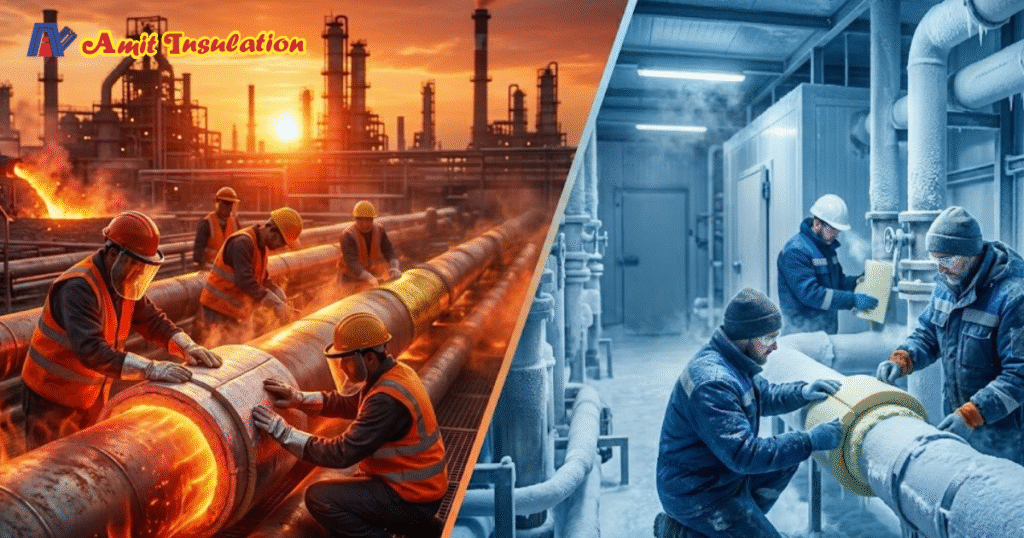
Hot insulation maintains heat in systems above 100°C, like steam lines. Cold insulation blocks external heat in sub-10°C setups, such as chillers. Core principle: Reduce heat transfer. Materials create barriers against conduction, convection, radiation.
In India, services follow IS 12436 standards. They include assessment, fabrication, application, testing. Hot & cold insulation in India handles diverse climates—from coastal humidity to desert heat.
Key Types and Materials As per According For Information
Types split by temperature: hot (150-1000°C), cold (-50 to 10°C), dual-purpose.
Hot: Rockwool blankets, microporous silica. Cold: PIR boards, elastomeric rubber.
Materials info: Density affects durability; higher for mechanical stress.
Hot & cold insulation manufacturers use fiberglass for flexibility, per ASTM C547.
| Type | Material Examples | Temp Range | Common Use |
|---|---|---|---|
| Hot | Rockwool, Ceramic Fiber | 150-1200°C | Boilers, Exhausts |
| Cold | PU Rigid Foam, Phenolics | -200-100°C | Cryo Tanks, Ducts |
| Acoustic-Thermal | Foam Glass | -200-500°C | Noisy Pipes |
Benefits and Applications As per According For Information
Benefits: 25% energy reduction (NITI Aayog 2025). Safety via lower surface temps (<60°C).
Applications: Refineries (hot process lines), pharma (cold chains), power (turbines).
Hot & cold insulation services prevent CUI—corrosion under insulation—saving ₹10-20 lakh/site yearly.
| Benefit | Quantified Gain | Industry Example |
|---|---|---|
| Energy Save | 20-40% | Oil & Gas |
| Safety | 50% fewer incidents | Chemicals |
| Durability | 25-year life | Food Processing |
Comparison of Methods As per According For Information
Methods: Removable blankets (fast install), spray-applied (seals gaps), pre-slit segments (pipes).
Spray excels in odd shapes; blankets for maintenance access.
Hot & cold insulation suppliers prefer hybrid methods for 15% faster installs.
| Method | Install Speed | Cost (₹/sqm) | Best For |
|---|---|---|---|
| Spray Foam | Fast (1 day/100sqm) | 300-500 | Irregular Surfaces |
| Blankets | Medium | 250-450 | Removable Access |
| Pre-Formed | Slow | 400-600 | Straight Pipes |
| Injection | Very Fast | 200-400 | Existing Systems |
Cost Analysis and ROI As per According For Information
Costs: Materials ₹150-700/sqm; labor 40% extra. Thickness 40-150mm optimal.
ROI: Payback 12-18 months. Example: 500sqm install saves ₹8 lakh/year at ₹10/unit energy.
Factors: Location (Gujarat lower by 10%), volume discounts.
Hot & cold insulation exporter pricing drops 20% for bulk.
| Scenario | Initial Cost (₹ Lakh) | Annual Savings | ROI (Months) |
|---|---|---|---|
| Small Plant (200sqm) | 1.2 | 2.5 | 18 |
| Medium (1000sqm) | 6 | 12 | 12 |
| Large (5000sqm) | 28 | 50 | 10 |
Selection Criteria As per According For Information
How to Choose the Right Hot & Cold Insulation Services
Assess: Operating temp, humidity, vibration. Use R=d/kR=d/k for resistance value .
Certifications: UL 723 fire test, FM approval.
Test suppliers on lead time (<2 weeks), warranties (15+ years).
Internal tip: Pair with vapor barriers in 80% RH areas.
Steps: 1. Spec sheet. 2. Samples. 3. Pilot install.
You May Also Read – Acoustic Insulation Solutions for Factories: How to Reduce Noise in 2026
Future Trends 2026 As per According For Information
Market: ₹18,000 crore by 2026, 11% CAGR (IMARC 2025).
Trends: Nano-insulants (0.010 W/mK), self-healing polymers, AI-optimized designs.
EV sector booms cold insulation for batteries. Green mandates push recycled content (50% by 2027).
Hot & cold insulation in India integrates BIM for 20% waste reduction.
| Trend | 2026 Market Share | Key Advantage |
|---|---|---|
| Aerogel | 18% | 90% thinner |
| Smart Coatings | 12% | Auto-repair |
| Recycled Foam | 25% | Eco-compliant |
| Hybrid Nano | Emerging 8% | Ultra-low k |
Conclusion
Hot & cold insulation services transform industrial operations. They deliver energy savings, safety, and longevity amid India’s growth. From material picks to 2026 innovations like aerogels, informed choices yield top ROI.
Facility owners and engineers: Invest now for compliance and efficiency. Looking for hot & cold insulation services in India? Amit Insulation offers customized solutions for industrial and commercial needs across Gujarat and India.
FAQ
What exactly are hot & cold insulation services?
Services for applying thermal barriers to hot (heat-retaining) and cold (heat-blocking) systems, including materials and installation.
Difference between hot and cold insulation materials?
Hot uses inorganic fibers (e.g., rockwool); cold favors foams (e.g., PU) for vapor control.
Cost of hot & cold insulation services per square meter?
₹300-800, varying by material and method; ROI in 1-2 years.
Best insulation for high-temperature steam pipes?
Calcium silicate or ceramic fiber, handling 650°C+ with low conductivity.
How to prevent condensation in cold insulation?
Use vapor barriers and closed-cell materials like phenolic foam.
What standards govern insulation in India?
IS 818, IS 12436; aim for BIS certification.
Future of insulation market in India 2026?
₹18,000 crore, driven by aerogels, green materials, and Industry.