Industrial insulation failure rarely happens overnight — it builds up quietly through moisture, heat stress, and poor workmanship until a plant is suddenly facing energy loss, corrosion, or an unplanned shutdown. Understanding the real insulation failure causes behind these breakdowns is the first step to preventing them. In this guide, we break down the seven most common causes of industrial insulation failure, how to identify each one early, and the practical fixes engineers and facility managers use to stop small insulation problems from turning into expensive plant failures.
Whether you manage hot pipelines, cold storage systems, or process equipment, this article gives you a field-tested framework — backed by real insulation project experience from Amit Insulation — to diagnose, repair, and prevent insulation breakdown across your facility.
What Is Industrial Insulation Failure?
Industrial insulation failure is the loss of an insulation system’s ability to control heat transfer, prevent condensation, or protect underlying pipework and equipment. It shows up as wet or sagging insulation, cracked cladding, rising energy bills, visible corrosion, or hot/cold spots on an otherwise insulated surface. Left unaddressed, insulation deterioration doesn’t stay cosmetic — it accelerates corrosion under insulation (CUI), reduces process efficiency, and can eventually force equipment shutdowns for emergency repair.
Most insulation systems are engineered to last 15–25 years, but poor material choice, moisture intrusion, or weak installation practices can cut that lifespan down to just a few years. That’s why recognizing insulation failure causes early — during routine inspection rather than after a leak or energy audit flags the problem — saves plants significant repair cost.
Why This Matters for Plant Operations
| Impact Area | Effect of Unaddressed Insulation Failure |
|---|---|
| Energy Cost | Up to 20–40% higher heat/cooling loss on affected sections |
| Equipment Life | Accelerated corrosion under insulation (CUI), pipe/vessel thinning |
| Safety | Higher risk of surface burns, condensation slip hazards, fire load |
| Compliance | Failure to meet energy efficiency and process safety audits |
| Downtime | Emergency repairs cost 2–3x more than planned maintenance |
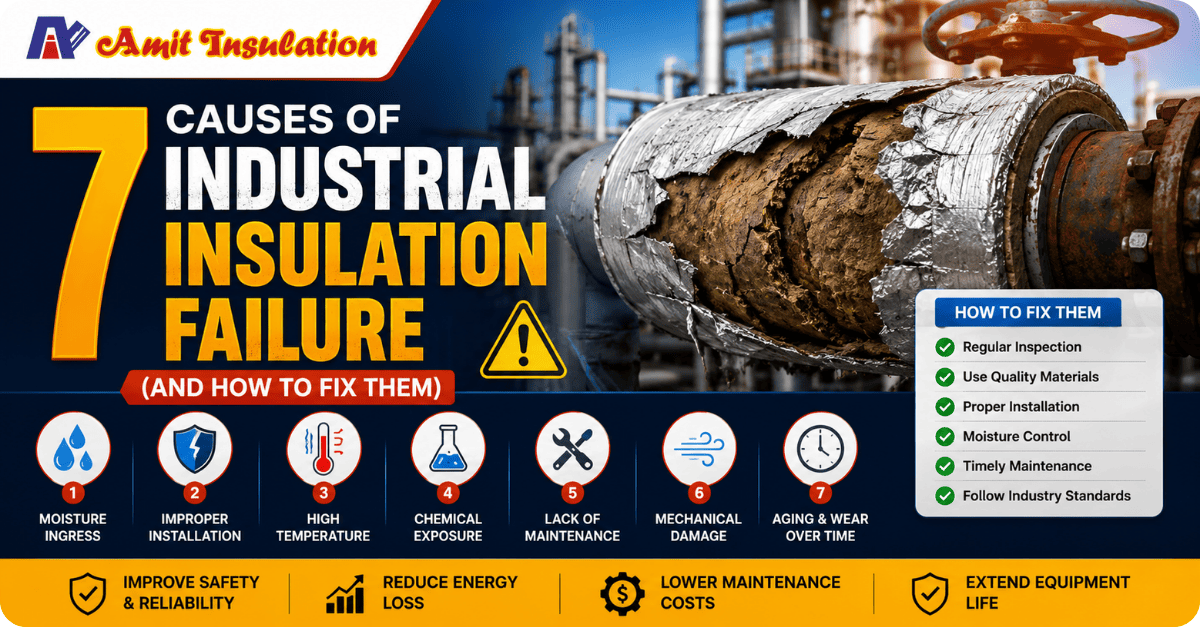
7 Causes of Industrial Insulation Failure
1. Moisture Ingress and Corrosion Under Insulation (CUI)
Moisture is the single biggest contributor to insulation system failure in industrial plants. Once water gets past a damaged cladding seam, insulation joint, or penetration point, it saturates the insulation material, destroys its thermal resistance, and sits against the pipe or vessel wall — creating the ideal condition for corrosion under insulation. CUI is widely recognized across the piping insulation industry as one of the costliest and hardest-to-detect forms of insulation-related damage because it develops out of sight, underneath the cladding.
How to fix it: Use closed-cell, hydrophobic insulation materials on hot and cold lines, seal all cladding overlaps and penetrations with weatherproof mastic, and schedule periodic CUI inspections at pipe supports, low points, and valve/flange connections where moisture typically collects first.
2. Poor Material Selection
Not every insulation material suits every application. Using a general-purpose material on a cryogenic line, or a low-density board on a high-vibration pipe run, sets the system up to fail early. Common mismatches include using standard mineral wool where a closed-cell elastomeric or PUF (polyurethane foam) product is needed for condensation control, or selecting a material with a lower temperature rating than the actual process temperature.
How to fix it: Match insulation type to the operating temperature, moisture exposure, and mechanical stress of the application — rockwool for high-heat pipelines, elastomeric nitrile rubber or PUF for cold and chilled-water lines, and fire-rated boards where compliance requires it. Amit Insulation’s team routinely audits hot and cold pipe insulation selections during site surveys to correct these mismatches before installation.
3. Thermal Cycling and Thermal Bridging
Repeated heating and cooling cycles cause insulation materials to expand and contract, which over time creates gaps, cracks, and loosened joints — especially at flanges, elbows, and supports. When even a small section of pipe is left exposed or under-insulated, it creates a thermal bridge, letting heat escape (or cold penetrate) at a concentrated point, which also raises the local surface temperature or lowers it below the dew point, encouraging condensation nearby.
How to fix it: Design insulation thickness and jointing methods to accommodate thermal movement, use expansion joints at line breaks, and ensure full, continuous coverage — including fittings, valves, and supports — to eliminate thermal bridging points.
4. Damaged or Poorly Installed Cladding and Jacketing
Cladding is the insulation system’s outer shield against weather, physical impact, and UV exposure. When cladding is dented, poorly overlapped, or fastened with the wrong screws and sealants, rainwater and humidity find their way in almost immediately. This is one of the most preventable causes of industrial insulation failure, yet it remains one of the most common because cladding installation is often rushed at the end of a project.
How to fix it: Install cladding with correct overlap direction (always shingled to shed water downward), use stainless steel bands and screws in corrosive environments, and inspect cladding seams annually for gaps, dents, or missing sealant.
5. Mechanical Damage and Physical Impact
Industrial environments are busy — scaffolding, forklifts, maintenance tools, and foot traffic regularly come into contact with insulated pipework and equipment. A single impact that dents cladding or compresses insulation creates a weak point where moisture and heat loss concentrate, even if the damage looks minor from the outside.
How to fix it: Install protective guards or barriers around insulation in high-traffic zones, train maintenance crews to report visible impact damage immediately, and repair damaged sections promptly rather than waiting for the next scheduled turnaround.
6. Improper Installation Workmanship
Even premium insulation materials fail early when installed incorrectly. Gaps between insulation segments, missing vapor barriers on cold systems, insufficient fastening, or skipped sealant at joints are all workmanship issues that compromise the entire system — regardless of material quality. This is why choosing an experienced insulation contractor matters as much as choosing the right material.
How to fix it: Work with insulation contractors who follow manufacturer application standards and conduct quality checks at each stage — insulation fitting, vapor barrier application, and cladding closure. Amit Insulation applies a documented thermal and acoustic insulation process across every project to reduce workmanship-related failure risk.
7. Lack of Regular Inspection and Maintenance
Insulation failure causes often go unnoticed simply because nobody is looking. Without a scheduled inspection routine, minor issues like a small cladding gap or a slightly loose joint go unaddressed for months, giving moisture and thermal stress time to cause serious damage underneath.
How to fix it: Build insulation inspection into routine plant maintenance schedules — checking cladding integrity, joint sealant, and surface temperature at key points — rather than treating insulation as a one-time installation.
You May Also Read:- Insulation Thickness Calculation for Hot & Cold Service
Common Causes vs. Symptoms vs. Fixes
| Cause | Early Warning Sign | Recommended Fix |
|---|---|---|
| Moisture ingress / CUI | Rust staining, damp cladding | Hydrophobic material, sealed joints |
| Poor material selection | Frequent re-insulation, condensation | Application-specific material audit |
| Thermal cycling / bridging | Hot/cold spots, cracked joints | Expansion joints, full coverage |
| Damaged cladding | Dents, gaps, missing screws | Re-clad with shingled overlap |
| Mechanical impact | Visible dents, compressed insulation | Protective guards, prompt repair |
| Poor workmanship | Uneven finish, missing vapor barrier | Certified contractor, QA checks |
| Missed maintenance | No inspection records | Scheduled inspection program |
How to Prevent Insulation Failure
- Choose the right material for the application — hot, cold, cryogenic, or acoustic insulation each need different specifications.
- Insulate the whole system, not just the pipe run — flanges, valves, and supports are common failure points.
- Protect the outer jacketing — cladding is your first defense against moisture and physical damage.
- Inspect on a schedule, not just after a complaint — early detection is far cheaper than emergency replacement.
- Use experienced installers — correct workmanship prevents most avoidable insulation problems.
Recommended Insulation Materials by Application
| Application | Recommended Material | Why |
|---|---|---|
| Hot pipelines / steam lines | Rockwool, ceramic wool | High temperature tolerance, fire resistance |
| Chilled water / cold pipelines | Nitrile rubber, PUF (closed-cell) | Condensation control, moisture resistance |
| Cryogenic lines | Cellular glass, closed-cell foam | Extreme low-temperature stability |
| Wall & slab insulation | Rock wool, glass wool, foam panels | Thermal bridging control, soundproofing |
| Over deck / under deck | PUF panels | UV resistance, rooftop heat protection |
When to Call a Professional Insulation Contractor
Some insulation issues — a small cladding dent or a minor sealant gap — can be flagged during routine in-house checks. But once moisture has reached the insulation core, or corrosion under insulation is suspected, the repair needs a contractor who can safely remove, inspect, and re-insulate the affected section without disrupting plant operation.
| Situation | DIY / In-House Fix | Call a Professional Contractor |
|---|---|---|
| Minor cladding scuff | Suitable | Not required |
| Visible rust stains under cladding | Risk of missing hidden CUI | Recommended |
| Repeated condensation on cold lines | Often a material mismatch | Recommended |
| Full re-insulation after turnaround | Requires trained crew | Recommended |
| Insulation on high-temperature process lines | Safety risk | Recommended |
Why Plants Trust Amit Insulation for Failure Prevention and Repair
With over 30 years of experience delivering industrial insulation solutions across Gujarat and pan-India projects, Amit Insulation has repaired and re-insulated hundreds of pipelines, vessels, and structures affected by the exact causes covered in this guide. From material selection and correct cladding installation to scheduled inspection programs, our team addresses insulation failure causes at the source rather than patching surface symptoms.
Amit Insulation’s services include hot & cold pipe insulation, wall and slab insulation, over deck and under deck insulation, scaffolding support for insulation access, and complete fabrication and erection work for insulation-related structural needs — giving plant operators a single, accountable point of contact for both new installation and failure remediation. If your facility is showing early signs of insulation deterioration, a professional site survey can catch the problem before it becomes a shutdown-level repair.
Frequently Asked Questions
1. What are the most common insulation failure causes in industrial plants?
The most common causes are moisture ingress and corrosion under insulation (CUI), poor material selection, thermal cycling, damaged cladding, mechanical impact, poor installation workmanship, and lack of regular inspection.
2. How does corrosion under insulation (CUI) happen?
CUI happens when moisture penetrates damaged cladding or insulation joints and becomes trapped against the pipe or vessel surface, creating a corrosive environment that is hidden from view until the insulation is removed for inspection.
3. How can I tell if my industrial insulation is failing?
Warning signs include rising energy costs, visible condensation or rust staining on cladding, hot or cold spots on insulated surfaces, sagging or wet insulation, and cracked or gapped cladding seams.
4. How often should industrial insulation be inspected?
Most facilities benefit from at least one detailed insulation inspection per year, with more frequent visual checks during routine maintenance rounds, especially in humid or high-traffic areas.
5. Can damaged insulation be repaired, or does it need full replacement?
It depends on the extent of damage. Localized cladding damage or small joint gaps can often be repaired, but insulation that has been saturated with moisture or shows active corrosion underneath typically needs to be removed and replaced.
6. What is the difference between hot insulation and cold insulation materials?
Hot insulation materials like rockwool and ceramic wool are designed to withstand high temperatures and reduce heat loss, while cold insulation materials like nitrile rubber and PUF focus on preventing condensation and controlling heat gain on chilled or cryogenic systems.
7. Does poor installation really affect insulation lifespan that much?
Yes. Even high-quality insulation material will fail early if installed with gaps, missing vapor barriers, or poor cladding overlap, since these workmanship issues create direct entry points for moisture and thermal loss.
8. What is thermal bridging in industrial insulation?
Thermal bridging occurs when a section of pipe, fitting, or structure is left under-insulated or exposed, allowing heat to escape (or cold to penetrate) at that point, which can also trigger localized condensation.
9. How much does insulation failure cost a plant in energy loss?
Depending on the extent of damage, poorly insulated or failed sections can increase energy loss by 20–40% on the affected system, along with added costs from equipment corrosion and unplanned downtime.
10. Who should I contact for industrial insulation failure repair?
An experienced industrial insulation contractor with expertise in hot and cold systems, cladding, and CUI remediation — such as Amit Insulation — should be contacted to inspect, diagnose, and repair failing insulation safely.
Conclusion
Industrial insulation failure is almost always traceable to one of seven root causes: moisture ingress and CUI, poor material selection, thermal cycling, cladding damage, mechanical impact, installation workmanship, or missed inspections. Catching these insulation failure causes early — through scheduled inspection and the right material choice for each application — is far more cost-effective than emergency repair after a leak, corrosion event, or energy audit failure. For plants that want a single, experienced partner to diagnose and fix industrial insulation failure at the source, Amit Insulation brings three decades of hands-on insulation expertise to every project, from pipe and slab insulation to full plant-wide maintenance programs.