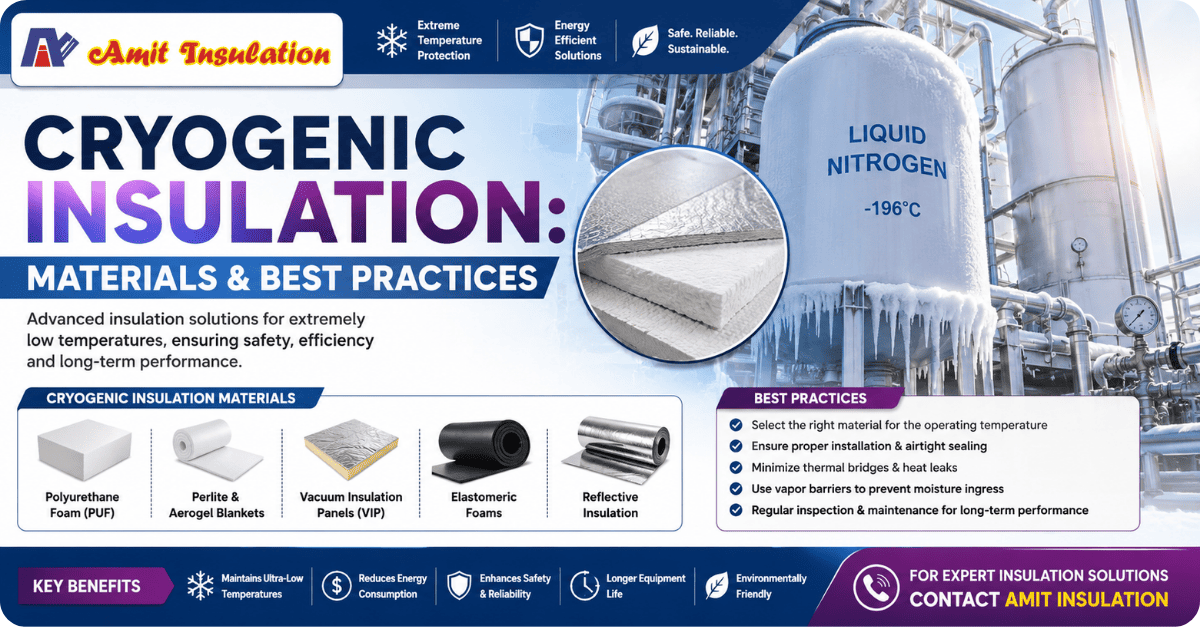
Cryogenic insulation is the specialized barrier system that keeps piping, tanks, and vessels operating at extremely low temperatures — often below -150°C (-238°F) — safe, efficient, and free from heat gain. Whether you handle liquid nitrogen, liquid oxygen, LNG, or liquid hydrogen, the right cryogenic insulation material and installation method directly determine boil-off rates, energy costs, and long-term system safety. This guide breaks down the leading cryogenic insulation materials, compares their thermal performance, and walks through the field-tested best practices that separate a system built to last from one that fails within a few years. At the end, we’ll show how Amit Insulation helps industrial and commercial teams specify, source, and install cryogenic insulation systems that meet exact project requirements.
What Is Cryogenic Insulation?
Cryogenic insulation refers to the materials and techniques used to limit heat transfer into systems that store or transport substances at ultra-low temperatures. Unlike standard thermal insulation used in HVAC or building envelopes, cryo insulation must perform reliably across an enormous temperature differential — from ambient conditions down to -196°C (liquid nitrogen) or even -253°C (liquid hydrogen).
The core objectives of any cryogenic insulation system are:
- Minimizing heat ingress to reduce product boil-off and vaporization losses
- Preventing frost and ice formation on the outer jacket, which can compromise the vapor barrier
- Maintaining structural integrity through repeated thermal cycling, contraction, and expansion
- Protecting personnel from cold-contact hazards and protecting equipment from condensation-driven corrosion under insulation (CUI)
Because low-temperature insulation behaves very differently from room-temperature insulation, material selection, vapor barrier design, and joint detailing all require specialized engineering knowledge — which is where an experienced cryogenic insulation contractor like Amit Insulation adds the most value.
Why Cryogenic Insulation Materials Matter
Choosing the wrong low-temperature insulation material is one of the most expensive mistakes in industrial piping and storage design. A material that performs well at ambient temperature can become brittle, lose its R-value, or absorb moisture catastrophically once it’s exposed to cryogenic conditions. That’s why every credible cryogenic insulation specification starts with three technical criteria: thermal conductivity (k-factor), moisture resistance, and dimensional stability under thermal cycling.
Key Selection Criteria
- Thermal conductivity — lower k-values mean less heat transfer and lower boil-off rates.
- Moisture and vapor resistance — closed-cell structures resist water vapor ingress far better than open-cell materials.
- Compressive strength — insulation under a supported pipe or tank must bear structural load without crushing.
- Fire performance — especially relevant for LNG and hydrocarbon storage facilities.
- Installed cost and lifecycle value — material price is only part of the equation; labor, maintenance, and replacement cycles matter just as much.
Common Cryogenic Insulation Materials Compared
The table below compares the most widely used cryogenic and low-temperature insulation materials across the metrics that matter most for specification.
| Material | Typical Thermal Conductivity (W/m·K) | Moisture Resistance | Best Use Case | Relative Cost |
|---|---|---|---|---|
| Cellular Glass | 0.038–0.05 | Excellent (impermeable, closed-cell) | Tank foundations, below-grade piping, fire-sensitive areas | High |
| Rigid Polyurethane (PU) Foam | 0.020–0.025 | Very good when properly jacketed | Internal tank insulation, LNG carriers | Medium |
| Polyisocyanurate (PIR) Foam | 0.022–0.026 | Good | Cryogenic piping, industrial gas lines | Medium |
| Aerogel Blankets | 0.013–0.016 | Good (hydrophobic treatments available) | Space-constrained piping, retrofit projects | High |
| Multilayer Insulation (MLI) | Near-zero (vacuum-dependent) | N/A (vacuum-sealed) | Liquid helium, liquid hydrogen, aerospace tanks | Very High |
| Perlite (Expanded) | 0.03–0.06 | Moderate | Vacuum-jacketed vessel annular space | Low–Medium |
Note: Values vary by manufacturer, density, and installed thickness. Always confirm with current product data sheets during specification.
Cellular Glass
Cellular glass is a rigid, all-glass, closed-cell insulation that is completely impermeable to water and water vapor — a critical property for any cryogenic pipe insulation exposed to condensation. It also offers strong compressive strength, making it a preferred choice for pipe supports and tank base insulation where load-bearing capacity is required. Its non-combustible nature makes it a common specification requirement in LNG and petrochemical facilities.
Polyurethane and Polyisocyanurate Foams
Rigid PU and PIR foams dominate cryogenic piping insulation because they combine low thermal conductivity with reasonable mechanical strength across a wide temperature range. When properly jacketed with a vapor-retarder facing, these foams resist moisture ingress effectively and remain one of the most cost-efficient options for industrial gas lines, cryogenic trucks, and LNG piping systems.
Aerogel Blankets
Aerogel insulation has grown in popularity for cryogenic and sub-ambient applications where space is limited. With thermal conductivity values among the lowest of any solid insulation material, aerogel blankets allow engineers to achieve required thermal performance in thinner insulation profiles — useful in congested piping racks or retrofit projects where clearance is tight.
Multilayer Insulation (MLI)
For the most extreme cryogenic applications — liquid hydrogen, liquid helium, and aerospace propellant tanks — multilayer insulation combined with a high vacuum annular space delivers near-zero heat transfer. MLI systems use alternating layers of reflective foil and low-conductivity spacer material inside a vacuum jacket, virtually eliminating conductive and convective heat transfer.
Perlite
Expanded perlite, an inorganic, granular insulation, is commonly used to fill the annular vacuum space in vacuum-jacketed vessels and piping. It’s cost-effective and widely used in bulk cryogenic storage tanks, though it requires a maintained vacuum to perform at its rated thermal efficiency.
Cryogenic Insulation System Components
A complete low-temperature insulation system is more than just the core insulating material. The table below outlines the functional layers that make up a properly engineered cryogenic insulation assembly.
| System Layer | Function | Common Materials |
|---|---|---|
| Core Insulation | Reduces heat transfer between the cold surface and ambient air | Cellular glass, PU/PIR foam, aerogel, MLI |
| Vapor Barrier | Prevents moisture and water vapor from migrating into the insulation | Reinforced foil-scrim-kraft (FSK), polyethylene film, mastic coatings |
| Adhesives & Sealants | Bond insulation layers and seal joints against air/moisture infiltration | Vapor-stop mastics, joint sealants, flashing compounds |
| Outer Jacketing | Provides mechanical protection and weatherproofing | Aluminum jacketing, stainless steel jacketing, PVC covers |
| Support System | Prevents thermal bridging at pipe supports and hangers | Load-bearing inserts, cellular glass shoes, composite supports |
You May Also Read:- How to Prevent Condensation in Chilled Water & Cold Lines
Best Practices for Cryogenic Insulation Installation
Even the best cryogenic insulation material will underperform — or fail outright — if installation practices are substandard. The following best practices are consistently cited across engineering guidance and field experience in cryogenic and LNG insulation projects.
1. Design for Thermal Cycling from Day One
Cryogenic systems expand and contract repeatedly as temperatures fluctuate between ambient and operating conditions. Insulation systems that don’t account for this movement develop gaps, cracks, and vapor barrier breaches over time. Multi-layer installation with staggered joints, along with properly detailed contraction joints, is a standard practice for any well-executed cryogenic insulation project.
2. Prioritize a Continuous, Sealed Vapor Barrier
Because moisture ingress is the number-one cause of cryogenic insulation failure, every seam, joint, penetration, and termination point must maintain an unbroken vapor seal. A single breach can allow moisture to migrate into the insulation, freeze, expand, and physically destroy the material’s insulating properties — a failure mode that often isn’t visible until the outer jacket shows frost or ice.
3. Match Insulation Thickness to Actual Operating Temperature
Thickness calculations should be based on actual process temperature, ambient design conditions, and required surface temperature — not generic rules of thumb. Under-specifying thickness leads to excessive boil-off and condensation; over-specifying adds unnecessary cost and weight.
4. Use Proper Supports to Eliminate Thermal Bridging
Pipe supports and hangers are common weak points where metal-to-metal contact can create a direct thermal bridge, bypassing the insulation entirely. Load-bearing insert materials — often cellular glass or engineered composite blocks — are used at support points to preserve continuous insulation performance.
5. Account for Fire and Safety Codes Early
Facilities handling LNG, liquid oxygen, or other hazardous cryogenic fluids often have strict fire-resistance and code-compliance requirements. Materials like cellular glass, which is non-combustible, are frequently specified in these environments, and system design should reflect applicable NFPA and API standards from the outset.
6. Commission Experienced Installers, Not Generalist Contractors
Cryogenic insulation is a distinct discipline from general commercial or building-envelope insulation work. A contractor who doesn’t proactively discuss contraction joints, vapor barrier continuity, and support detailing may not be equipped for cryogenic-grade work — regardless of general insulation experience.
Common Failure Points and How to Prevent Them
| Failure Point | Root Cause | Prevention Practice |
|---|---|---|
| Ice/frost on outer jacket | Vapor barrier breach allowing moisture ingress | Continuous sealed vapor barrier, routine inspection |
| Crushed or compressed insulation | Inadequate compressive strength at support points | Use load-rated inserts (e.g., cellular glass shoes) |
| Cracked joints | Insulation not designed for thermal contraction | Staggered, multi-layer joints with contraction allowance |
| Excess boil-off / energy loss | Undersized insulation thickness | Thickness calculated for actual operating temperature |
| Corrosion under insulation (CUI) | Trapped moisture against metal surfaces | Moisture-resistant materials plus proper vapor sealing |
Application-Based Material Recommendations
| Application | Recommended Insulation | Why |
|---|---|---|
| LNG storage tanks | Cellular glass base + PU/PIR foam wall insulation | Fire resistance and compressive strength at foundation, low k-factor on walls |
| Cryogenic process piping | Rigid PIR foam with vapor-retarder jacketing | Balance of thermal performance and installed cost |
| Vacuum-jacketed piping (liquid nitrogen, oxygen, argon) | Perlite or MLI in evacuated annular space | Near-zero convective heat transfer under vacuum |
| Liquid hydrogen / liquid helium systems | Multilayer insulation (MLI) with high vacuum | Extreme temperature differential requires radiative heat transfer control |
| Space-constrained retrofit piping | Aerogel blankets | Lowest thermal conductivity in the thinnest profile |
Cryogenic Insulation in LNG and Industrial Gas Applications
The demand for reliable cryogenic thermal insulation continues to grow alongside LNG infrastructure expansion, industrial gas distribution, and emerging applications such as liquid hydrogen fuel systems for aviation and heavy transport. In every one of these applications, the fundamentals remain the same: select a material engineered for cryogenic-range performance, design the system to handle thermal cycling and moisture control, and install it with a contractor who specializes in low-temperature insulation systems rather than general building insulation.
Facilities are also facing supply chain pressure on high-performance materials like cellular glass, perlite, and aerogel blankets, making strategic sourcing and vendor partnerships an increasingly important part of project planning — another area where working with an established cryogenic insulation supplier pays off over time.
Why Choose Amit Insulation for Your Cryogenic Insulation Project
Specifying and installing cryogenic insulation correctly requires more than picking a material off a data sheet — it requires a contractor who understands thermal engineering, vapor barrier detailing, and the operational realities of cryogenic and LNG systems. Amit Insulation works with industrial facilities, gas suppliers, and process piping projects to:
- Recommend the right cryogenic insulation material for your specific temperature range, application, and budget
- Engineer vapor barrier systems and joint details that prevent moisture-driven failure
- Install multi-layer insulation systems with proper contraction joints and load-bearing supports
- Support ongoing maintenance and insulation audits to catch failures before they cause costly boil-off or safety issues
If your project involves LNG storage, cryogenic piping, industrial gas lines, or any system operating below ambient temperature, Amit Insulation can help you specify a system built for long-term performance rather than short-term cost savings. Contact Amit Insulation to discuss your cryogenic insulation requirements, or explore our cryogenic insulation for a closer look at how we approach material selection and installation.
Frequently Asked Questions
1. What is the best material for cryogenic insulation?
There isn’t a single “best” material — it depends on the application. Cellular glass is preferred where compressive strength and fire resistance matter; rigid PU/PIR foam is common for general cryogenic piping; aerogel suits space-constrained retrofits; and multilayer insulation (MLI) under vacuum is used for the most extreme temperatures, such as liquid hydrogen and liquid helium systems.
2. What temperature range is considered cryogenic?
Cryogenics generally refers to temperatures below -150°C (-238°F), though some definitions extend to any temperature below -100°C. Applications range from liquid nitrogen (-196°C) to liquid hydrogen (-253°C) and liquid helium (-269°C).
3. Why is moisture resistance so important in cryogenic insulation?
Moisture that migrates into insulation will freeze at cryogenic temperatures, expand, and physically damage the material’s cellular structure. This destroys thermal performance and can lead to ice buildup on the outer jacket, corrosion under insulation, and eventual system failure.
4. How thick should cryogenic pipe insulation be?
Thickness depends on operating temperature, ambient conditions, insulation type, and required surface temperature to prevent condensation. Thickness should always be calculated using the specific material’s thermal conductivity data rather than a generic industry rule of thumb.
5. What’s the difference between cryogenic insulation and standard thermal insulation?
Standard thermal insulation is designed for ambient-range temperature control (building envelopes, HVAC). Cryogenic insulation must perform reliably across an extreme temperature differential, resist significant thermal cycling and contraction, and maintain an essentially unbroken vapor barrier — requirements far more demanding than typical building insulation.
6. Is cellular glass better than foam insulation for cryogenic applications?
Cellular glass offers superior moisture resistance, compressive strength, and fire performance, making it ideal for tank foundations and load-bearing points. Foam insulation (PU/PIR) typically offers lower thermal conductivity and lower installed cost, making it well suited for piping runs where compressive load isn’t a primary concern. Many systems use both materials in different parts of the same installation.
7. What causes cryogenic insulation systems to fail?
The most common failure causes are vapor barrier breaches allowing moisture ingress, insulation crushed at unsupported or poorly designed support points, cracked joints from unaccounted thermal contraction, and undersized insulation thickness leading to excessive boil-off.
8. Can cryogenic insulation be retrofitted on existing piping?
Yes. Aerogel blankets are particularly popular for retrofit projects because they achieve strong thermal performance in a thin profile, which is useful where existing piping racks or enclosures have limited clearance for additional insulation thickness.
9. What is multilayer insulation (MLI) used for?
MLI is used in the most extreme cryogenic applications — liquid hydrogen, liquid helium, and aerospace propellant tanks — where alternating reflective foil layers inside a vacuum-sealed jacket minimize radiative heat transfer and achieve near-zero effective thermal conductivity.
10. How do I choose a cryogenic insulation contractor?
Look for a contractor with specific cryogenic and low-temperature insulation experience — not just general commercial insulation work. A qualified contractor should proactively address vapor barrier continuity, contraction joint design, and support detailing without needing to be prompted. Amit Insulation specializes in exactly this type of project scope, from material selection through installation and maintenance.
Conclusion
Cryogenic insulation performance comes down to three things: choosing a material engineered for extreme low-temperature service, designing the system around moisture control and thermal cycling, and partnering with an installer who treats cryogenic work as the specialized discipline it is. Cellular glass, polyurethane and polyisocyanurate foams, aerogel blankets, perlite, and multilayer insulation each have a defined role depending on temperature range, application, and budget — and getting that selection right is what separates a system that lasts decades from one that fails within a few seasons.
For teams evaluating cryogenic insulation materials or planning an LNG, industrial gas, or cryogenic piping project, Amit Insulation offers the technical expertise to specify, source, and install a system engineered for your exact operating conditions. Get in touch with Amit Insulation to start planning a cryogenic insulation system built for long-term, low-boil-off performance.