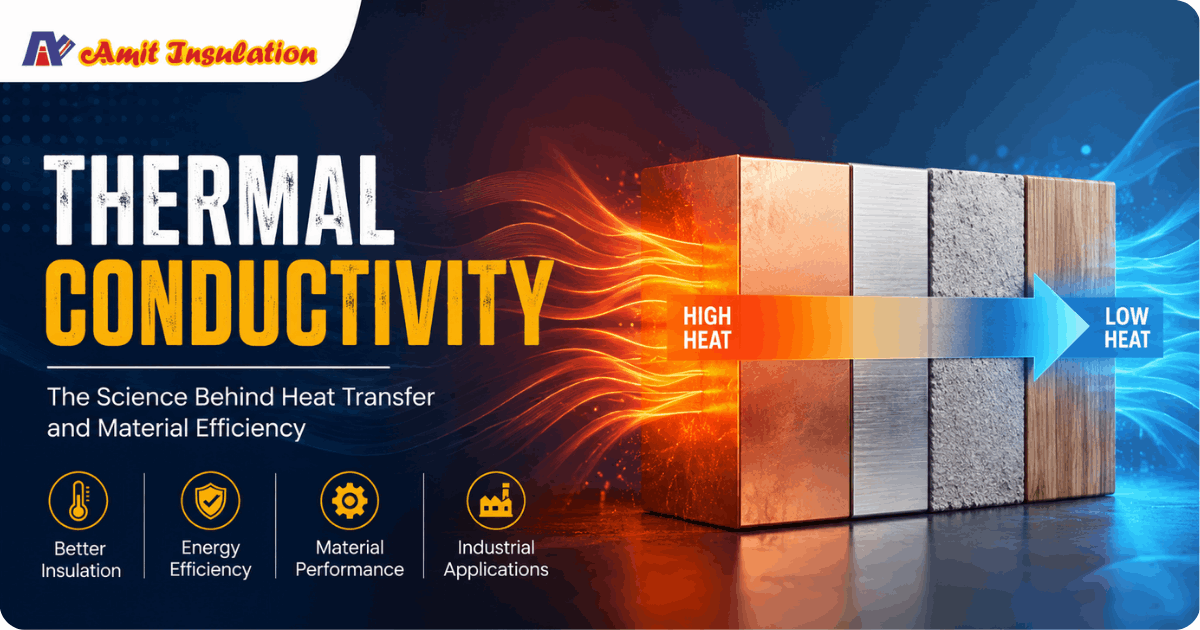
Thermal conductivity is one of the most important physical properties in construction, engineering, and energy efficiency. Whether you are selecting insulation materials for your home in India, designing industrial pipelines in the UK, or managing building energy codes in the USA or Australia — understanding thermal conductivity is the first step toward smarter, cost-saving decisions.
What Is Thermal Conductivity? (Definition)
Thermal conductivity is the physical property of a material that describes its ability to conduct or transfer heat. In simple terms, it measures how quickly or slowly heat passes through a substance. Materials with high thermal conductivity allow heat to move rapidly through them (like metals), while materials with low thermal conductivity resist heat flow (like insulation foams, mineral wool, or aerogel).
Thermal conductivity is denoted by the symbol k (also written as λ or κ) and is scientifically defined as:
“The rate of heat transfer through a unit thickness of material per unit area, per unit temperature difference.”
This concept governs everything from how quickly your metal pan heats up on a stove to how effectively an insulated industrial pipe retains process heat — areas where Amit Insulation provides industry-leading solutions across India and beyond.
Thermal Conductivity Formula (Fourier’s Law of Heat Conduction)
The mathematical foundation for thermal conductivity is Fourier’s Law of Heat Conduction:
Q = k × A × (ΔT / L)Where:
- Q = Heat transfer rate (Watts)
- k = Thermal conductivity coefficient (W/m·K)
- A = Cross-sectional area (m²)
- ΔT = Temperature difference across the material (Kelvin or °C)
- L = Thickness of the material (metres)
The differential form of Fourier’s law is: q = −k · ∇T
This formula shows that the thicker the insulation layer and the lower its k-value, the less heat escapes — a principle central to all high-performance thermal insulation products.
SI Unit of Thermal Conductivity
The SI unit of thermal conductivity is Watts per metre per Kelvin (W/m·K), also written as W·m⁻¹·K⁻¹.
This unit means: the amount of heat (in watts) that flows through one metre of material in one second, for every degree Kelvin of temperature difference.
In some engineering applications — especially in the USA — thermal conductivity may also be expressed in BTU·in/(hr·ft²·°F) or BTU/(hr·ft·°F).
Thermal Conductivity Values of Common Materials (W/m·K)
| Material | Thermal Conductivity (W/m·K) | Category |
|---|---|---|
| Diamond | 2,000 – 2,200 | Natural conductor |
| Silver | 429 | Metal conductor |
| Copper | 398 | Metal conductor |
| Aluminium | 205 | Metal conductor |
| Steel (carbon) | 50 – 54 | Metal conductor |
| Concrete | 0.8 – 1.4 | Building material |
| Glass | 0.8 – 1.0 | Building material |
| Water | 0.6 | Liquid |
| Wood | 0.1 – 0.3 | Natural material |
| Mineral Wool / Rock Wool | 0.033 – 0.040 | Insulation material |
| Glass Wool | 0.030 – 0.040 | Insulation material |
| Expanded Polystyrene (EPS) | 0.033 – 0.040 | Insulation material |
| PIR / PU Foam Board | 0.022 – 0.028 | Insulation material |
| Aerogel | 0.015 – 0.020 | Advanced insulation |
| Air (still) | 0.025 | Gas |
Lower k-value = Better insulation performance. Insulation materials like those supplied by Amit Insulation are engineered to have extremely low thermal conductivity values, minimising heat gain or loss in buildings and industrial systems.
Factors That Affect Thermal Conductivity
Understanding what influences heat conductivity helps engineers and builders make better material choices. The major factors include:
1. Temperature
As temperature increases, the thermal conductivity of most metals slightly decreases, while for insulating materials and gases, it may slightly increase. This is why industrial insulation must be rated for the specific operating temperature range.
2. Material Composition and Molecular Structure
Materials with simple atomic structures and tightly packed atoms (like metals) have higher heat transfer coefficients. Porous, fibrous, or foam materials trap still air — which has one of the lowest conductivity values (0.025 W/m·K) — making them excellent thermal insulators.
3. Moisture Content
Water has a thermal conductivity of approximately 0.6 W/m·K, which is roughly 20× higher than most insulation materials. Wet insulation loses its effectiveness dramatically. This is why vapour-barrier-protected insulation systems from Amit Insulation are critical in humid climates across India.
4. Density
Denser insulation does not always mean better performance. There is an optimal density range for each insulation type. Beyond a certain density, trapped air pockets decrease, and the material’s heat conduction begins to increase.
5. Pressure
Gases show a strong pressure dependence in thermal conductivity. This is leveraged in vacuum-insulated panels (VIPs), which achieve ultra-low k-values by removing air.
6. Direction of Heat Flow (Anisotropy)
Some materials like wood or layered composites conduct heat differently in different directions — this property is called anisotropy. Isotropic materials conduct heat equally in all directions.
Types of Heat Transfer: Where Thermal Conductivity Fits
Thermal conductivity specifically governs conduction — one of the three fundamental mechanisms of heat transfer:
1. Conduction — Heat transfer through direct molecular contact within a solid or between touching solids. Governed by thermal conductivity (k).
2. Convection — Heat transfer through fluid (liquid or gas) movement. Governed by convective heat transfer coefficients.
3. Radiation — Heat transfer through electromagnetic waves (no medium needed). Governed by emissivity and the Stefan-Boltzmann law.
Effective insulation systems must address all three modes. For example, aluminium-foil-faced insulation products from Amit Insulation combine low-conductivity cores (blocking conduction) with reflective surfaces (blocking radiation).
Thermal Conductivity vs. Thermal Resistance (R-Value)
Two terms that are often confused but are mathematically related:
- Thermal Conductivity (k) = a property of the material itself, independent of thickness.
- Thermal Resistance (R-Value) = a property of a specific insulation layer, dependent on both material and thickness.
Formula: R = L / k
Where L is the thickness in metres and k is the thermal conductivity. The higher the R-value, the better the insulation.
In the UK, insulation performance is typically measured in R-values or U-values (W/m²·K), while in India, BEE (Bureau of Energy Efficiency) standards reference similar metrics. In Australia, the NCC (National Construction Code) mandates minimum R-values by climate zone.
Thermal Conductivity of Common Insulation Materials Used in India & Globally
| Insulation Product | k-Value (W/m·K) | Typical Application | Temperature Range |
|---|---|---|---|
| Rock Wool / Mineral Wool | 0.033 – 0.045 | Industrial pipes, HVAC ducts, walls | -200°C to +750°C |
| Glass Wool | 0.030 – 0.040 | Roof insulation, false ceilings | Up to 250°C |
| Expanded Polystyrene (EPS) | 0.033 – 0.038 | Cold storage, building boards | -80°C to +75°C |
| Extruded Polystyrene (XPS) | 0.029 – 0.033 | Below-slab, inverted roofs | -50°C to +75°C |
| Polyurethane (PU) Foam | 0.022 – 0.028 | Refrigeration, pipes, panels | -196°C to +120°C |
| PIR (Polyisocyanurate) Boards | 0.022 – 0.025 | Roof boards, sandwich panels | -180°C to +150°C |
| Calcium Silicate | 0.055 – 0.085 | High-temp industrial pipes | Up to 1,000°C |
| Cellular Glass | 0.036 – 0.045 | Cryogenic, underground pipes | -260°C to +430°C |
| Aerogel Blankets | 0.015 – 0.020 | Space-constrained industrial uses | Up to 650°C |
| Reflective Foil (multi-layer) | Effective R depends on air gap | Roofs, walls, under-slabs | -50°C to +80°C |
Why Thermal Conductivity Matters for Buildings and Industry
The global push toward net-zero buildings and energy efficiency regulations makes low thermal conductivity insulation mandatory, not optional.
- In India, the Energy Conservation Building Code (ECBC) specifies U-value limits for walls, roofs, and glazing.
- In the UK, Part L of the Building Regulations enforces maximum U-values for new construction and retrofits.
- In the USA, ASHRAE 90.1 and IECC (International Energy Conservation Code) mandate R-value minimums by climate zone.
- In Australia, the NCC Section J sets minimum insulation R-values for all building classes.
Understanding and applying the correct k-value materials ensures compliance while reducing heating and cooling energy costs by up to 40%, according to the International Energy Agency (IEA).
For Industrial Applications
In oil & gas, chemical plants, power generation, and food processing, thermal conductivity directly impacts:
- Process efficiency — maintaining correct temperatures reduces energy waste
- Personnel safety — hot surface insulation (HSI) prevents burn injuries
- Corrosion under insulation (CUI) prevention — proper insulation selection prevents moisture ingress
- Regulatory compliance — OSHA, IS standards, and international codes govern industrial insulation
Amit Insulation specialises in industrial insulation systems that are engineered to precise k-value specifications, offering solutions for pipes, vessels, tanks, ducts, and equipment across sectors including refineries, power plants, and pharmaceutical facilities.
How Is Thermal Conductivity Measured?
There are two main categories of measurement methods:
Steady-State Methods
These measure conductivity when temperature is constant throughout the sample:
- Guarded Hot Plate Method (GHP) — ISO 8302, ASTM C177
- Heat Flow Meter Method (HFM) — ISO 8301, ASTM C518
- Searle’s Bar Method — used in laboratories
- Lee’s Disc Method — used for poor conductors
Transient Methods
These measure conductivity during the heating process:
- Transient Hot Wire Method
- Transient Plane Source (TPS) / Hot Disk Method
- Laser Flash Analysis (LFA) — used for small samples at high temperatures
Laboratory-tested k-values are listed on product data sheets. Always verify that the test standard matches your application’s temperature range
Thermal Conductivity in Insulation: The Role of Amit Insulation
Amit Insulation is one of India’s leading manufacturers and suppliers of thermal insulation materials, serving industries and construction projects across India and internationally. Their product portfolio is built around materials with proven, low thermal conductivity values that deliver:
Energy savings — reducing heat gain/loss in buildings and plants
Temperature control — maintaining process temperatures in industrial systems
Fire safety — passive fire protection with certified insulation systems
Acoustic performance — many thermal insulators also reduce noise
Moisture resistance — vapour-controlled systems for humid climates
Compliance — products tested to IS, ASTM, EN, and other international standards
Whether you need rockwool insulation for industrial pipes, glass wool for rooftop insulation in Agra, or PIR boards for cold storage facilities, Amit Insulation offers expert technical support alongside quality materials.
Related Terms: Semantic SEO Glossary
To fully understand thermal conductivity, it helps to know these related terms:
- Thermal Resistivity — the reciprocal of thermal conductivity (1/k); higher = better insulator
- R-Value — thermal resistance of a specific thickness of material
- U-Value — overall heat transfer coefficient of a building assembly (W/m²·K)
- Heat Transfer Coefficient — rate of heat transfer per unit area per unit temperature difference
- Specific Heat Capacity — energy required to raise 1 kg of material by 1°C
- Thermal Diffusivity — how quickly a material responds to temperature changes
- Emissivity — a material’s ability to emit radiant heat (relevant to reflective insulation)
- Conduction, Convection, Radiation — the three modes of heat transfer
Conclusion: Why Understanding Thermal Conductivity Is Essential
Thermal conductivity is not just a physics concept — it is a practical engineering tool that determines the energy efficiency, comfort, safety, and cost-effectiveness of every building and industrial facility. From the Fourier’s Law formula to real-world insulation material selection, a clear understanding of heat conduction allows engineers, architects, and facility managers to make better decisions.
Key takeaways:
- Thermal conductivity (k) measures how easily a material conducts heat, in W/m·K
- Lower k-values = better thermal insulators
- Factors like temperature, moisture, density, and molecular structure all affect k-values
- Global energy codes (ECBC in India, Part L in UK, ASHRAE in USA, NCC in Australia) rely on these values
- Proper insulation with low thermal conductivity materials delivers up to 40% energy savings
Amit Insulation brings decades of expertise in supplying and installing thermally optimised insulation systems across India’s industrial and construction sectors. Their technically certified products — tested to international standards — help clients achieve energy efficiency targets, regulatory compliance, and long-term cost savings.
Frequently Asked Questions (FAQs) About Thermal Conductivity
1. What is thermal conductivity in simple words?
Thermal conductivity is a measure of how easily heat passes through a material. A material with high thermal conductivity (like copper or aluminium) lets heat flow quickly. A material with low thermal conductivity (like mineral wool or foam insulation) slows down heat flow — making it useful as an insulator in buildings and industrial plants.
2. What is the SI unit of thermal conductivity?
The SI unit of thermal conductivity is Watts per metre per Kelvin (W/m·K). It is also written as W·m⁻¹·K⁻¹. In some countries, especially the USA, units like BTU·in/(hr·ft²·°F) are also used in practice.
3. What material has the highest thermal conductivity?
Diamond has the highest known thermal conductivity among natural materials, ranging from 2,000 to 2,200 W/m·K — approximately five times higher than copper (398 W/m·K). Among engineered materials, graphene has demonstrated even higher in-plane thermal conductivity values in laboratory conditions.
4. What is the difference between thermal conductivity and thermal resistance?
Thermal conductivity (k) is an intrinsic material property and does not depend on thickness. Thermal resistance (R-value) depends on both the material’s k-value and its thickness (R = L/k). For insulation purposes, you want a low k-value and a high R-value — both of which improve with thicker insulation made from low-conductivity materials.
5. How does thermal conductivity affect insulation selection for buildings in India?
In India, climate zones range from hot-dry (Rajasthan) to warm-humid (coastal regions) to cold (Himalayan zones). The right insulation must have a low k-value appropriate for the operating temperature, along with moisture resistance for humid zones. Products like rockwool, glass wool, and PIR boards — all available from Amit Insulation — are selected based on their certified k-values to meet ECBC and GRIHA building codes.