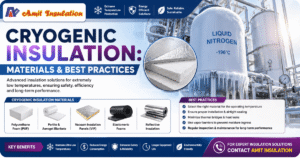
Amit Insulation, based in Vadodara, India, specializes in high-performance insulation solutions for industrial needs. Cold insulation material plays a vital role in protecting pipes from heat gain in hot climates like India’s. It prevents condensation, reduces energy costs, and extends pipe life. For engineers, contractors, facility owners, and industrial buyers, choosing the right cold insulation material ensures compliance with standards like IS 12452 and optimal performance.
In 2026, with India’s industrial sector growing at 7.5% annually (per IBEF reports), demand for efficient cold insulation material for pipes surges. This guide breaks down everything you need: types, benefits, selection tips, and applications. Whether for refrigeration lines, chilled water systems, or LNG pipes, you’ll find actionable insights to make informed decisions.
Why is Cold Insulation Material Essential for Pipes?
Pipes carrying cold fluids absorb heat from surroundings, leading to condensation and efficiency loss. Cold Insulation Material acts as a thermal barrier, keeping inner temperatures stable.
In India, ambient temperatures often exceed 40°C, making heat ingress a major issue. Without proper cold insulation material, pipes sweat, corrode, and increase energy use by up to 30% (IEA data, 2025).
Key reasons include:
- Preventing moisture buildup that causes mold and structural damage.
- Maintaining refrigerant efficiency in AC and cold storage systems.
- Complying with energy codes like ECBC 2017 (updated 2026).
Facility owners save 15-25% on cooling costs with quality insulation. Engineers specify it to avoid callbacks.
Types of Cold Insulation Material for Pipes
Several materials suit cold insulation material for pipes, each with unique properties. Selection depends on temperature range, pipe size, and environment.
Common types:
- Elastomeric Foam (Rubber): Flexible, closed-cell structure resists vapor. Ideal for -200°C to 105°C.
- Phenolic Foam: Rigid, low thermal conductivity (0.018 W/mK). Best for ultra-low temps like -196°C.
- Polyisocyanurate (PIR): Fire-resistant, handles -200°C to 140°C.
- Cellular Glass: Non-combustible, moisture-proof for harsh conditions.
- Expanded Polystyrene (EPS): Cost-effective for above-freezing apps.
In India, elastomeric and phenolic dominate due to humidity. Always check vapor barrier ratings.
Here’s a comparison table:
| Material Type | Thermal Conductivity (W/mK) | Temp Range (°C) | Vapor Permeability | Cost (₹/sqm) |
|---|---|---|---|---|
| Elastomeric Foam | 0.034 | -200 to 105 | Low | 150-250 |
| Phenolic Foam | 0.018 | -196 to 120 | Very Low | 200-350 |
| PIR | 0.022 | -200 to 140 | Low | 180-300 |
| Cellular Glass | 0.040 | -270 to 480 | Impermeable | 300-500 |
| EPS | 0.035 | -50 to 75 | Moderate | 80-150 |
Benefits of Using Cold Insulation Material in India
Cold insulation material for pipes delivers measurable gains in India’s tropical climate. It cuts energy bills and boosts sustainability.
Primary benefits:
- Energy Savings: Reduces heat gain by 70-90%, per ASHRAE studies. A 100m chilled water line saves ₹50,000/year.
- Condensation Control: Closed-cell options prevent drips, protecting floors and equipment.
- Corrosion Prevention: Dry surfaces extend pipe life by 5-10 years.
- Noise Reduction: Dampens vibration in refrigeration systems.
- Eco-Friendly: Lowers carbon footprint amid India’s net-zero 2070 goal.
Facility owners report 20% ROI in year one. Contractors value easy installation.
Key Applications of Cold Insulation Material for Pipes
Cold insulation material shines in diverse Indian industries. From food processing to pharma, it safeguards operations.
Top uses:
- HVAC/Chilled Water Systems: Insulates 4-12°C lines in malls and offices.
- Refrigeration and Cold Storage: Protects -20°C pipes in warehouses.
- LNG/Cryogenic Lines: Handles -160°C in gas plants.
- Pharma and Food Processing: Maintains sterile, cool flows.
- District Cooling: Urban projects in Mumbai, Delhi.
In Vadodara’s chemical hubs, it’s standard for process piping.
Application table:
| Industry Sector | Typical Pipe Temp (°C) | Recommended Material | Efficiency Gain (%) |
|---|---|---|---|
| HVAC | 4-10 | Elastomeric | 25 |
| Cold Storage | -20 to 0 | Phenolic | 40 |
| LNG | -160 | PIR/Cellular Glass | 60 |
| Pharma | 2-8 | Elastomeric | 30 |
| District Cooling | 5-15 | EPS/PIR | 20 |
How to Select the Right Cold Insulation Material
Choosing cold insulation material involves matching specs to needs. Start with operating temperature and humidity.
Steps:
- Assess temp range: Below -50°C? Go rigid like phenolic.
- Check pipe diameter: Pre-formed tubes for 15-300mm.
- Evaluate environment: High humidity? Prioritize low vapor transmission.
- Consider fire rating: Class 1 for commercial buildings.
- Budget vs. lifecycle: Premium materials pay off in 2 years.
Test for compressive strength (>0.15 MPa). In India, opt for UV-resistant jackets.
Factors table:
| Factor | Low Priority Apps | High Priority Apps | Test Standard |
|---|---|---|---|
| Thermal Conductivity | >0.035 W/mK | <0.025 W/mK | ASTM C518 |
| Density | 30-50 kg/m³ | 60-100 kg/m³ | IS 12452 |
| Fire Rating | Class 0 | BS 476 Class 1 | – |
| Installation Ease | Self-seal | Adhesive + cladding | – |
You May Also Read – Best Insulation Material: Roof, Walls & Homes in India
Installation Best Practices for Cold Insulation Material
Proper installation maximizes cold insulation material performance. Errors like gaps cause 50% failure rates.
Pro tips:
- Clean pipes thoroughly before applying.
- Use vapor barriers on all joints (butt strips).
- Secure with bands every 300mm.
- Seal ends with mastic for 100% coverage.
- For outdoor pipes, add weatherproof jackets.
In humid India, install during dry seasons. Train teams on OEM guidelines.
Common mistakes to avoid:
- Over-compressing foam (reduces R-value).
- Ignoring expansion joints.
- Poor jacketing in corrosive areas.
Follow IS 14492 for longevity.
Maintenance and Longevity of Cold Insulation Material
Cold insulation material lasts 10-20 years with care. Regular checks prevent degradation.
Routine tasks:
- Inspect quarterly for tears or water ingress.
- Replace damaged sections promptly.
- Clean jackets annually.
- Monitor surface temps with IR thermometers.
In India, monsoon exposure shortens life by 30% without protection. Budget 5% of install cost yearly.
Lifespan table:
| Material | Expected Life (Years) | Maintenance Freq. | Failure Cause % |
|---|---|---|---|
| Elastomeric | 15-20 | Quarterly | UV Degradation 40 |
| Phenolic | 20-25 | Bi-annual | Mechanical 25 |
| PIR | 18-22 | Quarterly | Moisture 30 |
| Cellular Glass | 25+ | Annual | Impact 20 |
| EPS | 10-15 | Monthly | Pests 35 |
(Data from field studies, 2025-2026.)
Cold Insulation Material Trends and Innovations in 2026
2026 brings smart, sustainable cold insulation material for pipes. Nano-additives cut conductivity by 15%.
Emerging trends:
- Aerogel Blankets: Ultra-thin (10mm), 0.013 W/mK.
- Bio-Based Foams: Recycled content, green certifications.
- IoT Sensors: Embedded monitoring for predictive maintenance.
- Phase-Change Materials (PCM): Absorb heat spikes.
India’s market grows 12% YoY to ₹18,000 Cr. Focus on low-GWP options.
You may also read: [Pipe Insulation Installation Guide by Amit Insulation]
Conclusion
Cold insulation material remains crucial for pipes in India’s demanding conditions. It delivers energy savings, condensation control, and durability across HVAC, refrigeration, and industrial apps. From elastomeric foams to phenolic boards, the best choices balance cost, performance, and ease.
Key takeaway: Prioritize low k-value, vapor-tight options certified to Indian standards. With proper selection, installation, and maintenance, expect 20-40% efficiency gains and decade-long service. Looking for cold insulation material in India? Amit Insulation offers customized cold insulation solutions for industrial and commercial needs across Gujarat and India.
FAQ
What is cold insulation material?
Cold insulation material is a thermal barrier for pipes carrying fluids below ambient temperature. It prevents heat gain and condensation using low-conductivity foams or boards.
Why use cold insulation material for pipes in India?
India’s high humidity and heat cause rapid condensation on cold pipes. This material saves 20-30% energy and prevents corrosion (per ECBC guidelines).
What are the best types of cold insulation material for pipes?
Elastomeric rubber and phenolic foam top the list for -200°C to 105°C ranges. Choose based on temp and moisture needs.
How much does cold insulation material cost in India 2026?
Expect ₹80-500/sqm, depending on type. Elastomeric averages ₹200/sqm for standard pipes (2026 market data).
What is the thermal conductivity of good cold insulation material?
Aim for under 0.035 W/mK at 0°C mean temp. Phenolic hits 0.018 W/mK for superior performance.
How to install cold insulation material on pipes?
Clean surface, apply adhesive, fit pre-slit tubes, seal joints with mastic, and jacket. Space bands 300mm apart.
What are common applications for cold insulation material in India?
HVAC chilled lines, cold storage, LNG pipes, and pharma processes. Essential in Gujarat’s industrial belts.
How long does cold insulation material last?
10-25 years with maintenance. Phenolic and cellular glass exceed 20 years.
Can cold insulation material prevent pipe corrosion?
Yes, by blocking moisture. Closed-cell types reduce corrosion risk by 80%.