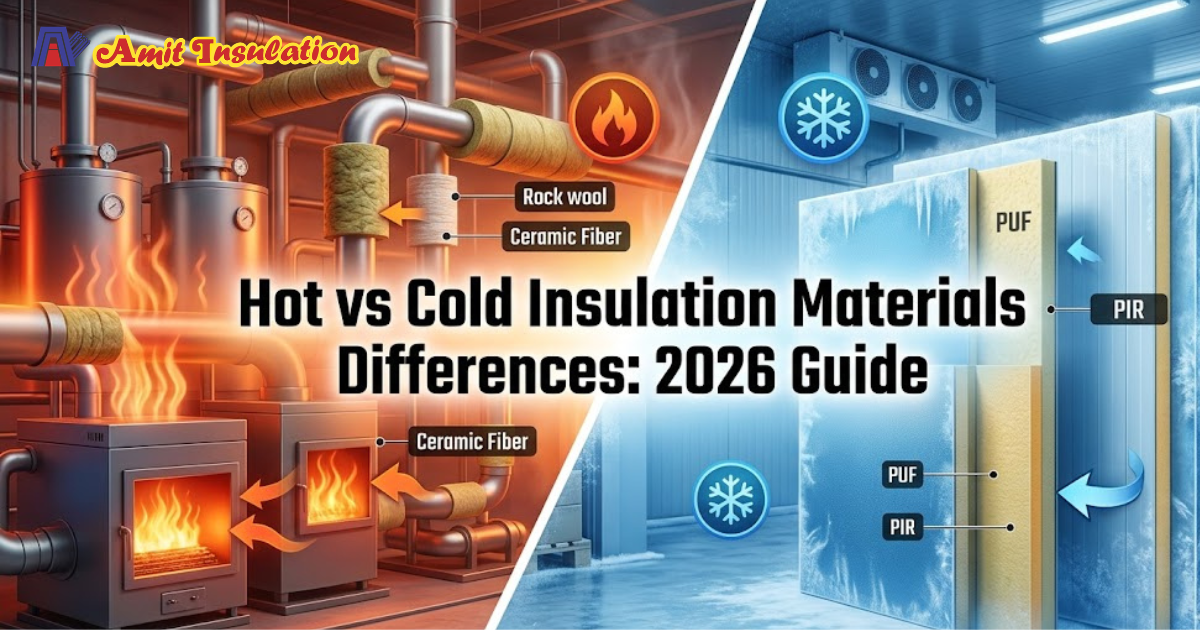
Hot and cold insulation materials are the backbone of thermal management in buildings, industrial plants, cold‑storage facilities, and district‑energy systems. In 2026, with tighter energy‑efficiency norms, stricter fire‑safety codes, and growing focus on sustainability, understanding the real differences between hot‑insulation and cold‑insulation materials is critical for engineers, contractors, and facility‑owners. This guide explains how these two categories work, compares their key properties, and helps you choose the right insulation for your project in 2026.
What Exactly are Hot vs Cold Insulation Systems?
Hot insulation is applied to surfaces that are hotter than their surroundings (e.g., steam pipes, boilers, hot‑water lines, furnace walls). Its primary job is to:
- Minimize heat loss to the environment.
- Maintain process or fluid temperature.
- Protect personnel and nearby components from high surface temperatures.
Cold insulation is used where the surface is colder than the ambient air (e.g., refrigerant lines, chilled‑water pipes, cold‑storage rooms, LNG tanks). Its main functions are:
- Preventing heat gain into the system.
- Controlling surface condensation.
- Minimizing corrosion under insulation (CUI) and energy waste.
Both systems aim to control heat flow—but the direction of that flow, the temperature range, and the moisture‑management requirements create fundamentally different design and material choices.
Core Differences in Purpose and Heat‑Flow Direction
| Aspect | Hot insulation systems | Cold insulation systems |
| Heat‑flow direction | Heat moves out of the pipe/equipment into the air. | Heat moves into the system from the air. |
| Primary design goal | Limit heat loss and protect from high temps. | Prevent heat gain and condensation. |
| Typical surface temp | Often 100 °C to 600+ °C (or even higher). | Often 0 °C to −150 °C (or lower for cryogenics). |
| Biggest risk | Personnel burns, overheating of surroundings, fire‑spread. | Condensation, icing, CUI, excessive compressor load. |
In cold systems, the outer surface of the insulation is warmer than the chilled core, so moisture‑laden ambient air can cool down on the jacket and form condensate. This is why cold insulation always demands a robust vapor‑control strategy, while hot systems generally do not.
Temperature Ranges and Material Selection
Insulation materials are chosen mainly by their maximum exposure temperature, thermal conductivity (λ‑value), and dimensional stability at service temperature.
Hot‑Insulation Materials (high‑temperature range)
Common hot‑insulation materials in 2026:
- Mineral wool / rockwool / slag wool:
- Usual range: up to around 700–1000 °C (depending on grade).
- Good fire‑resistance, sound absorption, and moderate cost.
- Often used on boilers, steam lines, and industrial equipment.
- Calcium silicate:
- Typical range: about 650–900 °C.
- Rigid boards/sections; good for pipes, vessels, and high‑temperature HVAC.
- Mechanically strong but heavier than some alternatives.
- Ceramic fiber (refractory fiber, alumino‑silicate):
- Can exceed 1200–1600 °C in 2026 furnace and kiln applications.
- Very lightweight, excellent thermal‑shock resistance.
- Often used in high‑temperature process equipment, petrochemical, and aerospace.
| Hot‑insulation material | Approx. max service temp (°C) | Typical 2026 uses |
| Mineral wool (rockwool) | 700–1000 | Boilers, steam lines, hot‑water pipes |
| Calcium silicate | 650–900 | Process piping, vessels, high‑temp HVAC |
| Ceramic fiber boards/blankets | 1200–1600 | Furnaces, kilns, reactors, exhaust systems |
These materials are usually rigid or semi‑rigid, and are designed to withstand long‑term heat without shrinking, cracking, or losing strength.
Cold‑Insulation Materials (low‑temperature range)
In cold applications, the priority flips: materials must:
- Handle condensation and water exposure.
- Resist thermal shrinkage at low temperatures.
- Maintain closed‑cell structure to limit moisture ingress.
Common cold‑insulation materials:
- Flexible elastomeric foam (rubber foam, EPDM‑based):
- Usual range: about −40 °C to +120 °C (short‑term peaks may be higher).
- Excellent vapor‑closure without a separate vapor barrier, low moisture absorption.
- Widely used on chilled‑water pipes, HVAC ductwork, and refrigeration lines.
- Polyurethane foam (PUR / PIR):
- Often −180 °C to about +120–150 °C, depending on formulation.
- Very low thermal conductivity (high R‑value per inch).
- Used in cold‑rooms, refrigerated trucks, industrial cold‑storage panels.
- Phenolic foam:
- Good performance at −180 °C to about +120 °C.
- Better fire‑safety than many PU foams; often used where fire‑rating is critical.
- Applied in some industrial and commercial cold‑rooms.
- Polyisocyanurate (PIR) panels (e.g., PUF panels):
- In India and many markets, PUF/PIR “sandwich” panels are the top choice for cold‑rooms and insulated cold‑chain facilities.
- Core is rigid foam between metal skins; low thermal conductivity and good structural strength.
| Cold‑insulation material | Approx. usable temp range (°C) | Key advantages in 2026 |
| Flexible elastomeric foam | −40 to ~120 | No separate vapor barrier, easy bending, low moisture uptake |
| Polyurethane / PIR foam | −180 to ~120–150 | Very low λ‑value, high R/per inch, good for cold‑rooms |
| Phenolic foam | −180 to ~120 | Better fire reaction, often used in higher‑risk facilities |
| PUF/PIR panels (metal‑faced) | −40 to +120 | Combines structure + insulation, fast erection, high energy‑savings |
Cold‑insulation systems are often more flexible, closed‑cell, and vapor‑tight by design, while hot systems are typically rigid, open‑structure, and breathable to allow moisture to escape.
Moisture, Condensation, and Vapor‑Barrier Needs
This is the biggest practical difference between Hot vs Cold Insulation Materials in 2026.
Hot insulation: usually no vapor barrier needed
- On hot surfaces, the pipe/equipment is warmer than the air, so moisture in the insulation tends to evaporate outward.
- Mineral wool and calcium silicate can tolerate some moisture, provided it can dry.
- A separate vapor barrier is rarely specified for hot‑insulation (unless the pipe runs through a very cold zone or underground).
Cold insulation: vapor barrier is mandatory
For cold systems, the insulation jacket is often colder than the dew point of ambient air, so:
- Water vapor condenses on the outer surface of the insulation or on the metal.
- If moisture penetrates the insulation, it:
- Increases thermal conductivity (wet insulation is 2–5× worse than dry).
- Promotes corrosion under insulation (CUI), which can lead to leaks and failures.
That is why 2026 cold‑insulation standards emphasize:
- Closed‑cell materials (e.g., elastomeric foam, PUF, PIR, phenolic).
- Continuous vapor barriers or self‑sealing jackets.
- Sealed joints, factory‑made fittings, and adhesive tapes to maintain continuity.
In practice, many modern cold‑insulation products (especially flexible elastomeric foam for HVAC) are sold as vapor‑tight systems that eliminate the need for a separate aluminum‑foil‑or‑plastic vapor barrier. This simplifies installation and reduces the risk of detail‑level mistakes.
Mechanical Design, Installation, and Service life
The way hot and cold insulation are installed and maintained also differs significantly.
Hot Insulation: Robust, Rigid, and Mechanical‑Stress‑Resistant
- Hot‑insulation applications (boilers, steam lines, reactors) are often high‑vibration, high‑pressure, and subject to thermal cycling.
- Materials like calcium silicate and mineral‑wool sections are chosen for their compressive strength and ability to withstand mechanical abuse.
- Metal cladding or bands are used to hold sections in place and protect against impact.
Key points:
- Joints are less critical for moisture ingress (because the system “breathes” outward).
- Maintenance focuses on physical damage, erosion, and fire‑safety compliance, not vapor barriers.
Cold Insulation: Flexibility, Sealing, and CUI Control
Cold‑insulation systems must:
- Accommodate differential movement (e.g., chilled‑water pipes that expand/contract).
- Seal tightly at every joint, bend, and fitting to preserve vapor‑tightness.
Typical installation practices:
- Factory‑made bends and fittings for flexible foam (elastomeric) to reduce field cutting.
- Adhesive‑coated backs or double‑sided tapes to ensure continuous bond.
- Weather‑resistant outer jackets (PVC, aluminum, or coated steel) to protect against UV, rain, and physical damage.
Failure to seal properly leads to:
- Localized condensation, wet insulation, and higher energy use.
- Hidden corrosion under insulation, which can only be detected during costly overhauls.
Thermal performance and R‑value trends (2026)
Modern insulation products are increasingly compared by R‑value per inch and long‑term thermal resistance (LTTR), especially in cold‑chain and building‑envelope applications.
Typical R‑values and Thermal Conductivity
Below is an approximate comparison of common insulation types relevant to both hot and cold systems. Values are rounded for simplicity and may vary by brand and thickness.
| Insulation type | Typical thermal conductivity (λ, W/m·K) | Approx. R‑value per inch (RSI per mm) |
| Mineral wool (rockwool) | 0.032–0.040 | R‑3.1 to R‑3.8 (0.048–0.058) |
| Calcium silicate | 0.050–0.060 (slightly higher than mineral wool) | R‑2.5 to R‑3.0 (0.038–0.046) |
| Flexible elastomeric foam | 0.034–0.040 | R‑3.0 to R‑3.8 (0.046–0.058) |
| Polyurethane foam (PUR) | 0.018–0.025 | R‑6.0 to R‑7.0 (0.087–0.101) |
| Polyisocyanurate (PIR / PUF core) | 0.020–0.025 | R‑5.5 to R‑7.0 (0.080–0.101) |
| Phenolic foam | 0.020–0.025 | R‑5.5 to R‑7.0 (0.080–0.101) |
In 2026, high‑performance foams (PUR/PIR/phenolic) dominate where space is limited and energy efficiency is critical (e.g., cold‑rooms, cold‑storage, refrigerated transport, and building envelopes).
However, cost, fire‑performance, and service‑temperature limits still keep mineral wool and calcium silicate in strong demand for industrial hot‑insulation.
Fire‑Safety and Sustainability (2026 focus)
Regulations and market expectations in 2026 push insulation toward:
- Better fire‑reaction ratings (limited surface spread of flame, low smoke).
- Reduced overall carbon footprint during manufacture and life‑cycle.
- Safer handling and end‑of‑life recyclability where possible.
Hot Insulation and Fire Resistance
- Mineral wool and ceramic fiber are inherently non‑combustible and receive top fire‑safety classifications (e.g., Euroclass A1, ASTM E136 non‑combustible).
- They are widely specified in industrial plants, power‑stations, and high‑risk facilities.
- Calcium silicate is also non‑combustible and often used as a fire‑barrier or cladding layer in composite systems.
Cold Insulation and Evolving Standards
- Foams (PUR/PIR, phenolic) have historically raised fire‑safety concerns, so suppliers now offer:
- Fire‑retardant grades (e.g., PUF panels with flame‑retardant cores).
- Improved fire‑test ratings (e.g., Euroclass B‑s1,d0, UL‑tested wall‑panel assemblies).
- Some manufacturers now publish environmental product declarations (EPDs) and global‑warming‑potential (GWP) data for their insulation products, helping projects meet green‑building and ESG targets.
For you as a content manager or project specifier, this means:
- Always check fire‑classification data and local code requirements.
- For cold‑rooms, data centers, and logistics hubs, PUF/PIR panels with good fire‑ratings are often the best balance of performance and cost in 2026.
Application Examples: where Hot and Cold Insulation Differ
To make this concrete, here are typical 2026 use‑cases:
Hot‑Insulation Applications
- Power plants & boilers: Mineral wool or calcium silicate on steam lines, economizers, and boiler casings.
- Oil & gas process piping: High‑temperature mineral wool or ceramic fiber on process lines operating above 400 °C.
- Industrial HVAC: High‑temp blankets or sections on hot‑air ducts and exhaust systems.
In these environments, the main design questions are:
- What is the maximum temperature?
- How strong must the insulation be against vibration and impact?
- What are the fire‑safety and personnel‑protection requirements?
Cold‑Insulation Applications
- HVAC chilled‑water pipes: Flexible elastomeric foam with self‑sealing jackets; often used in commercial buildings and hospitals.
- Cold‑storage warehouses & food plants: PUF/PIR panels for walls and roofs, plus closed‑cell foam on refrigerant lines.
- Cryogenic and LNG systems: Specialized phenolic or PUR‑based foams designed for −180 °C and below.
For these, the key questions are:
- What is the lowest operating temperature?
- How critical is energy efficiency (i.e., compressor load and electricity bills)?
- How strict is the vapor‑tightness and CUI‑mitigation requirement?
Cost, ROI, and When to Choose What
Both hot and cold insulation must justify their cost through energy savings, maintenance reduction, and safety improvement.
Short‑term cost vs long‑term savings
| Factor | Hot insulation materials | Cold insulation materials |
| Typical first‑cost (material) | Moderate (mineral wool, calcium silicate) to high (ceramic fiber). | Low–moderate (elastomeric foam) to high (high‑performance PUF/PIR panels). |
| Main savings driver | Reduced heat loss, lower fuel/steam consumption, lower ambient temps. | Lower compressor load, reduced refrigeration energy, fewer condensation‑related repairs. |
| Typical payback period | Often 1–3 years in industrial settings. | Often 1–5 years, depending on usage and climate. |
Conclusion
Choosing between hot and cold insulation materials is not simply a matter of picking the cheapest or most available product — it is a critical engineering and business decision that directly affects energy costs, safety, equipment life, and regulatory compliance. Hot insulation systems, built around materials like mineral wool, calcium silicate, and ceramic fiber, are designed to contain heat, withstand extreme temperatures, and resist fire. Cold insulation systems, powered by elastomeric foam, PUF, PIR, and phenolic foam, are engineered to block heat gain, seal out moisture, and prevent the costly damage caused by condensation and corrosion under
Amit Insulation. In 2026, both categories are evolving rapidly — with tighter fire-safety standards, growing sustainability expectations, and smarter installation systems pushing the industry forward. Whether you are insulating a steam line in a power plant, a chilled-water pipe in a hospital, or a cold-storage warehouse in a food processing facility.