In industrial operations across India, understanding the best conductor of heat is crucial for optimizing energy efficiency and preventing heat loss. Whether designing pipelines, reactors, or HVAC systems, knowing top thermal conductors helps engineers select effective insulation strategies. Amit Insulation, based in Vadodara, India, specializes in high-performance solutions for such challenges.
The best conductor of heat directly impacts material choices in manufacturing, power plants, and refineries. Metals like silver dominate due to free electrons, while non-metals like diamond shine in specialized uses. This guide breaks down rankings, applications, and trends for 2026. Facility owners and contractors gain actionable insights to cut costs and boost performance.
What is Thermal Conductivity?
Thermal conductivity measures a material’s ability to transfer heat. It quantifies heat flow through a unit thickness under a temperature gradient, expressed in W/(m·K). High values indicate the best conductor of heat, essential for heat exchangers or cookware.
In solids, free electrons in metals drive conduction, making them superior. Insulators like foam trap heat effectively. Engineers use this property to balance heat transfer and retention. For industrial setups, low-conductivity materials prevent energy waste. Understanding it ensures safer, efficient systems. Real-world tests rank materials precisely for reliability.
Key Types of Heat Conductors
Heat conductors split into metals and non-metals, each with unique traits.
Metals (Best Conductor of Heat Metal):
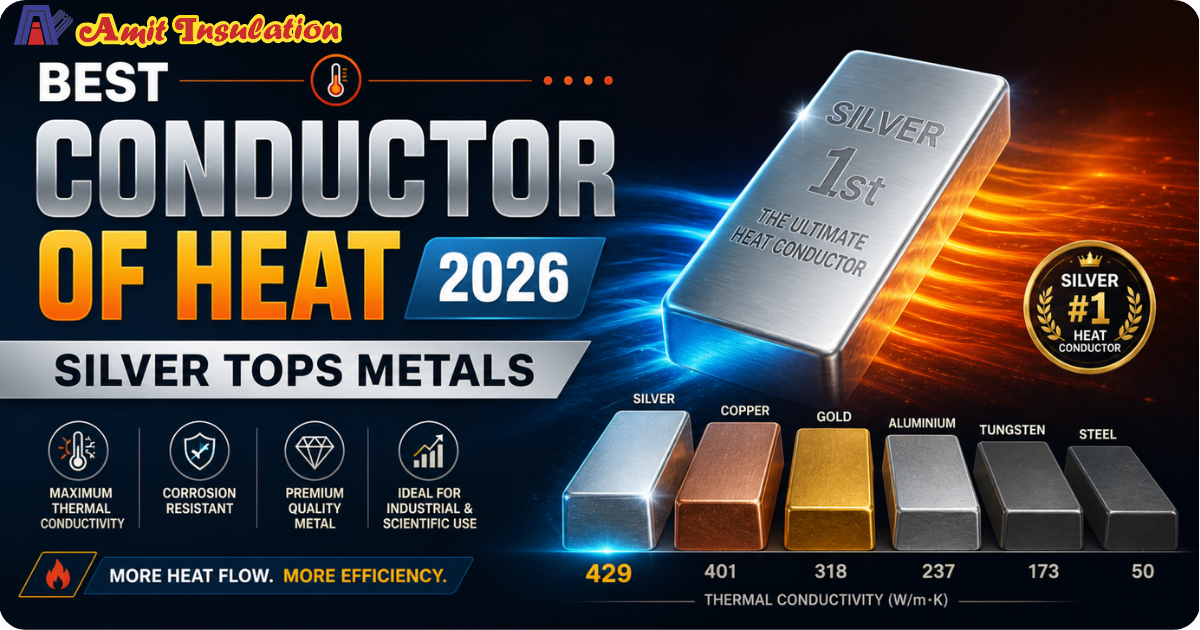
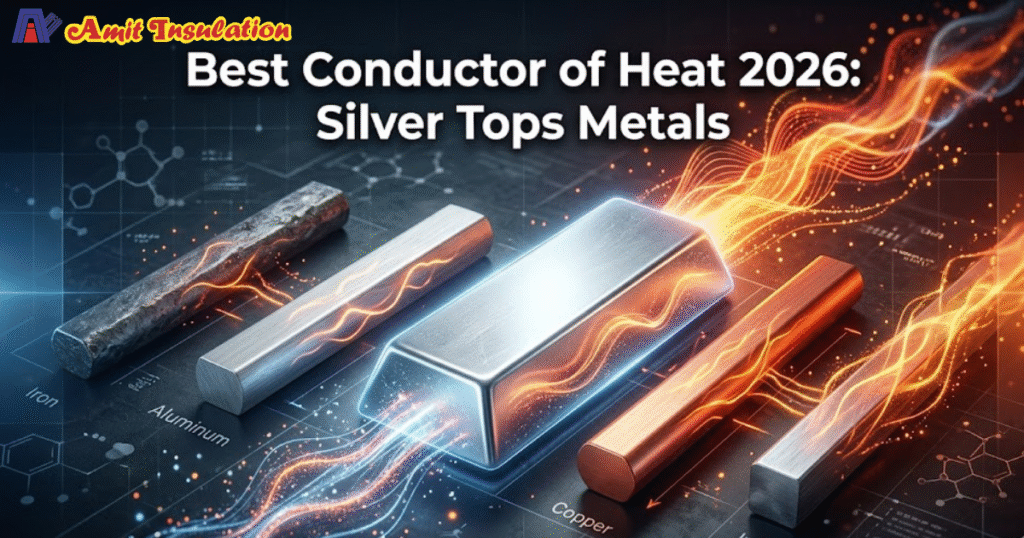
Silver tops at 429 W/(m·K), followed by copper (401) and gold (317). These excel in electrical wiring and heat sinks due to electron mobility.
Non-Metals (Best Conductor of Heat Non Metal):
Diamond leads at 2000-2500 W/(m·K) from phonon vibrations. Graphite (150-2000) varies by structure; boron nitride hits 300+.
Pure metals outperform alloys, but cost limits use. Non-metals suit extreme environments like aerospace.
| Category | Top Material | Conductivity (W/m·K) | Common Use |
| Metal | Silver | 429 | Electronics |
| Metal | Copper | 401 | Pipes |
| Non-Metal | Diamond | 2000+ | Cutting tools |
| Non-Metal | Graphite | 150-2000 | Batteries |
Benefits and Applications
High-conductivity materials speed heat transfer, cutting processing time in refineries by 20-30%. Silver’s efficiency suits precision tools; copper powers India’s growing EV sector.
Applications include:
- Heat exchangers in petrochemical plants.
- Cookware and radiators for uniform heating.
- Electronics cooling to prevent overheating.
For insulation pros, knowing the best conductor of heat metal like copper helps spec barriers that block 95% heat flow. Non-metals like diamond enable compact designs in high-heat zones. Benefits: lower energy bills, extended equipment life, compliance with Indian standards like IS 17884.
Comparison Table
Compare top conductors for industrial selection.
| Material | Type | Conductivity (W/m·K) | Cost (₹/kg) | Density (g/cm³) | Melting Point (°C) | Best Use Case |
| Silver | Metal | 429 | 80,000 | 10.5 | 962 | High-end heat sinks |
| Copper | Metal | 401 | 900 | 8.96 | 1085 | Pipes, exchangers |
| Gold | Metal | 317 | 6,00,000 | 19.3 | 1064 | Aerospace |
| Aluminum | Metal | 237 | 250 | 2.7 | 660 | Lightweight structures |
| Diamond | Non-Metal | 2000+ | 5,00,000+ | 3.5 | 3550 | Cutting/electronics |
| Graphite | Non-Metal | 150-2000 | 100 | 2.2 | 3650 | High-temp furnaces |
| Silicon Carbide | Non-Metal | 120-270 | 500 | 3.2 | 2700 | Power electronics |
Data from standard thermal tables; costs approx. India market 2026.
Cost, ROI, and Factors to Consider
Silver costs ₹80,000/kg, yielding ROI in niche apps via 40% faster cooling. Copper at ₹900/kg offers 2-3 year payback in pipes, saving 15% energy.
Factors:
- Budget: Aluminum (₹250/kg) balances cost-conductivity.
- Environment: Corrosion resistance for humid Gujarat plants.
- Thickness: Thinner high-conductors reduce material use.
ROI calc: A copper exchanger saves ₹5 lakh/year in a mid-size plant. Maintenance adds 10% yearly cost. Prioritize conductivity-to-price ratio for 25% efficiency gains.
You May Also Read – Which Statement Best Defines Specific Heat? 2026 Guide
| Factor | High Impact | Low Impact | Example Savings |
| Conductivity | Silver | Aluminum | 30% energy |
| Cost | Gold | Copper | ₹10L over 5 yrs |
| Durability | Diamond | Graphite | 50% less replacement |
How to Choose the Right Conductor
Assess needs first: heat load, space, budget. Test conductivity via ASTM E1225 standards.
Steps:
- Define application (e.g., high-heat furnace?).
- Rank by W/m·K vs. cost.
- Check compatibility with insulation like rockwool.
- Prototype for real conditions.
For best conductor of heat non metal, pick diamond for vacuums. Metals suit wet areas. Consult thermal sim software for 98% accuracy.
You may also read: [Rockwool Insulation for Industrial Pipes]
Future Trends (2026 Focus)
By 2026, nanomaterials boost conductivity 50%. Graphene hybrids hit 5000 W/m·K, per IIT research. India’s market grows 12% YoY to ₹5000 Cr, driven by green manufacturing.
Trends:
- Nanocomposites: Silver-graphene for EVs.
- Sustainable options: Recycled copper rises 20%.
- AI optimization: Predicts best conductor of heat metal for custom alloys.
Expect 3D-printed conductors in refineries, cutting waste 25%. Non-metals like boron arsenide challenge diamond.
| Trend | Impact 2026 | Growth Rate |
| Nanomaterials | +50% conductivity | 15% market |
| Green Metals | Cost -10% | 20% adoption |
| AI Design | Efficiency +30% | Emerging |
Conclusion
Mastering the best conductor of heat empowers industrial pros to design superior systems. Silver rules metals, diamond non-metals, with applications spanning Gujarat factories to pan-India plants. Balance conductivity, cost, and durability for peak performance. Future innovations promise even better efficiency.
Looking for heat conductor insulation solutions in India? Amit Insulation offers customized thermal barriers for industrial and commercial needs across Gujarat and India.
FAQ
What is the best conductor of heat?
Silver, at 429 W/m·K, is the best overall due to superior electron transfer.
Which is the best conductor of heat metal?
Silver leads metals, followed by copper (401 W/m·K). Ideal for industrial heat transfer.
What is the best conductor of heat non metal?
Diamond, with 2000+ W/m·K, excels among non-metals thanks to strong atomic bonds.
Why is silver the best conductor of heat?
Its free electrons move heat efficiently, unmatched by other materials.
How does copper compare to silver as a heat conductor?
Copper (401 W/m·K) is nearly as good but far cheaper, making it practical.
Is diamond really better than metals for heat conduction?
Yes, at 2000+ W/m·K, but cost limits it to specialized uses.
What affects thermal conductivity in materials?
Structure, purity, temperature, and impurities; metals rely on electrons, non-metals on phonons.
Can insulators become heat conductors?
No, but advanced composites mimic conductors in hybrids.