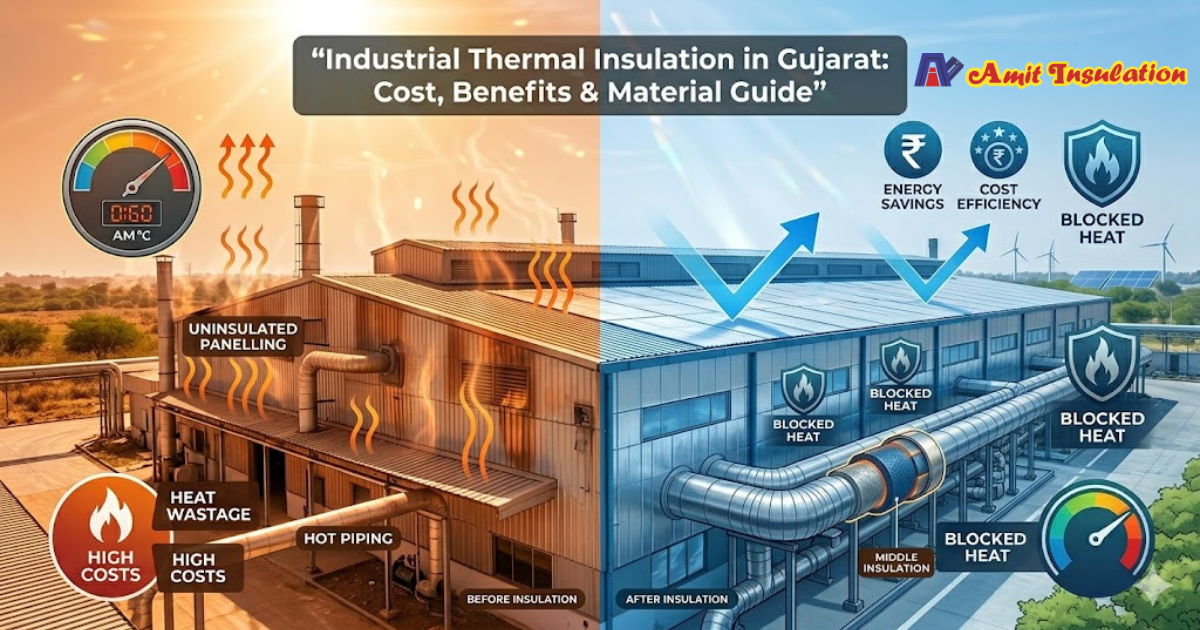
Industrial thermal insulation plays a crucial role in Gujarat’s booming industrial sector, helping factories, refineries, and pharma plants cut energy costs amid rising temperatures and regulations. This guide breaks down costs, benefits, materials, and more for informed decision-making.
Industrial Thermal Insulation in Gujarat’s Industrial Boom
Gujarat leads India’s manufacturing with over 5 million MSMEs and giants like Reliance & Amit Insulation in Jamnagar, contributing 18% to national industrial output. The state’s hot climate, averaging 40°C summers, drives up energy use for cooling and heating in sectors like chemicals, textiles, and petrochemicals. Thermal insulation in Gujarat addresses this by minimizing heat gain or loss, aligning with national goals to cut industrial energy intensity by 2.5-3.5%.
India’s thermal insulation market grows at 8.4% CAGR through 2032, fueled by energy efficiency mandates and Gujarat’s policy incentives. Local demand surges in Ahmedabad, Vadodara, and Surat hubs, where industries face ₹70-300 per sq ft insulation costs.
Key Benefits
Proper insulation slashes operational expenses by up to 40% through reduced heat loss in high-temperature processes. It boosts safety by keeping pipe surfaces below burn thresholds and complies with Bureau of Indian Standards (BIS) for fire resistance.
Energy savings extend equipment life, lowering maintenance by 20-30%, while subsidies under Gujarat Industrial Policy 2020 offer up to 50% aid for energy-efficient upgrades. Environmentally, it cuts CO2 emissions, supporting India’s net-zero push.
| Benefit | Impact | Gujarat Example |
| Energy Savings | 30-40% fuel reduction | Refineries save millions annually |
| Cost Reduction | ROI in 1-2 years | ₹2-5 crore yearly for large plants |
| Safety | Surface temps <60°C | Prevents burns in pharma units |
| Compliance | Meets IS 818-2005 standards | Qualifies for green incentives |
Common Materials
Polyurethane Foam (PUF) panels top choices for their R-value up to 1.7 for 50mm thickness, ideal for cold storage in food processing. Rockwool and glasswool offer fire resistance up to 1000°C, suiting petrochemical pipes.
Reflective foils like aluminum-laminated bubbles block 97% radiant heat, perfect for Gujarat roofs at ₹30-50/sq m. Emerging options include PIR panels for higher stability and natural fibers growing at 7.3% CAGR.
| Material | Thermal Conductivity (W/m·K) | R-Value per inch | Price (₹/sq m, Gujarat) | Best For |
| PUF Panels | 0.022-0.028 | 3.6-4.2 | 200-400 | Cold storage, sheds |
| Rockwool | 0.035-0.045 | 3.3-4.2 | 150-300 | High-temp pipes |
| Glasswool | 0.029-0.035 | 2.9-3.8 | 100-250 | HVAC, boilers |
| Air Bubble Foil | 0.028-0.035 | 1.4-1.7 (50mm) | 30-50 | Roofs, walls |
| EPS/XPS | 0.030-0.038 | 3.6-4.2 | 80-200 | Warehouses |
Market Overview
Gujarat hosts suppliers like Neo Thermal in Ahmedabad and Aerolam, serving PEBs and power plants. National market hits USD 7.73B in 2025, with mineral wool at USD 1.07B. Local prices range ₹7-9/sq ft for basics, up to ₹178 for laminated rolls.
Trends favor lightweight composites and fire-resistant foams amid 9.14% global industrial growth. Subsidies cap interest at 9% for solar-integrated insulation.
| Top Suppliers in Gujarat | Location | Specialties | Contact Info |
| Neo Thermal Insulation | Ahmedabad | Bubble sheets, foils | info@neothermalinsulation.com |
| Aerolam Insulations | Ahmedabad | PUF, reflective | aerolam.com |
| Dharti Engineering | Ahmedabad | High-temp mats | dhartiengpro.com |
| Thermal Insulation Industries | Vadodara | Mineral wool, FRP | indiamart profile |
| SMVK Engineering | Gujarat-wide | Glass/rock wool | Local fabricators |
Cost Breakdown
Installation averages ₹250/sq m for industrial pipes, including labor and cladding. Material costs dominate: PUF at ₹200-400/sq m, plus 20-30% for accessories like mesh. Total project ROI hits in 18 months via 35% energy cuts.
Factors like thickness (50-100mm standard) and location hike prices 10-15% in remote areas. Government aid covers 25-50% for MSMEs.
| Cost Component | Range (₹/sq m) | Notes |
| Materials (PUF) | 200-400 | Varies by density |
| Labor/Installation | 50-100 | Pipes higher |
| Cladding/Alu Sheet | 50-100 | Chicken mesh included |
| Total per sq m | 300-600 | Excludes subsidies |
| Annual Savings | 100-200 | 30% energy cut |
Installation Guide
Prep surfaces by cleaning and applying primer for adhesion. Cut mats to fit pipes or walls, secure with wire mesh, then clad with aluminum sheets. For roofs, lay bubble foils underdeck, sealing joints with foil tape.
Hire certified contractors; audits like Jamnagar refinery thermography ensure 20% efficiency gains. Follow IS standards for longevity up to 20 years.
Case Studies
Jamnagar Refinery’s thermography post-insulation fixed hotspots, saving on repairs and boosting uptime. Ahmedabad pharma plants using PUF panels report 25% cooling savings. Bhuj housing pilots showed thermal mass walls cut indoor temps effectively.
A Vadodara chemical firm insulated boilers with rockwool, achieving 35% fuel reduction.
Regulations and Incentives
BIS IS 818 governs hot insulation; Gujarat mandates efficiency audits for large units. Policy 2020 offers 35% capital subsidy for common boilers, up to ₹50 crore. MSMEs get 25% term loan aid, plus 1% extra for women/SC/ST owners.
Future Trends
By 2034, market doubles to USD 16.99B with smart sensors and bio-based foams. Gujarat pushes green hydrogen plants needing advanced insulation. Aerogels and VIPs (R-30/inch) emerge for ultra-efficiency.
Selecting Right Insulation
Match R-value to needs: high for extremes (PUF), fire-rated for hazards (rockwool). Consult locals like Neo Thermal for Gujarat climate tweaks. Budget for audits to verify savings.
Conclusion
Industrial thermal insulation has become an essential investment for industries across the state of Gujarat. With extreme summer temperatures, rising energy costs, and stricter efficiency regulations, proper Amit Insulation helps factories significantly reduce heat loss, control operational expenses, and maintain safer working environments.
From materials like PUF panels and rockwool to reflective foil insulation, industries can choose solutions based on their temperature requirements, safety standards, and budget. In major industrial hubs such as Ahmedabad, Vadodara, and Surat, companies are increasingly adopting modern insulation technologies to improve energy efficiency and meet sustainability goals.
Beyond energy savings of up to 40%, insulation also extends equipment lifespan, improves workplace safety, and helps businesses comply with industrial standards. With government incentives and growing awareness of sustainable manufacturing, industrial thermal insulation will continue to play a major role in improving productivity and reducing environmental impact in Gujarat’s expanding industrial ecosystem.
Frequently Asked Questions (FAQs)
1. What is industrial thermal insulation?
Industrial thermal insulation is a protective layer applied to equipment, pipes, tanks, or buildings to reduce heat transfer. It helps maintain process temperatures, improves energy efficiency, and protects workers from high surface temperatures.
2. Why is thermal insulation important for industries in Gujarat?
Industries in Gujarat operate in high-temperature environments where heat loss or gain can increase energy consumption. Thermal insulation helps reduce fuel usage, improve process efficiency, and lower operational costs.
3. Which materials are commonly used for thermal insulation in Gujarat?
Some widely used insulation materials include:
- Polyurethane Foam (PUF) Panels
- Rockwool Insulation
- Glasswool Insulation
- Aluminum Foil Bubble Insulation
- EPS and XPS Boards
Each material is selected based on temperature range, fire resistance, and application area.
4. What is the average cost of industrial thermal insulation in Gujarat?
Industrial insulation costs in Gujarat generally range between ₹300 to ₹600 per square meter, depending on the material, thickness, and installation requirements.
5. How much energy can thermal insulation save?
Properly installed thermal insulation can reduce energy consumption by 30–40%, helping industries lower fuel costs and improve overall operational efficiency.
6. How long does industrial insulation last?
High-quality insulation systems can last 15–20 years with proper installation and regular maintenance.
7. Are there government incentives for thermal insulation projects?
Yes, under the Gujarat Industrial Policy, eligible industries can receive 25–50% subsidies for energy-efficient upgrades, including insulation projects.